
Israel's Political 'Armageddon': Netanyahu Regime Could Fall Next Month
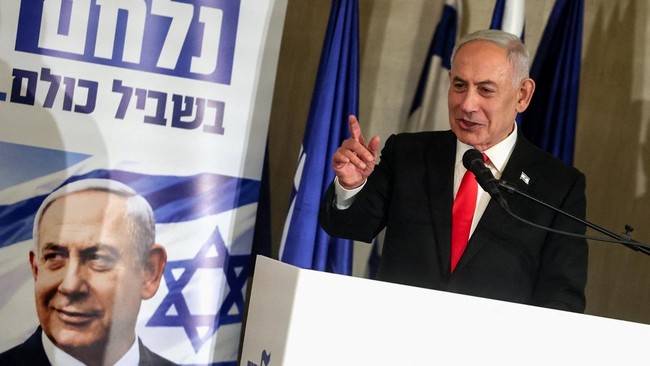
Extreme uncertainty is currently shrouding the streets of Jerusalem ahead of the general election to be held in less than a month. This contest is believed to be a crucial turning point for Israel, which has changed drastically following the 7 October 2023 attacks and the bloody battles lasting nearly three years in Gaza, Lebanon, and Iran.
Quoting The Guardian on Thursday (1/10/2026), the country’s political struggle remains on the brink. For over two years, most polls have consistently predicted that the party coalition led by Prime Minister Benjamin Netanyahu will drop below the 61-seat Knesset threshold required to form a new government.
However, there is no smooth path to power for his main opponent, former IDF Chief of Staff Gadi Eisenkot. A recent Channel 13 poll last week recorded an extreme deadlock: anti-Netanyahu parties are projected to win 52 seats, against 51 seats for the Prime Minister’s bloc, with both failing to reach the 61-seat majority.
Eisenkot’s Yashar party leads the polls with 22 seats, while Netanyahu’s Likud party is projected to garner only 18 seats. Eisenkot’s progress is hindered because he firmly refuses to form a coalition with parties representing Palestinian citizens in Israel, which are projected to secure 12 crucial seats. As a result, a highly fragmented parliament appears likely to recur.
Public Anger & Economic Storm
A sense of pessimism and doubt is now palpable among the public. Public trust in state institutions has plummeted to 34% in 2025, compared to 61% in 2012. The 7 October tragedy is believed to be the heaviest burden for the incumbent, with 68% of Jewish respondents citing it as the deciding factor for their vote.
Ilda, a shop owner on Jaffa Road, demands full accountability from the government, especially following a Haaretz investigation claiming Netanyahu was warned about the potential Hamas attack.
“After 7 October, everyone in this government must be held responsible,” she asserted. “After journalists revealed what happened, look at what they did: they attacked the journalists instead of taking responsibility.”
This dissatisfaction has also extended to basic necessities. Amidst regional conflict and disrupted supply chains, fresh food prices in Israel have surged by 9.5% over the last two years. Turgeman, a resident relaxing in Jaffa, admitted to being fed up with the current regime’s pro-war policies that ignore the economic crisis.
“I will vote for anyone except the Prime Minister of 7 October,” said Turgeman. “We need a normal Prime Minister, someone who also cares about the economy and the prices that are skyrocketing due to the war.”
Conscription Calamity & The Blocking of Arab Parties
Netanyahu’s position is further squeezed after the Supreme Court decided in 2024 to abolish the military service exemption for ultra-Orthodox (Haredi) men. This ruling sparked anti-conscription protests, road closures, and clashes with police. Young Haredim are now expressing their anger towards Netanyahu for failing to pass legislation protecting their exemption rights.
Pinchas, an ultra-Orthodox student, believes this dynamic will encourage his generation to defy the instructions of rabbis when voting.
“All the choices in this election are rubbish, but I think I will vote for Eisenkot,” he said.
On the other hand, Eisenkot’s path to ousting Netanyahu is threatened after the Central Elections Committee voted last week to ban Ra’am and the Joint List, two major Palestinian parties in the country, from participating in the election.
This controversial ban was triggered by a petition from the extreme right-wing party Otzma Yehudit, led by Itamar Ben-Gvir, which accuses the Arab parties of supporting terrorism. A counter-petition from the Democratic party to ban Otzma Yehudit for inciting racism was flatly rejected.
The fate of this ban now rests with the Supreme Court. If the Arab parties are permitted to run, they will become the key deciders for Eisenkot’s prospects of forming a government. For Amir, an Arab-Israeli from Mashhad, this political participation is the only instrument to combat systemic racism following 7 October.
“This election is about our strength as an Arab community and our ability to have an influential political voice,” he said. “We need strong and united Arab representation on issues of equality, discrimination, and the Palestinian struggle, while cooperating when it benefits our community.”