
Israel’s Most Consequential Election: The Country’s Future and Netanyahu’s Rule at Stake
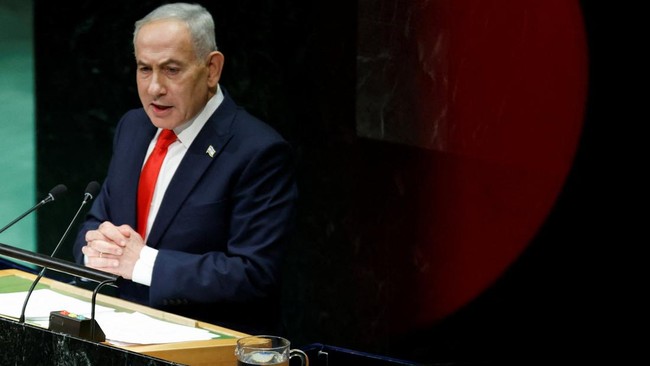
Jakarta, CNBC Indonesia — Israel is holding its first general election today since the Hamas attacks of 7 October 2023, described as the deadliest day in the country’s history, with around 1,200 people killed.
The Guardian reported on Tuesday (27 October 2026) that since the attacks, Israel has launched a war of annihilation in Gaza, fought two inconclusive wars with Iran and intensified a state-backed campaign of ethnic cleansing in the West Bank.
Domestically, the coalition led by Benjamin Netanyahu has continued to target democratic institutions, including the Supreme Court. Many Israelis have therefore described this election as the most consequential in their history.
Who are the main contenders?
Prime Minister Benjamin Netanyahu has led Israel for 19 of the past 30 years. He is now seeking a fresh mandate with the support of US President Donald Trump. The political contest is highly personal for Netanyahu: he is standing trial on corruption charges, and losing power could increase his risk of imprisonment.
His main rival is Gadi Eisenkot, a former head of the Israeli military and a newcomer to politics. Eisenkot’s son and two nephews were killed fighting in Gaza in 2024.
Eisenkot presents himself as the complete opposite of Netanyahu, a contrast reflected in the name of his new party, Yashar, meaning “honesty”.
What are the key issues for voters?
Security is at the heart of the election, overshadowing even the rising cost of living. The current government’s opponents have focused on the 7 October disaster, the erosion of democratic institutions, the rise of religious extremism and the enormous cost of waging war on multiple fronts.
They have pledged to establish a state commission of inquiry into 7 October and end the exemption from military service for ultra-Orthodox men.
Netanyahu, by contrast, has sought to shift responsibility for 7 October to Israel’s security agencies. He argues that he is the only leader with the experience and international contacts needed to protect the country. He recently posted an AI-generated image of a nuclear bomb striking Tel Aviv on social media.
“Anyone who cares about their physical survival should pause before voting for the opposition,” he said.
Meanwhile, Netanyahu’s right-wing allies have called for the radical removal of Palestinians from Gaza and the West Bank, as well as the expansion of settlements. His ultra-Orthodox partners insist on preserving military-service exemptions and subsidies for religious study.
What do the polls say?
Most polls indicate that Netanyahu’s Likud party and its current coalition partners are on course to lose their majority. The decline in support has been remarkably consistent for more than two years, pointing to a clear anti-Netanyahu majority.
However, opposition seats are split between a bloc of Israeli Jewish parties led by Yashar and parties representing Palestinians in Israel. The Jewish parties are considered unlikely to win a majority on their own, but have rejected forming a coalition with Palestinian parties.
Palestinian politicians, meanwhile, have indicated they may be willing to support a minority government led by Israeli Jewish parties solely to bring down Netanyahu’s right-wing coalition.
How does the system work?
The Knesset has 120 seats, elected through proportional representation. No single party has ever won an outright majority of 61 seats, so Israel has always been governed by coalitions.
The result is expected to depend heavily on the fate of two small parties, each of which must win 3.25% of the vote to enter the Knesset. If they clear the threshold, each would secure four decisive seats. The right-wing Amcha Yisrael party has pledged to support Netanyahu if it enters the Knesset, while the right-wing Zionist party The Reservists has firmly ruled out joining a government backed by either the ultra-Orthodox or Palestinian parties.
How democratic is the vote?
Around 15 million people currently live in territory under Israeli control. However, only about seven million Israeli Jews and 1.7 million Palestinians in Israel, living within the pre-1967 borders, have full voting rights.
In the West Bank, more than 500,000 Israeli settlers can vote freely, while 3.1 million Palestinians subject to military rule have no voting rights. In East Jerusalem, more than 230,000 Israelis can vote, while 350,000 Palestinians cannot.
More starkly, two million Palestinians in Gaza, currently living under Israeli military occupation, have no vote at all.
Source: jawawa.id (https://jawawa.id/newsitem/israels-most-consequential-election-the-countrys-future-and-netanyahus-rule-at-stake-1793073034)
Originally published by CNBC Indonesia (https://www.cnbcindonesia.com/news/20261027073644-4-779687/pemilu-paling-menentukan-nasib-israel-rezim-netanyahu-dipertaruhkan), translated from Indonesian