
Israel’s Election to Determine Netanyahu’s Political Future
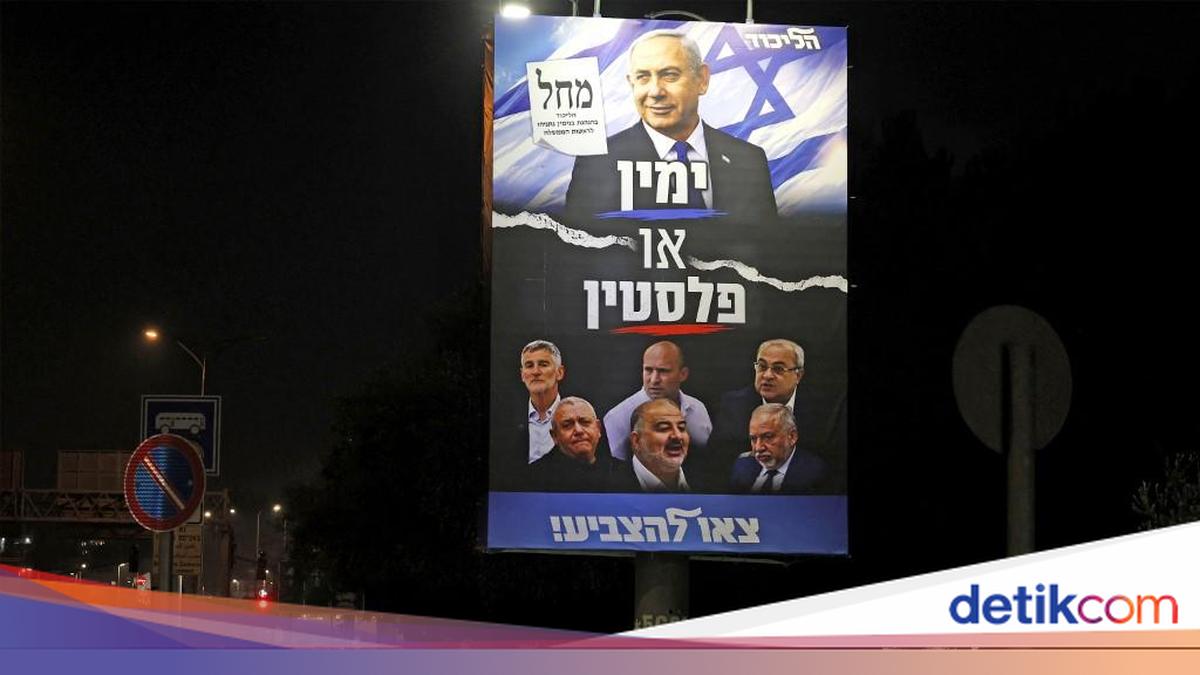
Israel’s general election will determine the fate of Prime Minister Benjamin Netanyahu. His political career will be decided by the vote.
Millions of Israelis are expected to cast their ballots in a fiercely contested legislative election on Tuesday (27 October), local time. The election could end Netanyahu’s lengthy period in power or leave the Jewish state once again facing political deadlock.
There are predictions that neither of the main political blocs will be able to win a parliamentary majority and form a new government.
This is Israel’s first election since Hamas’s deadly attack on 7 October 2023, which was followed by an unrelenting series of Israeli military strikes on the Gaza Strip, as well as military confrontations with Hezbollah in Lebanon and with Iran.
It is also the first Israeli election to be held on schedule since 1988. For decades, successive governments have collapsed before completing their four-year terms.
Voting, according to Anadolu Agency and AFP on Tuesday (27 October 2026), will run from 7am to 10pm local time. Election day has been declared a public holiday in Israel.
Polling stations prepared
A total of 12,018 polling stations have been set up across the country, with around 18,000 ballot boxes prepared.
About 7.3 million eligible voters, including approximately 1.2 million Palestinian-descended Israeli citizens, are expected to vote in the legislative election. More than half a million are young voters casting a ballot for the first time.
Tens of thousands of Israelis are expected to have flown home from abroad to take part in an election regarded as crucial to the country’s future.
“I think this is one of the most important election days in the history of the State of Israel. The country clearly needs change for the better in every respect,” 58-year-old estate agent Uriel Brandler told AFP in Jerusalem before voting began.
Thirty-seven parties and electoral lists are competing for seats in the 120-member Knesset. A government coalition requires the support of at least 61 MPs.
Under Israel’s proportional representation system, voters choose a party rather than an individual candidate. A party must win at least 3.25 per cent of the valid vote to enter parliament.
No single party in Israel’s political history has ever won an outright majority in the Knesset. Coalition negotiations are therefore decisive in determining who becomes prime minister.
Exit polls are expected shortly after polling stations close. Preliminary official results will begin to emerge during the night, although counting ballots from military personnel, hospitals, prisons and other special polling stations will take several days.
Final official results are due to be announced by 4 November at the latest.
Netanyahu’s main rival
The latest published opinion polls show Netanyahu, 77, Israel’s longest-serving prime minister, in a close contest with his main rival, Gadi Eisenkot, 66, a former chief of the Israeli military who is a newcomer to politics. Eisenkot, known for his calm demeanour, is regarded as Netanyahu’s antithesis.
Polls published by Israel’s three main television channels put Eisenkot’s Yashar party ahead of Netanyahu’s Likud, projecting it to win 22–23 Knesset seats, compared with 19–21 for Likud.
The B’Yachad opposition coalition, led by former prime ministers Naftali Bennett and Yair Lapid, is projected to win 14–15 seats. Other opposition parties include the Democrats, led by former general Yair Golan, and Yisrael Beytenu, led by former defence minister Avigdor Lieberman.
The three polls project Netanyahu’s right-wing and religious coalition to win 50 seats, while the opposition bloc is expected to secure 52–56.
Parties led by Palestinian-descended figures and politicians, which could break the deadlock, are projected to win a combined 14–16 seats.
The projections indicate that neither Netanyahu nor Eisenkot has a clear path to the 61 seats required to form a government. Winning the most seats does not automatically determine who will become prime minister.
President Isaac Herzog will consult the elected parties before asking the MP he considers best placed to secure majority support in parliament to form a government.
Netanyahu fights for his political future
Netanyahu is seeking another term after serving as prime minister for more than 18 years across three separate periods. His campaign has focused heavily on national security, presenting his experience and military policies as essential to confronting regional threats.
However, he has faced criticism over his government’s failure to prevent Hamas’s 7 October 2023 attack, its handling of the conflict that followed, and his refusal to establish an independent commission of inquiry into the security failures.
He is also on trial over a series of corruption allegations, which he denies, and faces an International Criminal Court (ICC) arrest warrant over alleged war crimes and crimes against humanity in the Gaza Strip.
Israeli president’s message
President Isaac Herzog cast his ballot in the legislative election on Tuesday (27 October), urging that no one be allowed to “damage or undermine” Israel’s democratic process.
Herzog, according to The Times of Israel on Tuesday (27 October 2026), voted with his wife, Michal, at a polling station in the Rehavia area. He spoke to reporters after casting his ballot.
“It is a great honour to vote, and I am proud that Michal and I have exercised the basic right of every citizen,” Herzog told reporters.
“I hope this will be a true celebration of democracy,” he said.
He urged people to celebrate the election and said he did not want it to be undermined.
“No one should be allowed to damage or undermine it,” Herzog stressed.
“Today we are all equal. This is a day for us to participate, make an impact and exercise our right to vote,” the Israeli president said.