
Israel’s Aid Restrictions Put 560,000 Gaza Children at Risk of Freezing to Death
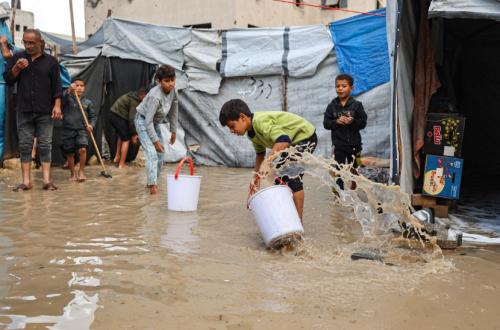
GAZA — More than 560,000 children in the Gaza Strip face a fourth winter without safe, adequate shelter. Israeli restrictions on humanitarian aid, particularly shelter materials and winter supplies, have left hundreds of thousands of Palestinian children trying to survive in damaged emergency tents that cannot protect them from rain and cold weather.
Humanitarian organisation Save the Children warned that conditions for children in Gaza had become increasingly alarming after the first winter storm hit the territory last weekend. Heavy rain flooded around 70,000 displacement tents in a single day.
Gaza’s Civil Defence agency received more than 1,500 emergency calls from people affected by the flooding. Many families were forced to leave their shelters at night after the tents they were staying in became inundated.
In a report cited by Palestine Chronicle on Tuesday (10 November 2026), Save the Children said more than half a million children in Gaza were facing winter in extremely poor housing conditions.
The latest assessment by the Palestine Shelter Cluster found that around 58 per cent of Gaza’s population, or 1.2 million people, were living in conditions classified as critical to catastrophic. More than 560,000 of them are estimated to be children.
Many families have been forced to live in overcrowded, fragile tents and emergency shelters. Conditions have deteriorated further after years of exposure to extreme weather and repeated dismantling and rebuilding amid Israel’s military campaign.
Save the Children said Israeli authorities had repeatedly blocked the entry of caravans or sturdier temporary housing to replace tents. The ceasefire agreement announced more than a year ago had provided for these facilities to enter Gaza.
Israeli restrictions also cover a range of essential winter supplies, including tents, tarpaulins, plastic sheeting, insulation, blankets, fuel, cooking gas, heating equipment and construction materials to repair damaged homes.
As a result, Palestinian children are sleeping on damp mattresses, wearing wet clothes and staying in structurally unsafe buildings. Temperatures in Gaza are expected to fall to around 5 degrees Celsius as another winter storm approaches.
Conditions for displaced families in Gaza are growing increasingly dire, with many lacking adequate means to heat their shelters.
The Shelter Cluster assessment found that 84 per cent of surveyed families had no effective way to heat their homes. Nearly half, or 48 per cent, were forced to burn plastic, used tyres, rubbish and cardboard for cooking.
This practice poses serious health hazards. Toxic smoke from burning these materials can cause respiratory illnesses, smoke inhalation injuries and carbon monoxide poisoning. The risks of fires and burns are also higher, particularly for children living in crowded, poorly ventilated displacement camps.
Access to winter clothing is also far from adequate. More than one million people in Gaza need warm clothes, but available stocks are estimated to meet only around one per cent of the total need.
For children, this is not simply a matter of discomfort; it is a threat to their lives.
Last winter, at least 11 children were reported to have died from hypothermia. Many others suffered respiratory infections, worsening malnutrition and chronic illnesses.
Save the Children also reported that more than 464,000 people were living in displacement sites at high risk of flooding. These include Al-Mawasi in western Khan Younis, displacement sites in Deir al-Balah, and vulnerable areas in Gaza City, northern Gaza and Rafah.
Meanwhile, around 60 per cent of the US$283 million needed to prepare for winter remains unfunded.
Israel deliberately obstructing aid
Ahmad Alhendawi, Save the Children International’s regional director for the Middle East, North Africa and Eastern Europe, said the organisation’s staff in Gaza had witnessed floodwater sweep through displacement tents while families were asleep.
Children were shivering without winter clothing, while families lost the few belongings they still had.
“This is not simply the result of bad weather. Tents, shelter supplies and fuel are waiting at Gaza’s border while children sleep in pools of water because the Israeli authorities are blocking these supplies from entering,” Alhendawi said.
He said the situation was the result of a policy choice whose consequences Palestinian children were being made to bear.
“This is a choice, and children are paying the price. More than a year after what is being called a ceasefire, the agreement has failed to protect Palestinian children,” he said.
Alhendawi stressed that deaths from hypothermia among children could be prevented if their basic needs were met.
As an occupying power, he said, Israel had a legal obligation to ensure civilians received the supplies necessary for their survival.
But aid restrictions were depriving Palestinian families of the most basic means of protecting their children.
He urged the international community to exert meaningful pressure on the Israeli government to open all crossings and allow tents, shelter materials, fuel and winter clothing to enter without restrictions.
International donors were also urged to increase funding immediately, including for the UN Relief and Works Agency for Palestine Refugees (UNRWA), which has been central to the humanitarian response in Gaza.
Save the Children’s warning came as winter storms began to worsen the humanitarian crisis in the Palestinian territory, which has been devastated by a prolonged war.
A UN report on 10 November 2026 said around 65 per cent of Gaza’s population, or 1.4 million people, were living in tents or emergency shelters.
Flooding and strong winds had also destroyed more than 6,000 family shelters and damaged a further 17,400 by 8 November. At least 3,900 families had been left without any shelter.
The UN warned that stocks of tents, tarpaulins, blankets and clothing inside Gaza were nearly exhausted. Yet around 150,000 tents purchased by humanitarian partners and several countries were available outside Gaza and ready to be delivered.
The situation shows that the threat to Gaza’s people does not end when the intensity of military attacks declines. Without adequate shelter, access to aid and protection from extreme weather, Palestinian children remain at risk of death amid a protracted humanitarian crisis.
Source: jawawa.id (https://jawawa.id/newsitem/israels-aid-restrictions-put-560-000-gaza-children-at-risk-of-freezing-to-death-1794351041)
Originally published by Republika (https://news.republika.co.id/berita/tob3up393/israel-batasi-bantuan-560-ribu-anak-gaza-terancam-meninggal-kedinginan), translated from Indonesian