
Israel Votes Today as Netanyahu Fears Defeat and Raises Iran Nuclear Threat
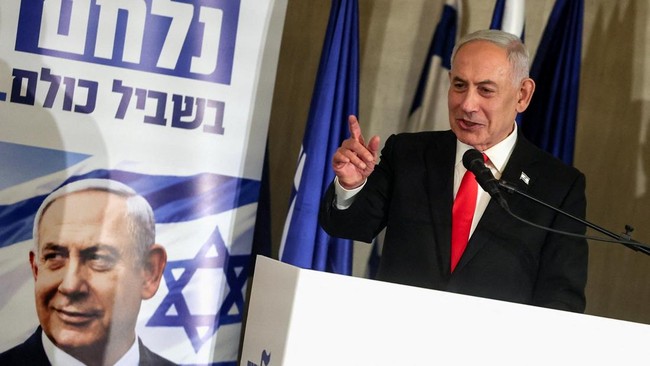
Jerusalem, CNBC Indonesia – Israeli Prime Minister Benjamin Netanyahu has stepped up his threatening warnings ahead of Tuesday’s general election (27 October 2026). With the contest close and several polls giving the opposition bloc a narrow lead, Netanyahu has reportedly urged the Israeli military to take action against Iran.
Netanyahu even posted an AI-generated image showing a nuclear mushroom cloud destroying Tel Aviv. In the post, he warned voters that choosing him was a way to avoid the threat of destruction by nuclear weapons.
“Anyone who cares about their own safety, their family and their loved ones should tremble at the thought of voting for [the opposition],” Netanyahu wrote in a social media post referring to Iran’s nuclear programme.
Israeli television channel Channel 12 reported that Netanyahu had clashed in recent days with Lieutenant General Eyal Zamir, Chief of the General Staff of the Israel Defense Forces. The dispute was said to concern instructions to the military that could trigger a direct conflict with Iran at a highly sensitive moment, while also risking a miscalculation by Tehran.
Zamir reportedly asked for the instructions, whose details have not been disclosed, to be given to him in writing.
Netanyahu denied the report. Israel’s Defence Ministry subsequently said it had no plans to launch a military operation against Iran.
However, CNN reported on Monday that Netanyahu had tried in recent weeks to persuade US President Donald Trump to strike Iran again. Such a move could reignite the war launched by the two leaders in February.
CNN’s report confirmed earlier reporting by the Financial Times, which said Trump had refused to launch a new attack on Iran before next week’s US congressional elections.
On Monday, the Israel Defense Forces (IDF) issued a statement that did not directly deny reports of a possible military operation. It said only that any decision would be based on “security, professional, objective and national considerations”.
Netanyahu’s statements this time contrast with the triumphant stance he adopted after last year’s war against Iran and the renewed conflict that broke out this spring.
In March, Netanyahu said Israeli and US strikes had destroyed Iran’s ability to enrich uranium and produce ballistic missiles. In 2025, he also claimed to have achieved a “historic victory” over Iran, with effects that would last for generations.
Opposition rejects use of military as political tool
Gadi Eisenkot, leader of the opposition bloc and one of Netanyahu’s main challengers for the premiership, said he had confidence in Zamir. Eisenkot is a retired general.
“We will not allow the IDF to be used as a pawn in Netanyahu’s campaign to cling to power,” Eisenkot said, according to The Guardian.
Many polls suggest that the opposition bloc, dominated by centre-right groups and led by Eisenkot, could win more seats in Israel’s parliament, the Knesset, than Netanyahu’s coalition. Nevertheless, both camps are expected to struggle to reach the 61 seats needed to form a majority government.
The opposition could secure a majority by forming an alliance with parties representing Palestinian citizens of Israel, who make up around one-fifth of the country’s population.
However, conservatives within Eisenkot’s bloc have rejected the possibility of forming such a coalition. This creates the prospect of a minority government, another election or Netanyahu strengthening his position once more.
As polling day approached, Netanyahu framed Israelis’ political choice as a matter of life and death. In an interview with Channel 14, a broadcaster known for strongly supporting him, Netanyahu said: “There is one fundamental issue here, and that is our existence.”
He described the opposition bloc as left-wing and allied with Palestinians, portraying it as a threat to Israel.
“We see what is happening in Europe. An alliance between the left and Islam could destroy the State of Israel,” he said.
In fact, Israel’s main opposition parties are mostly right-wing or centre-right. They also strongly oppose the creation of a Palestinian state and generally support the war in Gaza.
Several opposition leaders have even rejected the possibility of a political alliance with parties representing Palestinian citizens of Israel, although those parties could hold the balance of power in the Knesset after the election. Palestinians living in the occupied territories, meanwhile, do not have the right to vote in Israeli elections.
Legal troubles and political support
Israel’s opposition bloc has largely been united by its opposition to Netanyahu, who has dominated the country’s political stage for around three decades.
In recent years, Netanyahu has been seen as moving increasingly towards authoritarian government. He has sought to limit the judiciary’s independence and turn the police and Shin Bet, Israel’s domestic security agency, into political instruments.
Netanyahu is also on trial over corruption allegations. His legal position could become more precarious if he loses power.
In the final stage of the campaign, Netanyahu has also highlighted Trump’s explicit backing. The US president reiterated his support on Sunday in a social media post.
“When you go to the polls, remember that Bibi is an outstanding prime minister and fighter!” Trump wrote, using Netanyahu’s nickname.
Israeli outlet Walla News reported that the latest endorsement came after Netanyahu’s office repeatedly pressured Trump to voice his support again. It remains unclear how much influence the US president’s backing will have on voters.
Trump’s full-throated endorsement on 18 October had also appeared to make little difference to polling results.
In one survey, 64% of respondents said Trump’s support would not affect their choice. A further 17% said it made them less likely to vote for Netanyahu, while 12% said it strengthened their intention to vote for Netanyahu’s Likud party.
Economic warnings and central bank criticism
As the closely fought campaign drew to a close, Netanyahu also warned that Israel could face increasingly severe economic isolation. He said the billions of dollars in annual US military aid would soon dry up.
Netanyahu also received a rare public rebuke from Israel’s central bank after repeatedly saying that cryptocurrencies could be used to circumvent tightening international sanctions.
“Cryptocurrencies cannot be used as a means of evading sanctions,” the Bank of Israel said on Sunday night.
“The right course for Israel’s economy is to maintain economic ties with its major trading partners and focus on preventing sanctions and their adverse effects on the economy,” the central bank added.
A year earlier, Netanyahu had also painted a bleak picture of Israel’s future in isolation, saying the country might need to become a highly militarised “super-Sparta”. He later withdrew the remark after facing strong public criticism.
Netanyahu’s return to threatening rhetoric and fear-based political tactics, particularly after his right-wing allies suffered unexpected defeats in Serbia and Brazil, has raised questions about whether a leader who has weathered numerous political crises is now beginning to lose his grip.
Few of Netanyahu’s allies or opponents expected his government to last long after the 7 October attack, let alone complete its term. Yet for more than two years, most polls have consistently indicated that his coalition is at risk of losing its narrow parliamentary majority.
Source: jawawa.id (https://jawawa.id/newsitem/israel-votes-today-as-netanyahu-fears-defeat-and-raises-iran-nuclear-threat-1793062244)
Originally published by CNBC Indonesia (https://www.cnbcindonesia.com/news/20261027065142-4-779673/hari-ini-pemilu-israel-netanyahu-takut-kalah-singgung-nuklir-iran), translated from Indonesian