
Islamic Financial Literacy and Inclusion Rates Decline in 2026, Why?
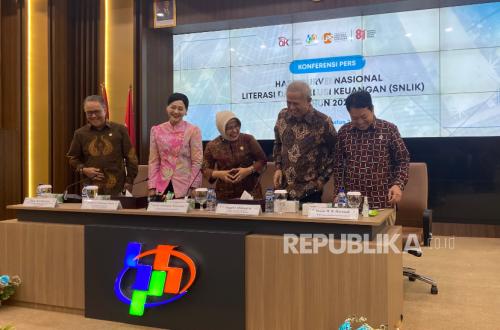
The results of the 2026 National Survey on Financial Literacy and Inclusion (SNLIK) show that the level of Islamic financial literacy and inclusion in Indonesia in 2026 has declined compared to the previous year. Statistics Indonesia (BPS) stated that this year’s SNLIK is quite different from the previous year because the survey was conducted down to the provincial level, thus providing a more comprehensive picture of the situation.
The 2026 SNLIK results recorded that the national financial literacy and inclusion level actually increased this year by 2.93 basis points to 69.57 percent, compared to 66.64 percent in the 2025 SNLIK. Despite the national increase, the level of Islamic financial literacy and inclusion actually declined.
The 2026 SNLIK results show that the Islamic financial literacy level reached 43.07 percent, a correction of 0.35 basis points compared to the 2025 SNLIK figure of 43.42 percent.
Similarly, the national financial inclusion index in 2026 also increased, rising 0.87 basis points to 93.61 percent from 92.74 percent the previous year. However, the Islamic financial inclusion level in the 2026 SNLIK was recorded at 13.24 percent, down 0.17 basis points compared to the 2025 SNLIK level of 13.41 percent.
In short, the increase in the Islamic financial literacy and inclusion index according to the 2026 SNLIK results came from conventional financial literacy and inclusion.
Responding to the decline in Islamic financial literacy and inclusion levels in the 2026 SNLIK results, Head of Statistics Indonesia (BPS) Amalia Adininggar Widyasanti explained that there is a novelty in the data presentation.
“We need to look at the coverage, because previously the 2025 SNLIK was still at the national level, whereas now we have been more comprehensive down to the provincial level in terms of regional coverage. We will need to dissect this further so that it is an apple-to-apple comparison,” Amalia told reporters after the press conference on the 2026 SNLIK Results at the BPS Building, Jakarta, Monday (10/8/2026).
She also responded to the disparity between Islamic financial literacy and inclusion levels, which differs from the condition of conventional financial literacy and inclusion levels.