
Islamic Boarding Schools Ready to Lead Productive Waqf Revolution
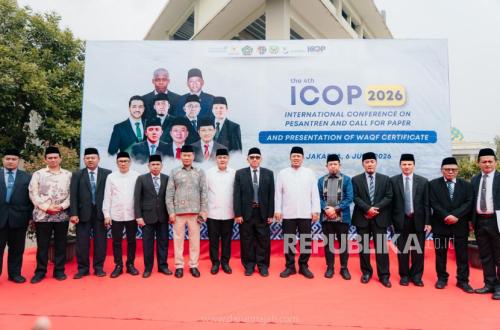
JAKARTA – Islamic boarding schools (pesantren) are being encouraged to become the primary drivers of the national revival of productive waqf. This commitment was highlighted during The 4th International Conference on Pesantren (ICOP) 2026, held at the Darunnajah Arena in Jakarta on Saturday (6/6/2026).
Under the theme “The Impact Mission: Unleashing the Power of Endowment & Waqf Funds for Islamic Education, Business, and Science & Technology”, this international forum featured the Minister of ATR/BPN, Nusron Wahid, alongside thousands of students, hundreds of clerics (kyai), and waqf experts from various countries. The conference emphasised the importance of endowment funds and waqf as Islamic financial instruments capable of supporting educational independence, strengthening the business sector, and driving advancements in science and technology.
The President of Darunnajah University, Hadiyanto Arief, asserted that Islamic educational institutions must return to being pioneers in professional and impactful waqf management. He noted that the concept of endowment funds supporting the world’s most prestigious universities has deep roots in Islamic waqf traditions, citing Al-Azhar’s thousand-year longevity as an example. Hadiyanto also shared Darunnajah’s success, noting how they expanded from a 700-square-metre plot to over 1,200 hectares of productive waqf land supporting 23 branch campuses.
Meanwhile, the Minister of ATR/BPN, Nusron Wahid, expressed full government support for strengthening the governance of waqf assets. He emphasised that accelerating the certification of waqf land is a strategic step to protect community assets from potential future disputes. Nusron also noted that the government is pushing for the resolution of administrative issues through the ‘Isbat Wakaf’ mechanism for lands lacking complete documentation.
Furthermore, Nusron revealed plans for regulatory breakthroughs that would allow the granting of Building Use Rights (HGB) on waqf land to optimise its economic utility. “We want to create regulatory breakthroughs for the empowerment of the community. Third parties or investors will eventually be able to build commercial infrastructure and lease land on waqf property from the nadzir (trustee). Thus, land that was previously passive can generate high economic value,” said Nusron. He expressed hope that these regulations would open significant opportunities for developing productive waqf in Indonesia as a key instrument for economic independence.
The 4th ICOP also featured international experts from the University of Sharjah and Universiti Teknologi MARA, alongside leaders from prominent Islamic institutions such as Pondok Pesantren Lirboyo, Al Falah Ploso, and Universitas Darussalam Gontor. The forum included research sub-themes ranging from waqf governance and financial digitalisation to ESG-based investment and cross-border regulatory harmonisation.