
Islamic Boarding Schools and Regional MSMEs Aid National Sharia Economic Development
A 500-square-metre greenhouse at the Hamalatul Qur’an Islamic boarding school in Manonjaya, Tasikmalaya, West Java, serves as evidence of how Sharia economic and financial inclusion can positively impact religious educational institutions.
It all began in 2020 when the nature-based boarding school received a greenhouse grant from Bank Indonesia (BI) Tasikmalaya. Simultaneously, they received mentoring to learn about melon cultivation.
“We were sent to study melon farming in depth for two weeks. From there, we remained at the boarding school to develop it,” explained Aazimuddin, a member of the Hamalatul Qur’an economic team, during the Jawa 2026 Sharia Economic Festival (FESyar) in Surabaya, East Java, on Saturday (26/9/2026).
Since then, a dedicated economic team at the school has been cultivating melons. The greenhouse now produces premium-grade melons. The facility covers 500 square metres and houses approximately 1,000 trees.
The school specialises in two varieties: the ‘Sweet Lavender’ melon, which features a crisp, apple-like texture and sweetness, and the ‘Honey Globe’ melon, which is even softer and sweeter.
These melons are sold both within and outside the boarding school. Internally, the school organises open harvest festivals for parents of the students to purchase. Externally, sales are made to supermarkets and resellers.
“We also frequently ship them out. Every month, we send supplies to Bandung, to resellers, and to various supermarkets through partnerships,” he said.
Aazimuddin revealed that net profits per harvest range between Rp35 million and Rp50 million, depending on sales and handling. While profits have occasionally dipped, the lowest recorded was Rp25 million.
Starting from the economic development assistance provided by BI Tasikmalaya, the melon profits now help support the boarding school’s operational costs. He hopes that in the future, profits can also be allocated to provide scholarships for high-achieving students.
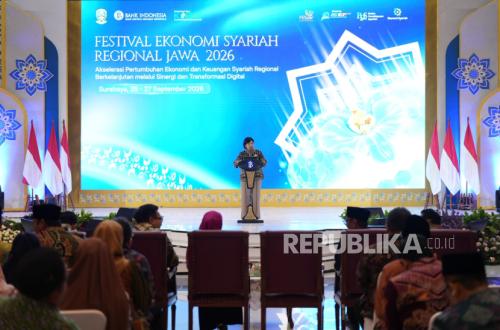
He brought these aspirations to the FESyar Jawa 2026 held in Surabaya from 25-27 September 2026, an event where business actors, Sharia financial institutions, the government, boarding schools, and various stakeholders convene.
“Through these events, we meet new connections to establish partnerships and share knowledge,” he added.
Alongside the products from Pesantren Hamalatul Qur’an, other halal products were featured at the event, integrating various national Sharia economic and financial development initiatives.
One such example is in the modest fashion sector. At one stall, various batik fabrics were displayed alongside clothing and accessories produced by Rezti’s Batik, owned by Lestari Kusumawati.
Lestari began her batik business in 2012 after attending batik training organised by the National Urban Independent Community Empowerment Programme in Tegal Sari, Ambulu, Jember. At the time, batik was not widely recognised as a signature product of Jember. The first two years were challenging as she had to educate potential customers on why her product prices differed from those found in standard shops.
Her business began receiving mentoring from BI Jember in late 2018. Through this, Lestari received various training sessions, equipment assistance, showcase opportunities, halal certification facilities, and invitations to participate in exhibitions.
According to Lestari, BI’s mentoring has helped her business grow by approximately 40 per cent. While not precisely calculated, she has felt a significant shift in public trust and brand recognition.
“What is most noticeable is that public trust and our branding have increased,” she said.
The stories of Aazimuddin and Lestari serve as small-scale illustrations of businesses being developed within the regional Sharia economic ecosystem. At FESyar, such products are brought together with other entrepreneurs, potential buyers, and financing institutions.
Source: jawawa.id (https://jawawa.id/newsitem/islamic-boarding-schools-and-regional-msmes-aid-national-sharia-economic-development-1790578655)
Originally published by Republika (https://sharia.republika.co.id/berita/tm25nh502/pesantren-dan-umkm-daerah-bantu-pengembangan-ekonomi-syariah-nasional), translated from Indonesian