
Islamic Banking Market Share Stagnates at 7 Percent, Shifting Civil Servant Payroll Seen as Key
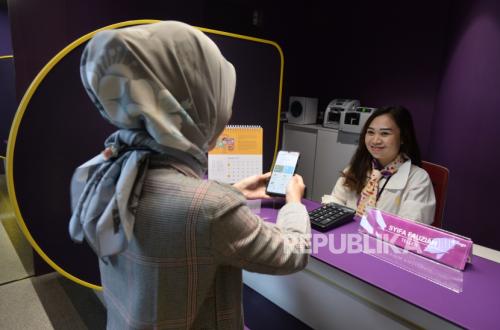
The market share of Islamic banking in Indonesia remains very low, at around 7 per cent. This is despite Indonesia being one of the countries with the largest Muslim majorities in the world, which has developed its Islamic banking sector for three decades. Mahbubi Ali, Deputy Dean of the IIUM Institute of Islamic Banking & Finance Malaysia, argues that there is in fact one main key to boosting the market share of Islamic banking in Indonesia: government favour, or political will.
He revealed, for instance, that when it comes to the payroll of civil servants (ASN), the percentage channelled through Islamic banks does not even reach 15 per cent. For this reason, the government’s commitment is seen as potentially the main driving factor.
“If we look, for example, at the report of KNEKS (the National Committee for Islamic Economy and Finance), more than 86 per cent of civil servants’ salaries are still held in conventional banks. So only around 15 per cent are in Islamic banks. This includes payrolls from Islamic institutions, such as Islamic universities and other bodies,” said Mahbubi at the Islamic Economics Summer School (IESS) 2026, organised online by the Centre for Islamic Economics and Business of Universitas Indonesia (PEBS UI) on Wednesday (29 July 2026).
The government is seen as needing to demonstrate its commitment to Islamic banking if it genuinely wishes to expand the reach of the Islamic finance market in Indonesia. The low market share of Islamic banking, in fact, indicates that the opportunities for its development remain considerable.
One approach would be to shift ASN payrolls from conventional banks to Islamic banks. In this way, funds within the State Budget (APBN) are expected to ‘migrate’ to Islamic banks. That is where political will from the government is required.
Intervention scenario reaching 50 per cent by 2045
Mahbubi outlined several government intervention scenarios for increasing the market share of Islamic banking. He mapped four instruments that could boost it: state budget (APBN) allocations, allocations from the Nusantara Investment Management Agency (BPI Danantara), allocations from the halal food and beverages (F&B) sector, and the Indonesia Shariah Stock Index (ISSI) instrument directed towards Islamic finance. The scenarios comprise low intervention of 5 per cent and moderate intervention of 10 per cent.
“For example, with our state budget, if we put in just a little — low, meaning 5 per cent intervention — into Islamic banks, we could actually accelerate the development of Islamic banking by five years. So, without intervention, 10 per cent market share would only be reached in 2035; with a 5 per cent intervention, with the state budget going into Islamic banks, we could reach 10 per cent market share by 2030,” he said.
If intervention is carried out at the moderate level of 10 per cent, the market share figure could be pushed even higher, to 11.19 per cent by 2030 or 13.32 per cent by 2035.
If intervention from BPI Danantara cash funds is added, the target for increasing market share could be achieved even more quickly. According to his calculations, if there is intervention from both state budget funds and Danantara cash funds, the market share of Islamic banking is predicted to exceed 20 per cent by 2045, compared with the organic scenario (without intervention) of only around 13 per cent.
Mahbubi continued that if the F&B fund instrument and placements in sharia-listed issuers (ISSI) are also added, the market share figure could rise even further.
“If we combine everything, then, God willing, we will reach 50 per cent market share by 2045. At a minimum, 42 per cent if we use low intervention. Without intervention, we would still be at 13 per cent twenty years from now,” he said.
“But there must be commitment and state policy willing to intervene — it need not be much, we are asking for just 5–10 per cent. And the figures would be tremendous,” he asserted.
Source: jawawa.id (https://jawawa.id/newsitem/islamic-banking-market-share-stagnates-at-7-percent-shifting-civil-servant-payroll-seen-as-key-1785412395)
Originally published by Republika (https://sharia.republika.co.id/berita/tizixy423/pangsa-bank-syariah-masih-7-persen-pengalihan-payroll-asn-dinilai-jadi-kunci), translated from Indonesian