
ISEI Promotes Sharia Economy as a Pillar of National Transformation
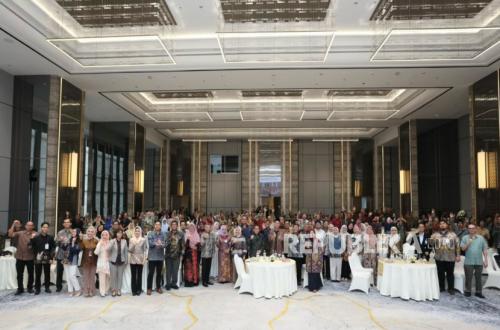
REPUBLIKA.CO.ID, JAKARTA – The Indonesian Economists Association (ISEI) Central, through its Sharia Economy and Finance Forum Group (FG), held a talkshow and halal bihalal event themed “Developing an Adaptive and Inclusive Sharia Economy: Exploring the Thoughts of Prof Sumitro Djojohadikusumo” at the Grand Ballroom of BSI Tower, Jakarta.
This event served as a strategic forum to deepen the role of the Sharia economy as part of a just, independent, and sustainable national economic structural transformation.
The gathering was attended by several national figures, including Muliaman D Hadad, Deputy Chairman of the Danantara Supervisory Board and also Deputy Chairman of the ISEI Supervisory Board.
In addition, Aida S Budiman, Deputy Governor of Bank Indonesia and Chair of the Macroeconomic and Financial Policy Formulation Sector of PP ISEI. The presence of these policymakers underscores the importance of the Sharia economy in the national economic policy architecture.
In his remarks, the Chairman of the FG Sharia Economy and Finance PP-ISEI, who is also the Deputy Director of PT Bank Syariah Indonesia (Persero) Tbk, Bob T Ananta, emphasised the importance of directed and integrated economic development, as highlighted in the Sumitronomics concept.
According to him, the development of the Sharia economy must be positioned as part of the grand national development strategy that not only focuses on the financial sector but also promotes the strengthening of the real sector and improves societal welfare.
“Sharia banking plays a role as an enabler in the Sharia economic ecosystem, from financing SMEs through various initiatives such as the UMKM Center, to strengthening the halal ecosystem that encompasses education, halal lifestyle, as well as the hajj and umrah industry,” he said in a statement quoted on Wednesday (15/4/2026).
According to him, strengthening the Sharia economy requires close synergy between policies and industry players, enabling the creation of broader and more equitable impacts for society.
He also stated that the greater the contribution of the Sharia banking industry, the greater the impact it can provide to society as a whole.
In his keynote speech, economist Anggito Abimanyu stated that the Sharia economy has unique characteristics as a blend of economic science and Islamic legal principles, with the primary goal of achieving societal welfare.
He explained that the dimension of religious compliance forms the main foundation of the Sharia economy, distinguishing it from conventional economic systems. Furthermore, Anggito linked Sharia economic principles to the thoughts of Prof Sumitro Djojohadikusumo, particularly regarding the importance of national economic independence and inclusive development. The principles of transactions in the Sharia economy, he clarified, must reflect a balance between halal aspects, goodness (thayib), and benefits (maslahat), overall to support societal welfare.
In the context of future development, Anggito also highlighted fundamental challenges in the Sharia economy, namely the existing gap between Sharia financial literacy levels and inclusion.
Therefore, more systematic efforts are needed to strengthen understanding while encouraging the utilisation of Sharia financial services so that they can contribute more optimally to national economic development.
The panel discussion session formed the core of this forum, featuring various strategic perspectives. Economic expert Murniati Mukhlisin emphasised the importance of strengthening Sharia financial literacy and inclusion through a collaborative ecosystem approach based on the ABG-MAC model, which integrates the roles of academics, businesses, government, media, aggregators, and communities in building an inclusive ecosystem.
Next, Sutan Emir Hidayat from KNEKS stated that Sharia economy development requires an integrated approach that includes strengthening the halal industry, exports, Sharia finance, and other supporting ecosystems.
“The Sharia economy has become part of the national strategic agenda in the RPJPN and RPJMN, with targets to increase its contribution to national economic growth,” he said.
From a macroeconomic policy perspective, Ali Sakti from Bank Indonesia emphasised that strengthening the Sharia economy needs to be supported by macroeconomic and monetary policy instruments that not only maintain stability but also drive economic transformation.
A value-based policy approach is important to ensure that the Sharia economy contributes to strengthening the real sector, equitable welfare distribution, and forming a more inclusive and sustainable economic structure, in line with Prof Sumitro’s thoughts.
From an industry implementation perspective, economic expert Banjaran Surya Indrastomo assessed that the direction of Sharia economic policies in Indonesia has become increasingly progressive and integrated with the national development agenda.
However, the main challenge still lies in the effectiveness of policy transmission to the real sector, where productive financing needs to be continuously strengthened to create greater economic added value.
The discussion also underlined that future strengthening of the Sharia economy does not only depend on increasing literacy and inclusion, but also on the ability to build an integrated ecosystem and encourage productive economic activities.
This becomes the key to enabling the Sharia economy to make a real contribution to national economic transformation.
The event concluded with a warm and communal halal bihalal session, strengthening synergy among stakeholders.
Through this forum, ISEI reaffirmed its commitment to continue promoting Sharia economy and finance as important pillars in inclusive, just, and sustainable national development.
Looking ahead, closer collaboration between regulators, industry, academics, and society is expected to accelerate the strengthening of the Sharia economic ecosystem, while propelling Indonesia towards a strategic position as a global Sharia economy centre.
Source: jawawa.id (https://jawawa.id/newsitem/isei-promotes-sharia-economy-as-a-pillar-of-national-transformation-1776261052)
Originally published by Republika (https://sharia.republika.co.id/berita/tdjern472/isei-dorong-ekonomi-syariah-sebagai-pilar-transformasi-nasional), translated from Indonesian