
Is the New Coordinating Ministry the Right Opportunity to Accelerate the Energy Transition?
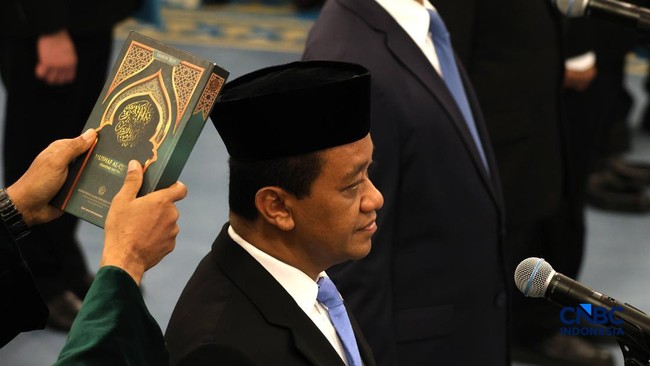
Energy and Mineral Resources Minister Bahlil Lahadalia was given a new assignment by President Prabowo Subianto at the beginning of the month: to lead the Coordinating Ministry for Downstreaming and Energy Transition (Kemenko HTE). The establishment of Kemenko HTE can be seen as a valuable opportunity for Indonesia.
This is particularly significant because, in the first two years of President Prabowo’s administration, Indonesia has made ambitious energy-transition commitments, including a 100-gigawatt-peak (GWp) solar power programme targeted for completion within the next three years.
However, several issues need attention if Kemenko HTE is to become a genuine catalyst for accelerating Indonesia’s energy transition.
First, it must ensure that the energy transition is incorporated into downstreaming. Downstreaming in Indonesia has been under way for some time; nickel investment alone reached Rp185.2 trillion in 2025, the highest of any commodity.
President Prabowo recently launched 11 nickel downstreaming projects in North Maluku, with total investment of Rp180 trillion. Nevertheless, Indonesia’s nickel downstreaming industry remains heavily reliant on coal-fired power plants, with capacity reaching 19.3 GW in early 2026.
This high dependence on coal has harmful consequences for the environment and local communities, as seen in North Maluku and Central Sulawesi. This practice must not be allowed to continue, and Kemenko HTE should encourage the nickel downstreaming industry to switch from coal-fired electricity to renewable energy. Without such action, the government’s efforts to curb new coal-fired power plant additions to the PT PLN (Persero) grid in order to reduce emissions will be meaningless.
Coordinating Minister Bahlil has identified several technical ministries that will come under Kemenko HTE, including the Ministry of Energy and Mineral Resources, the Ministry of Industry, and the Ministry of Investment and Downstreaming/BKPM. To ensure an energy transition in the downstreaming of nickel and other minerals, Kemenko HTE needs to align policies across ministries and agencies (K/L) to encourage industry players to adopt renewable energy.
For example, this could include incentives for companies willing to adopt renewable energy or to draw up measurable transition plans tailored to their industrial needs, alongside disincentives for those that fail to plan for the energy transition. Strong policy certainty would boost the confidence of investors, who are increasingly attentive to sustainability.
Second, Kemenko HTE must be able to take over the role of ad hoc bodies or task forces. Indonesia has several task forces that coordinate energy-transition issues, including the Energy Transition and Green Economy Task Force (Satgas TEH), which implements the Just Energy Transition Partnership (JETP), and the Acceleration of Downstreaming and National Energy Security Task Force (Satgas Hilirisasi), which handles downstreaming.
Kemenko HTE should become the focal point for managing Indonesia’s energy transition, allowing other bodies that previously had coordination duties to be disbanded. The government needs to issue a policy granting Kemenko HTE this authority.
This could address the problem of cross-ministerial coordination, for which the task-force model is ill-suited because it lacks a strong legal basis to direct ministries and has no dedicated mandate or budget.
Third, Kemenko HTE must ensure that energy-transition targets are reflected in national energy-planning documents. Data from the Ministry of Energy and Mineral Resources show that Indonesia’s energy mix is still dominated by coal, at 33.44%, while new and renewable energy accounts for only 18.3% in the first quarter of 2026.
During a state visit to Brazil in 2025, President Prabowo declared a commitment to a 100% renewable energy mix by 2035. Yet Indonesia’s current planning documents do not reflect this ambition.
PLN’s 2025–2034 Electricity Supply Business Plan (RUPTL) still includes an additional 16.6 GW of fossil-fuel capacity, predominantly coal and gas. The 2025 National Energy General Plan (RUEN) and National Electricity General Plan (RUKN) also project coal use through to 2060. Meanwhile, the integration of the 100 GWp solar programme into planning is still awaiting a revision of the RUPTL.
If Indonesia is serious about achieving 100% renewable energy by 2035, Kemenko HTE must coordinate the relevant ministries and agencies to revise energy plans. If international commitments are not reflected in domestic policy, it will be difficult to deliver on the promised energy transition.
The establishment of Kemenko HTE is a golden opportunity that must not be wasted. The ministry was created to address the fragmented coordination among ministries and agencies that has long hampered national energy-transition planning.
However, without tangible transition measures, Kemenko HTE risks becoming merely another layer of bureaucracy, unable to drive significant policy change. Can it provide the answer to the bureaucratic challenges facing Indonesia’s energy transition?
Source: jawawa.id (https://jawawa.id/newsitem/is-the-new-coordinating-ministry-the-right-opportunity-to-accelerate-the-energy-transition-1792741904)
Originally published by CNBC Indonesia (https://www.cnbcindonesia.com/opini/20261023133301-14-778911/kemenko-hte-momentum-tepat-percepat-transisi-energi), translated from Indonesian