
Is the Jakarta Provincial Government's Move to Eradicate Sailfin Catfish Appropriate? Here's What the Expert Says
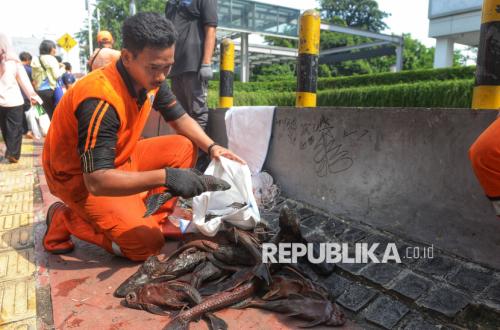
An expert in fish and fish conservation from the Faculty of Fisheries and Marine Sciences at IPB University, Charles PH Simanjuntak, believes that the operation to capture sailfin catfish conducted by the Jakarta Provincial Government also needs to be carried out from the upstream river areas. This is because his team has found that sailfin catfish already dominate the Ciliwung River from upstream in the Bogor region. “So this physical extermination activity must be holistic along the entire Ciliwung River Basin (DAS). Because during the rainy season, the young sailfin catfish will enter the downstream Ciliwung River from Bogor again,” he told Republika on Tuesday (21/4/2026). He explained that there are four species of sailfin catfish currently proliferating in Indonesian waters, including in Jakarta and its surroundings. The four species are Amazon sailfin catfish (Pterygoplichthys pardalis), Vermiculated sailfin catfish (Pterygoplichthys disjunctivus), Suckermouth catfish (Hypostomus Plecostomus), and Bristlenose catfishes (Ancistrus sp). According to him, sailfin catfish live comfortably in clean river water but also in waters polluted with organic or non-organic materials. He revealed that there are at least four reasons why sailfin catfish need to be controlled. First, sailfin catfish compete with native species for food and space/habitat. Second, based on study results, sailfin catfish show a strong preference for consuming eggs of native species, which can cause a significant decline in the reproductive success of native species. Third, the presence of sailfin catfish correlates negatively with the diversity of native fish and the decline in native fish populations. Finally, sailfin catfish cause physical damage to river ecosystems by eroding riverbanks, creating burrows for nests, and altering benthic habitats. “This activity reduces habitat quality for native species and disrupts ecosystem stability,” he said. In addition to control efforts, Charles believes that the Jakarta Provincial Government also needs to carry out river and lake restoration or rehabilitation. This means long-term efforts that need to create a roadmap for the restoration and/or rehabilitation of river ecosystems in Jakarta. “This effort must involve all stakeholders. The Love Rivers and Lakes Movement in Jakarta and its surroundings must be implemented immediately,” he said. Utilising Sailfin Catfish Charles explained that in their natural habitat in the Amazon River, sailfin catfish are utilised by communities as a source of animal protein. This is because sailfin catfish have a protein content ranging from 22.54-23.47 percent (moderate) and fat between 3.42-5.49 percent (low). This means that sailfin catfish can actually be consumed as a source of animal protein. “However, we need to ensure that the sailfin catfish come from uncontaminated waters,” he said. He revealed that several studies show that sailfin catfish from the Ciliwung River contain several harmful heavy metals, such as Pb, Cd, and Hg. Therefore, more in-depth research is needed on the heavy metal content in the bodies of sailfin catfish along the Ciliwung River and safe consumption thresholds (safety thresholds) for sailfin catfish from the Ciliwung River. He assessed that sailfin catfish from waters contaminated with heavy metals may contain sufficiently high levels of metals in their tissues, especially in the muscle, which is the main part used as animal feed. Although some processing methods can reduce heavy metal concentrations, there is a risk that livestock consuming feed derived from sailfin catfish may accumulate heavy metals in their bodies over time, especially metals like Pb and Cd. “Therefore, careful monitoring, risk assessment, and the implementation of effective mitigation strategies are very important before approving the use of sailfin catfish as animal feed,” he said. Based on research results, according to him, the use of sailfin catfish from heavy metal-contaminated waters as fertiliser (POC-Liquid Organic Fertiliser) for consumable plants is not recommended without adequate processing to remove heavy metals. Considering the well-documented safety risks, concerns about bioaccumulation, and potential negative impacts on the environment and human health. “Such use can only be considered safe and sustainable after effective remediation and comprehensive safety assessments have been carried out. However, liquid organic fertiliser derived from sailfin catfish can be used as fertiliser for ornamental plants or other non-consumable plants,” he said.