
Is Mining Behind the Proposal to Relocate Javan Rhinos to Alas Purwo?
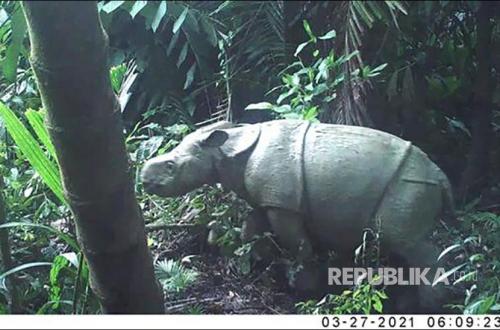
BANTEN — Ujung Kulon has long been synonymous with the habitat of the critically rare Javan rhinoceros (Rhinoceros sondaicus). A recent proposal to establish another habitat, raised in Antalya, Türkiye, has attracted attention in Indonesia.
The debate emerged after Hashim Djojohadikusumo, the President’s Special Envoy for Climate and Energy, floated the idea on the sidelines of the 31st United Nations Climate Change Conference (COP31) at the Antalya Expo Center. He cited the risk that Ujung Kulon National Park (TNUK) could be affected by earthquakes, tsunamis and eruptions of Mount Anak Krakatau in the Sunda Strait.
Hashim said a reserve population, or second habitat, should therefore be established so that the one-horned animal has another refuge beyond Ujung Kulon. The proposed site is around 800 kilometres to the east, at Alas Purwo National Park in East Java.
Despite the stated rationale, suspicions have spread on social media that relocating a species with an estimated population of just 87–100 could be connected to mining. The habitat lies near the Cibaliung mine, which borders the eastern edge of TNUK. The gold mine is operated by PT Cibaliung Sumberdaya, a subsidiary of PT ANTAM Tbk. It entered the post-mining phase around 2020–2022 after its reserves were depleted.
Banten’s Energy and Mineral Resources Agency estimates that the Ujung Kulon area, particularly around Mount Honje, has geological characteristics similar to those of nearby gold-producing areas, including the Honje Formation. However, the agency has not conducted a detailed investigation because of the area’s conservation status.
There is a precedent for claims that proposals to move rare species may be linked to mining exploration. In June 2026, the Forestry Ministry’s Directorate General of Natural Resources and Ecosystem Conservation (BKSDAE) also proposed relocating the Pari rhino, a subspecies of the Sumatran rhinoceros (Dicerorhinus sumatrensis harrissoni), from its habitat in the Mahakam Ulu forest in East Kalimantan. The stated reason was, similarly, to conserve the animal.
However, the East Kalimantan chapter of the Mining Advocacy Network (Jatam) alleged that the relocation was connected to coal exploration. Based on its spatial analysis of 2024 licensing data, Jatam Kaltim found that 61 per cent, or 208,682 hectares, of the combined area of five villages in Laham district, Mahakam Ulu regency — the Pari rhino’s habitat — was covered by coal-mining concessions, forest-use permits and plantation cultivation rights (HGU).
Danum Paroy village had the largest area under concessions, with 105,883 hectares, or 62.65 per cent of its territory, covered by permits. Nyaribungan village had the highest proportion of its area under permits, at 67.66 per cent of its 52,352 hectares.
The Forestry Ministry has rejected any association between the proposed Javan rhino relocation and plans to mine in Ujung Kulon. Ristianto Pribadi, head of the ministry’s Bureau of Public Relations and International Cooperation, stressed that the idea of a second habitat arose from conservation needs and the need to mitigate risks to the species’ survival.
The ministry has also called for claims about mineral potential to be treated cautiously and assessed against verifiable official data from the relevant authorities. Such information, it said, cannot automatically be linked to plans for developing a second habitat.
Ristianto said a second habitat could be part of a long-term conservation strategy, helping reduce risks to the Javan rhino population, which is currently concentrated in TNUK.
Those risks include natural disasters such as earthquakes, tsunamis and volcanic activity. For that reason, the possible selection of Alas Purwo National Park in East Java as a second habitat must be subject to a comprehensive assessment.
“Special Envoy of the President’s statement reflects the government’s strong commitment to ensuring the survival of the Javan rhino. This commitment provides the basis for strengthening protection in Ujung Kulon while scientifically examining the possibility of developing a second habitat for the species’ continued survival,” Ristianto said in a written statement on Monday, 16 November 2026.
Ristianto said the idea of developing a second habitat for the Javan rhino had been under consideration in conservation circles for several decades. A number of alternative sites had previously been considered to strengthen the species’ prospects for survival.
An assessment of a potential second habitat must examine ecosystem suitability, the area’s carrying capacity, food and water availability, disease risks, disaster threats, site security and readiness for long-term management. Social factors and the involvement of nearby communities must also be considered.
“Site selection must be based on scientific evidence and an adequate risk assessment. The animal’s safety and the habitat’s ability to support a healthy population that can grow sustainably must be the primary considerations,” Ristianto said.
If an assessment finds the site suitable, the selection of individual Javan rhinos would take into account their health, age, sex, genetic diversity and reproductive potential. The aim would be to establish a founder population capable of developing sustainably without undermining the population in Ujung Kulon.
The Forestry Ministry is also developing the Javan Rhino Study and Conservation Area (JRSCA) within TNUK. The facility is part of efforts to strengthen the management of Javan rhino conservation and research. Evaluations there could help refine conservation strategies, including the development of a second habitat.
The ministry stressed that Ujung Kulon National Park would remain the Javan rhino’s primary habitat and a government protection priority. Developing a second habitat is not intended to replace its natural habitat or reduce protection for the area.
“Protecting Ujung Kulon and exploring a second habitat are complementary conservation efforts. Ujung Kulon must continue to be protected as the Javan rhino’s primary habitat, while any opportunity to establish an additional population is prepared carefully and responsibly,” Ristianto said.
The government will continue efforts to protect the area from poaching, monitor the population, conserve and restore habitat, and manage ecological threats. These efforts will be strengthened through co-operation with experts, conservation partners, local governments and communities.
TNUK’s status and function as a conservation area will continue to underpin its management and protection in accordance with legislation.
“The government’s focus is on ensuring the survival of the Javan rhino and preserving the integrity of its habitat. Every conservation measure must deliver tangible benefits for the species’ survival while maintaining protection for Ujung Kulon,” Ristianto said.
The stated reasons have so far failed to quell opposition. Jaro Oom, a Kanekes community leader in Lebak regency, told Antara in Lebak on Monday that relocating rhinos out of TNUK in Pandeglang could put the rare animals at risk of dying.
He said the Javan rhino population was a source of pride for the people of Banten. He hoped the animals would remain in TNUK, where their habitat provided food, wetlands and wallows.
“We hope the Javan rhino will be subject to scientific study and continue to be conserved in its original ecosystem in TNUK, and not be relocated to Alas Purwo in East Java,” Jaro Oom said.
Pandeglang Deputy Regent Iing Andri Supriadi also called on the central government to review the relocation proposal and ensure that the protected rhino population in TNUK was conserved and allowed to grow.
He said Pandeglang would lose its icon if the rhinos were moved out of the regency. “We ask the central government to review the proposal to move the Javan rhino outside Pandeglang regency,” he said.
Alex Indra Lukman, deputy chairman of Commission IV of the House of Representatives, also said relocating Javan rhinos to Alas Purwo National Park required an in-depth assessment. Moving them without a definitive study, he said, could provoke international anger, given that the Javan rhino is one of the world’s most endangered animals.
“TNUK is the only home and last habitat in the world for the survival of the species known by its Latin name, Rhinoceros sondaicus. Floating the idea of moving a rare animal without an in-depth study will provoke international anger,” Alex said in a statement on Monday, 16 November 2026.
He said international concern could arise because the world’s rarest and most endangered animal is protected by stringent safeguards from various international bodies and agreements. Ujung Kulon National Park has also been designated a UNESCO World Heritage Site.
He therefore called on the government to suspend the decision-making process on relocation. Scientific research, ecological risks and funding, he said, should all be assessed before any decision is made.
“Protection of the Javan rhino must not become a pretext for creating uncertainty about the future of its habitat,” said the PDI-P politician.
He added that Javan rhinos had proved capable of surviving the effects of the 1883 Krakatau eruption, which devastated parts of Java and Sumatra with volcanic ash and a massive tsunami.
“Further research is needed into how this ancient rhino survived the devastating effects of the Krakatau eruption and has endured through to the present day, amid global warming,” he said.
Source: jawawa.id (https://jawawa.id/newsitem/is-mining-behind-the-proposal-to-relocate-javan-rhinos-to-alas-purwo-1794873072)
Originally published by Republika (https://analisis.republika.co.id/berita/tomak4393/ada-tambang-di-balik-pemindahan-badak-jawa-ke-alas-purwo), translated from Indonesian