
Is Malaysia’s BN gearing up for early state polls in Johor and Melaka with eye on GE?
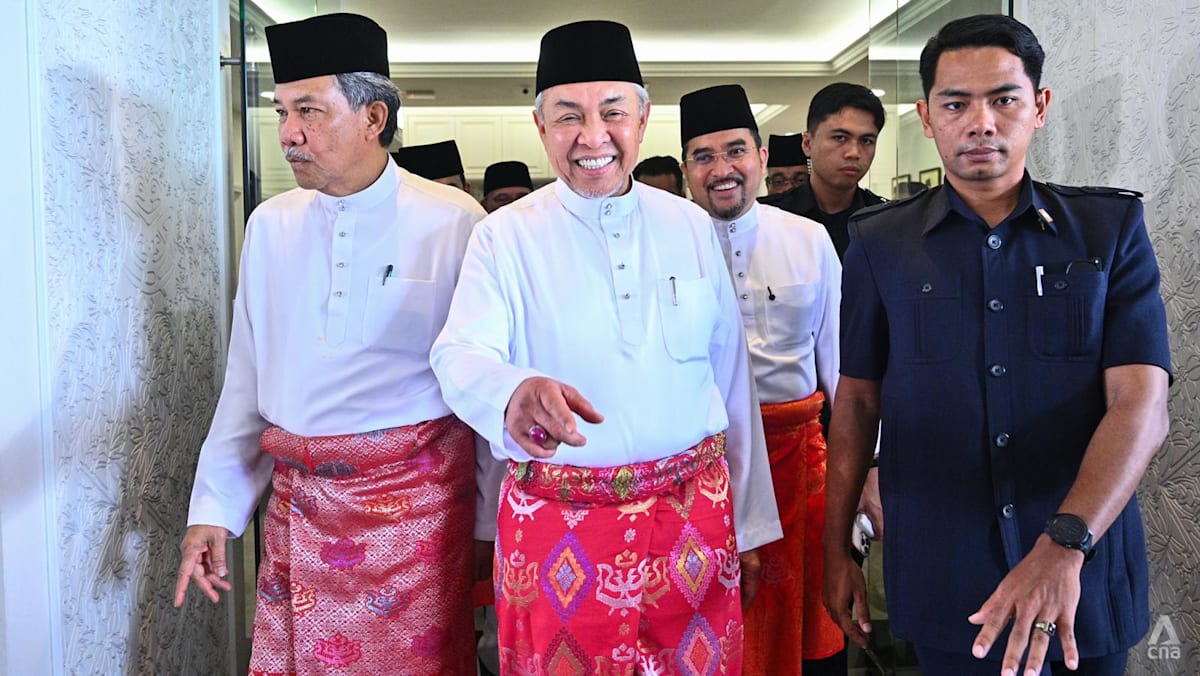
Is Malaysia’s BN gearing up for early state polls in Johor and Melaka with eye on GE?
Early elections in these two states would allow Barisan Nasional to drum up momentum and signal that the pact has regained strength ahead of the next general election, observers say.
JOHOR BAHRU: The United Malays National Organisation’s (UMNO) 80th anniversary celebration at Johor’s Istana Besar on Monday (May 11) was as much a show of political strength as it was a commemoration of history, reinforcing the southern state’s status as the party’s symbolic heartland.
Held at the palace where the erstwhile ruling party was founded, and attended by Malaysia’s King Sultan Ibrahim Iskandar and Johor Regent Tunku Ismail Ibrahim, the celebration took place against a backdrop of intensifying speculation that the party - a lynchpin of the Barisan Nasional (BN) coalition - is preparing for early state elections in Johor and Melaka.
If victorious in early state polls, it would allow UMNO-led BN to rebuild momentum independently of the federal unity government, positioning itself more strongly ahead of a general election due by early 2028, political analysts say.
The speculation gained traction after local reports suggested Johor UMNO leaders are pushing for polls as early as August or September, with party insiders indicating that the party’s recent supreme council meetings have increasingly centred on election readiness.
Johor’s state election is only due by mid-2027 while Melaka’s is due by early 2027.
Yet, on Monday, UMNO president Ahmad Zahid Hamidi was coy when reporters asked if state polls for Johor and Melaka were imminent.
“I hereby announce that the Johor state election will not be held tomorrow,” he joked.
“We met the king, but we did not speak about (state elections). There were many major national issues being discussed (during the supreme council meeting) but, in all seriousness, I would like to point out that this was just a normal meeting,” he said.
When pressed if Johor polls might be called together with Melaka’s, or before it, he said: “I will speak with the YAB chief minister (Johor Chief Minister Onn Hafiz Ghazi), after receiving blessing from the King (Johor ruler).”
It is the prerogative of the state’s ruler or governor to dissolve the state assemblies on the advice of the chief minister, who is typically from the state’s ruling party or coalition.
Despite Zahid’s comments, the sequencing of a supreme council meeting held in Melaka in mid-April, and subsequently in Johor, alongside mobilisation on the ground, has reinforced perceptions that preparations are underway.
An UMNO Johor state assemblyman, speaking on condition of anonymity, told CNA that party machinery has been quietly activated for a potential vote in the latter half of the year.
“We are not certain of the exact date, but preparations have started,” the assemblyman said.
“We’ve been told it is likely to be held some time after Hari Raya (Haji, in late May) - in the latter half of the year - but one way or the other, we are ready to reclaim Johor for UMNO,” the assemblyman added.
Political analysts said BN has a strong incentive to call early state polls rather than align them with the next general election, as lower turnout in standalone contests tend to favour the incumbent while putting its main rival, Pakatan Harapan (PH), at a disadvantage.
Although BN is aligned with PH at the federal level, they are rivals at the state level in Johor and Melaka.
Holding the elections sooner would also allow UMNO to exploit what observers describe as a period of softer support for PH, denying Prime Minister Anwar Ibrahim’s coalition a chance to regroup ahead of national polls due by February 2028.
However, opposition leaders and some analysts argue that decoupling state and federal elections would lead to unnecessary costs at a time when the country is under greater fiscal pressure due to the Middle East crisis.
BN EYES JOHOR, MELAKA AS SPRINGBOARD FOR GE
Former Democratic Action Party (DAP) lawmaker Ong Kian Ming, who is adjunct professor at Taylor’s University in Selangor, said early elections in Johor and Melaka would allow BN to translate state-level dominance into national momentum, particularly if it secures the two-thirds majorities widely expected by observers.
“BN wants to call a state election in Johor before the UMNO General Assembly in August 2026 because it knows that BN is strong in Johor, led by a popular chief minister,” said Ong, a former deputy minister of trade and industry.
“It wants to have the momentum of a strong showing in Johor to take into the UMNO General Assembly, where it will likely confirm that BN wants to go solo for GE16,” he added, referring to the next general election, Malaysia’s 16th.
Melaka could follow suit, said Ong.
DAP is a major component of PH, together with Anwar’s Parti Keadilan Rakyat and Parti Amanah Negara (Amanah). As for BN, besides UMNO, it is made up of smaller parties such as the Malaysian Chinese Association and the Malaysian Indian Congress.
BN’s confidence is underpinned by its commanding performances in the last standalone state polls. It won 21 of 28 seats in Melaka in 2021 and 40 of 56 seats in Johor in 2022. In contrast, PH secured just five and 12 seats respectively, noted Francis Hutchinson of Singapore’s ISEAS-Yusof Ishak Institute.
“BN did very well when these elections were held on their own, but PH has historically performed better when state and federal polls are held concurrently,” he said, pointing to PH’s breakthrough victories in Johor and Melaka during the 2018 general election, which was held concurrently with state elections.
Lower turnout in standalone state elections is a key factor, he said.
Johor, in particular, has a sizeable number of voters based in Singapore who are less likely to return home solely for state polls. This dynamic tends to hurt PH more than BN.
“PH needs higher turnout to perform well, whereas BN’s more disciplined machinery can reliably mobili