
Irrigation Water Overflows onto Road in Tabanan, Businesses Feel the Impact
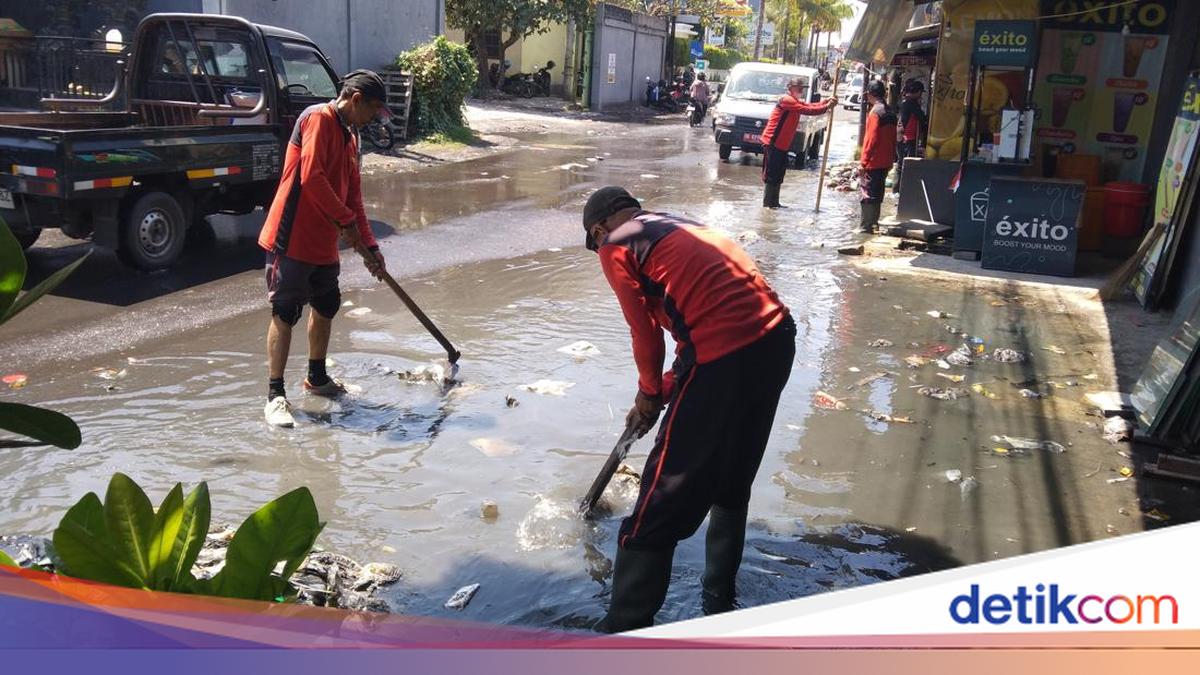
Water from the Subak Pala irrigation channel overflowed onto Jalan Jepun, Banjar Tegal Belodan, Dauh Peken Village, directly in front of Kasih Ibu Hospital in Tabanan. The overflowing irrigation water submerged both the carriageway and the road shoulder.
Observations at the scene on Tuesday afternoon (15/9/2026) showed the water spreading south as far as the shoulder of Jalan Bypass Ir Soekarno. Officers from the Tabanan Public Works and Spatial Planning Agency (PUPR) were busy clearing the blocked channel.
The overflowing irrigation water has not only disrupted traffic but has also begun to affect the activities of several businesses along the route. One business owner, Kadek Rupana, acknowledged as much.
Rupana said the water first appeared about five days ago and suddenly surged until it spilled onto the road. The situation has had a noticeable impact on his business, Maharupa Photo and Wedding Studio.
“The water appeared five days ago, then it suddenly grew large. It overflowed onto the road until night. It receded at dawn, from around 5am to 9am, then rose again at around 10am,” Rupana said.
According to Rupana, accumulated waste is one of the reasons the water cannot flow properly. The rubbish is dominated by plastic, nappies and various forms of household waste.
Customers intending to visit Maharupa Photo and Wedding Studio have become reluctant to stop by. Several other businesses along the watercourse have also been affected.
“Overall, many customers are reluctant to come down or stop by because water is spilling over near many businesses along the flow. There is also mud on the road shoulder,” Rupana explained.
Rupana has even had to explain the situation to customers regarding conditions around his business premises. However, the customers’ biggest complaint is the foul smell emanating from the standing water.
“I have to explain to customers that there is overflowing water. Although my business is mostly online, when customers do come they are disturbed by the putrid smell,” he said.
Rupana hopes the government will promptly revitalise the channel. According to him, the waterway is full of silt, increasingly restricting its flow capacity. Rupana also suggested that barriers or nets be installed at certain points to catch rubbish so that it does not continue to enter and block the flow.
Similar complaints have been voiced by Willy, a doughnut seller who only opened his shop in July 2026. He said the flooding has affected both walk-in customers and buyers using online services.
“Because it is a food business, there is an impression that it is dirty and unhygienic. There has been no significant drop in buyers, but that is the complaint I often receive, both from online comments and from those who buy directly,” Willy said.
Willy revealed that a similar situation had occurred last August. At that time, he said, conditions were far worse because various types of rubbish were carried by the water into his business’s car park.
“I only opened the shop in July, and the first time I was hit was last August. It was worse then, and all sorts of waste ended up in the business’s parking area,” Willy said.
Nevertheless, production and sales activities have continued. However, when the water overflows, production at the site is reduced. To meet demand, he shifts some production to his other outlets.
“We keep producing and selling. It is just that when the water spills over, production here is reduced. As it happens, I have several outlets, so I increase production at the others,” Willy explained.
Amid the problem, Willy believes waste management cannot be placed entirely on the government’s shoulders. He is convinced that the rubbish blocking the channel comes mostly from people’s behaviour.
“This waste is not a polemic or the government’s business. I know this waste comes from residents. It is not only the government’s task; the public must also be aware of protecting the environment,” he asserted.
The Head of Dauh Peken Village, I Komang Sana Yasa, revealed that the flooding has been occurring for about five days, with water spilling onto the road only over the past two days. In addition to the high water volume, accumulated rubbish is the main problem causing the blockage.
“In truth, this happens because public awareness of environmental management has not yet taken root. People are still careless about throwing rubbish into rivers,” Sana Yasa said.
Sana Yasa said this is not the first time the water has overflowed. The channel has reportedly been blocked by rubbish several times, even before the rainy season arrives.
“The water has often overflowed because the channel is clogged with waste. It is like this even outside the rainy season, let alone during it,” Sana Yasa explained.
In fact, the Dauh Peken village government has repeatedly coordinated and carried out clean-ups with various parties, including engaging the private sector.
Education efforts through traditional villages and between banjar have also been carried out. The public has been repeatedly reminded that rivers and irrigation channels are not places to dump rubbish.
“If people are not aware, this is the result. It is the public, business owners and road users who suffer. It also causes a foul smell,” Sana Yasa said.
Sana Yasa hopes the normalisation of the channel can be carried out soon. He said the normalisation of the irrigation channel has been included in the Tabanan PUPR Agency’s plans for this year.
He also believes supervision must be carried out jointly, involving traditional leaders (prajuru adat), the government and community figures.
Regarding sanctions for those who dispose of rubbish carelessly, Sana Yasa said regulations are already in place, both through regional regulations and the traditional village. However, he considers sanctions not to be the main solution; public awareness is deemed far more important to stop the habit of dumping rubbish into waterways.
“We really should not have to talk about sanctions. If we are aware, why would sanctions need to be enforced? Sanctions already exist in regional regulations, and the traditional village has issued its perarem. But again, it is not sanctions that should be the last weapon to reduce waste, but rather awareness itself,” Sana Yasa explained.
Source: jawawa.id (https://jawawa.id/newsitem/irrigation-water-overflows-onto-road-in-tabanan-businesses-feel-the-impact-1789476758)
Originally published by detikBali (https://www.detik.com/bali/berita/d-8664363/air-irigasi-di-tabanan-meluap-ke-jalan-pelaku-usaha-kena-dampak), translated from Indonesian