
IRGC's Strength Exposed: Iran's Missiles and Mines Keep the US on High Alert
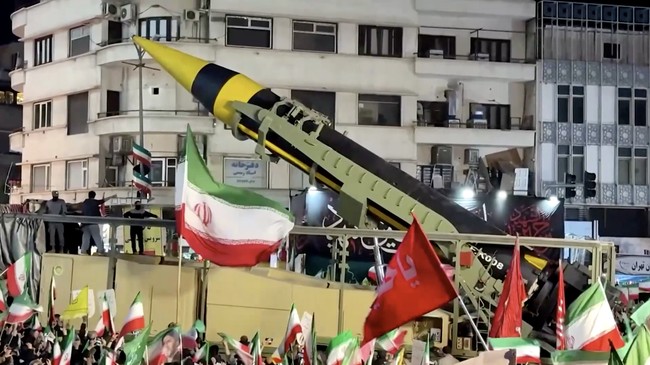
The Islamic Revolutionary Guard Corps (IRGC) warrants close attention after the war against the United States (US) and Israel shook Tehran. The IRGC is not merely an ordinary military force; it has become one of the most influential powers in Iran, playing a major role in defence, missile and drone programmes, overseas operations, and the country’s political direction. Scrutiny of the IRGC has intensified after General Ahmad Vahidi, the head of the Revolutionary Guard, reappeared in public ahead of the funeral of the late Supreme Leader of Iran, Ali Khamenei. Vahidi was seen attending a preparatory meeting for Khamenei’s funeral and sitting near his coffin in a small procession in Tehran. This was the first time Vahidi had been caught on camera in public since his last appearance on 8 February 2026, several weeks before the war broke out at the end of February. He is now said to be one of the key figures formulating Iran’s hardline stance in negotiations to permanently end the war with the US and Israel. Vahidi is also believed to be within a small circle that communicates directly with Iran’s new Supreme Leader, Mojtaba Khamenei. Mojtaba himself has not appeared in public after reportedly being injured in the US-Israeli attack at the start of the war that killed his father, Ali Khamenei. The Revolutionary Guard helps determine Tehran’s position in negotiations, while also serving as the backbone of Iran’s defence should conflict erupt again. The question then is, how strong is the IRGC after Iran was hit by thousands of US and Israeli attacks? Many missile and drone facilities, air defence systems, command centres, coastal radars, ports, and military bases were reportedly targeted. However, the IRGC is far from defeated. Its most difficult-to-destroy strength lies in its asymmetric network, including underground missiles, cheap drones, small boats, fast boats, sea mines, mini-submarines, and a dispersed command system. With these assets, the IRGC can still keep the US position in the Gulf region on high alert. The following is an overview of the IRGC’s military capabilities that form the backbone of Iran’s defence. 1. Naval Strength The IRGC’s strength is quite formidable at sea. The Strait of Hormuz is the most critical point as this waterway is one of the lifelines of the global energy trade. The IRGC Navy is Iran’s spearhead in this area. Unlike a conventional navy that relies on large ships, the IRGC predominantly uses small, high-speed boats, sea mines, mini-submarines, and coastal missiles. One of the biggest threats is sea mines. According to several sources, Iran is said to have a stockpile of sea mines ranging from 5,000 to 6,000 units. These mines do not need to completely seal off the Strait of Hormuz. Simply creating the suspicion of mines can slow merchant ships, causing insurance costs to rise, and ultimately forcing the US to deploy a time-consuming mine-clearing operation. The IRGC is also known for its fast attack craft tactics. These small boats can carry rockets, heavy machine guns, torpedoes, and light anti-ship missiles. Their function is not for open duels against US destroyers, but to harass, swarm, and force enemy warships into a defensive posture. Under the sea, Iran possesses Kilo-class or Tareq-class submarines equipped with 533-millimetre torpedo tubes capable of carrying heavy torpedoes and mines. Additionally, mini-submarines like the Ghadir and Nahang are more suited to shallow waters such as the Persian Gulf. These types of vessels can be used for close-range ambushes, special operations, and mine-laying. 2. Missile and Drone Strength The second layer of IRGC strength lies in its missiles and drones. This is the most robust part of Iran’s strategy because they are relatively cheap, can be dispersed across many points, and launched from mobile launchers. Iran possesses anti-ship cruise missiles such as the Noor and Qader. The Qader missile is reported to have a range of around 200 to 300 kilometres with a warhead of about 200 kilogrammes. This type of missile flies low over the sea surface, thus shortening the response time for enemy ships. Iran has also developed long-range anti-ship missiles like the Ghadr-380, which is claimed to have a range of up to approximately 1,000 kilometres. If this capability proves effective in a real war, US warships outside the Strait of Hormuz would still have to account for threats from the Iranian coast. In addition to cruise missiles, Iran also has anti-ship ballistic missiles such as the Khalij Fars. This missile is derived from the Fateh-110 family and is estimated to have a range of around 300 kilometres. The system is designed to attack ships from a high angle at high speed, making the opponent’s response time extremely short. There is also the Hormuz-2, described as a radar-homing or anti-radiation missile with a range of around 300 kilometres. This missile is intended to hunt warships or radars emitting signals. This equipment means opposing ships not only face physical threats but must also calculate the risks of using their radar and electronic systems. Drones are a vital complement to Iran’s missile strength. One-way attack drones like the Shahed model can be used in large numbers at a relatively low cost. Meanwhile, reconnaissance drones assist Iran in tracking ship movements and providing targeting data for subsequent Iranian missile strikes. 3. Air Defence, Radar, and Command The third layer is air defence, radar, and command systems. This component is crucial because, in a war, the US would likely first target Iran’s radars, missile bases, air defence systems, and command centres. Iran possesses long-range air defence systems such as the Russian-made S-300PMU2 and the domestically produced Bavar-373. The Bavar-373 is said to be