
Iran's Post-Khamenei Consolidation and the Revolutionary Security State
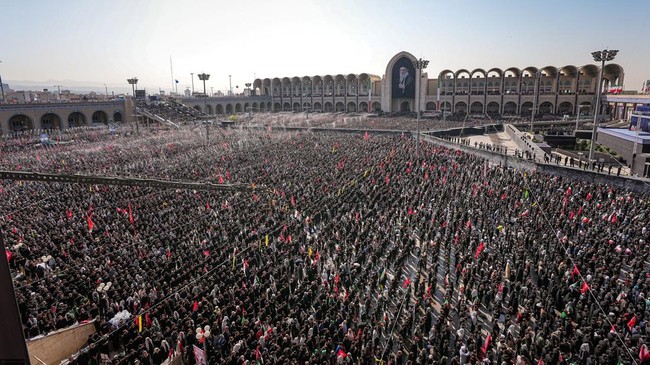
Information regarding the condition and the ‘approaching funeral’ of Ayatollah Ali Khamenei is spreading rapidly, mixed with official state reports, war propaganda, political rumours, and digital disinformation. In the context of open conflict between Iran, Israel, and the United States, the line between fact, psychological operations, and geopolitical propaganda is becoming increasingly blurred.
Nevertheless, from various international media reports, several relatively consistent patterns emerge: Iran is preparing a massive state funeral with a multi-day procession involving Tehran, Qom, Najaf, Karbala, and Mashhad. International media reports suggest the funeral procession is expected to last six days, attended by millions of Iranians, featuring extreme security and strong Shia symbolism.
The Iranian government appears to be attempting to make this funeral not merely a religious ceremony, but a demonstration of national unity amidst geopolitical pressure and domestic instability. In this context, the funeral of Ayatollah Ali Khamenei cannot be understood as an ordinary ceremony, but rather as a ritual of regime transition.
This is due to Khamenei’s position within the system of the Islamic Republic of Iran, which far exceeds the status of a head of state. Since succeeding Ayatollah Ruhollah Khomeini in 1989, Khamenei has become a symbol of the 1979 Islamic Revolution, the guardian of the doctrine of Wilayat al-Faqih, a mediator between elite factions, and a unifying figure between the clergy, the military, the state, and the Islamic Revolutionary Guard Corps (IRGC). Consequently, his death creates a massive vacuum that is not only administrative but also ideological and psychological.
Most international reports in 2026 suggest that Khamenei passed away due to a joint attack by the United States and Israel on his residence in Tehran. Although the detailed chronology is still debated, the primary narrative constructed by Iran is that Khamlamenei fell as a ‘revolutionary martyr’.
This is where the funeral plays a vital political function: framing the death of the Supreme Leader not as a strategic defeat, but as a sacred sacrifice in the struggle against Western imperialism and Zionism.
This situation is complicated by the emergence of Mojtaba Khamenei as a central figure in speculation regarding Iran’s political succession. Mojtaba, who has long been known to be very closed off from the public, is rumoured to be a candidate to succeed the leadership of the Islamic Republic.
However, reports regarding his health condition, potential injuries from attacks, and his absence from public processions have created a significant information crisis. International media have even reported concerns regarding Israeli intelligence threats should Mojtaba appear in public spaces.
This information crisis demonstrates that Iran is currently in a fragile transition phase. It remains unclear who fully controls the state, how internal elite dynamics are unfolding, and the extent to which the IRGC is taking over the centre of strategic decision-making. In such conditions, the massive funeral serves as an instrument for political stabilisation and the production of new legitimacy.
Therefore, the funeral procession for Khamenei is not merely an honour to a cleric or a head of state. It is a symbolic mechanism to maintain the continuity of the Islamic Republic amidst threats of legitimacy crises, regional conflict, and uncertainty in the succession of power.
From the Islamic Republic towards a Revolutionary Security State
Khamenei’s death is accelerating Iran’s transformation towards a model of state increasingly oriented towards national security and militarism. Many Middle East analysts observe that post-Khamenei Iran is moving from the format of a ‘Revolutionary Islamic Republic’ towards a ‘Revolutionary Security State’ that is more centralised, more militaristic, and increasingly controlled by security apparatuses and the IRGC.
In the era of Khomeini and Khamenei, state legitimacy was primarily built through a combination of Islamic revolutionary ideology, anti-Western populism, and the religious authority of the clergy. The state maintained its identity as the protector of the oppressed and the promoter of the export of the Islamic revolution. However, recent geopolitical dynamics are driving a major shift in the state’s orientation.
Following the major Iran-Israel-US conflict, Iran’s security paradigm has changed drastically. Threats are no longer viewed as episodic conflicts, but as long-term existential wars. As a result, all elements of the state are being directed towards geopolitical survival: the economy, media, education, religion, and even information technology are being integrated into the national resilience strategy.
It is in this context that the IRGC is gaining an increasingly dominant position. While the clergy were previously the primary actors in maintaining revolutionary ideology, the security and military elites are now becoming the new centre of gravity for the state. The IRGC is not merely a defence institution, but an economic, political, intelligence, technological, and regional power. They control proxy militia networks, the missile industry, cyber operations, and strategic economic projects.
Consequently, state ideology is also undergoing a transformation. While the Islamic revolution was once the centre of legitimacy, national security and state resilience are now the primary priorities. Religion continues to be used, but more as a source of psychological legitimacy to justify total security mobilisation.
The cross-city funeral procession through Iran and Iraq plays an important role in this change. The procession through Tehran, Qom, Najaf, Karbala, and Mashhad is not just a religious ritual, but a national psychological mobilisation. The state uses Shia symbolism to create mass loyalty and build a ‘new revolutionary memory’ for the Iranian people.
Within this framework, the narrative of Khamenei’s martyrdom serves as a vital foundation for Iran’s new ideology.