
Iran's Late Supreme Leader Khamenei Once Cited Sukarno's Bandung Speech to Advocate Unity
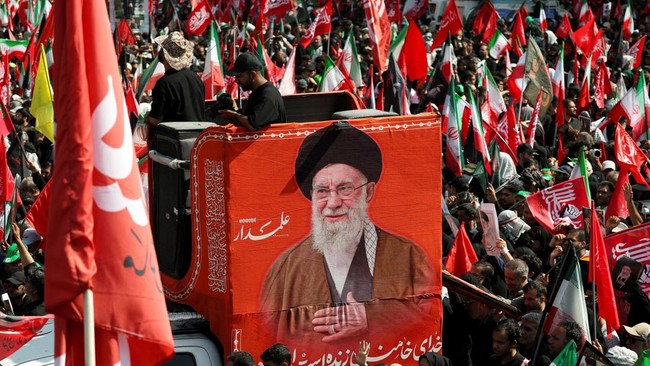
The late Supreme Leader of Iran, Ayatollah Ali Khamenei, once quoted a speech by Indonesia’s first president, Sukarno, to explain the importance of unity amidst religious and ideological differences. The story was revealed in the memoir ‘Cell No. 14’ (2021), which recounts Khamenei’s experiences as a political prisoner during the era of Shah Mohammad Reza Pahlavi’s government in the 1970s. In the memoir, Khamenei recounted sharing a cell with several prisoners, including a young man who later turned out to be a journalist with ties to the Tudeh Communist Party. According to Khamenei, the young man was very quiet and always avoided talking about himself. ‘I asked about him, but he never answered clearly and preferred to talk about trivial matters,’ Khamenei recalled. Khamenei then observed the young man’s mental state becoming increasingly depressed after his arrest. He rarely ate and appeared to have lost his spirit. Seeing this condition, Khamenei tried to help him, even spoon-feeding him on several occasions to get him to eat. Some time later, the young man finally revealed the reason he had always kept his distance. He admitted he was worried Khamenei would invite him to join an Islamic organisation. If the Islamic movement succeeded in establishing a republic, he felt he would face problems because he did not believe in religion. ‘Let me be honest, I do not believe in any religion,’ the young man said. Upon hearing this confession, Khamenei did not take issue with the difference in beliefs. Instead, he stressed that people facing the same difficulties should still be able to unite. To explain his view, Khamenei then quoted a speech by Indonesia’s first president, Sukarno, at the 1955 Asia-Africa Conference in Bandung. ‘Do you know that President Sukarno of Indonesia once said at the Bandung Conference that the basis for unity among developing nations is not shared religion, history, or culture, but a ’unity of needs’,’ Khamenei wrote in his memoir. According to Khamenei, Sukarno’s thinking also described the situation of political prisoners in the jail. Despite having different religious backgrounds, ideologies, and political views, they all faced oppression from the Shah’s regime. ‘It is that kind of unity that connects us now. The problems we face are the same, and our fate is uncertain. Religion should not be a separating factor among us,’ he continued. The answer surprised the young communist. He had not expected a cleric to quote Sukarno’s speech to explain the importance of unity. From that moment on, their relationship became closer. Several years later, Khamenei became one of the key figures in the Iranian Revolution that overthrew the government of Shah Mohammad Reza Pahlavi in 1979. He served as the Supreme Leader of Iran from 1989 until his passing this year.