
Iran's Kheibar Shekan Missile Breaches US Air Defences
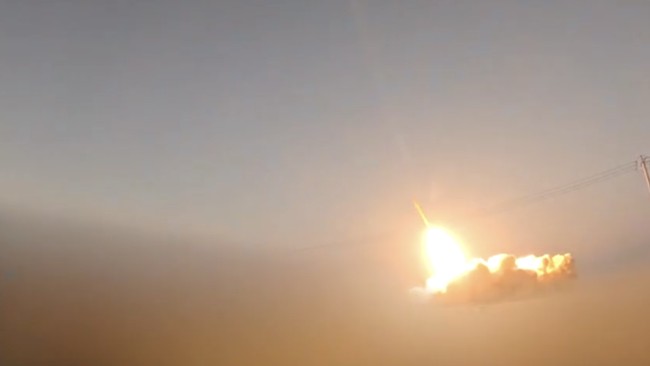
Jakarta, CNBC Indonesia – Iran has adapted its military tactics by using the Kheibar Shekan ballistic missile to strike American military bases across the Middle East. The approach has succeeded in penetrating US air defence systems through changes in flight paths, speed and mid-air manoeuvres.
Citing a Newsweek report drawing on The Wall Street Journal, on Sunday (26/7/2026), the tactical adjustments came amid waves of Iranian missile attacks targeting US facilities in at least five Middle Eastern countries since early July. The barrage tested a fragile ceasefire achieved in June, before both sides ultimately decided to temporarily halt their attacks.
President Donald Trump said on Friday that the United States remains open to negotiations whilst keeping alive the possibility of resuming military strikes. Both the United States and the Iranian military confirmed that air attacks had been suspended for two consecutive days as of Sunday.
Tehran’s latest escalation followed a strike on the Muwaffaq Salti air base in Jordan that killed three US service members: First Lieutenant Tyler James Feehan, Private Isabella Gonzales and Sergeant Angel Rampersad. Another American soldier, Sergeant Michael Emmanuel Swinton, was killed in a drone explosion at Erbil air base in Iraq, bringing the total number of US personnel killed in the conflict to 18.
“In recent weeks, Iran has also targeted US military facilities in Kuwait, Bahrain and Qatar,” the report stated, confirming the geographical spread of Iran’s attacks.
The Specifications and Advantages of the Kheibar Shekan Missile
The Kheibar Shekan medium-range ballistic missile was first unveiled by Iran in 2022, with an estimated range of 900 miles (approximately 1,448 km). This distance places the entire Middle East, parts of Russia, India, and NATO members such as Turkey within its firing range.
The weapon is launched from a mobile ground-based launcher and uses solid fuel. The use of solid fuel significantly cuts preparation and launch times compared with liquid-fuel systems, while narrowing the window for enemy forces to target the launch site.
“The missile’s name is taken from the Battle of Khaybar in 628 AD, the military campaign by the forces of the Prophet Muhammad that conquered the oasis fortress of Khaybar,” The Wall Street Journal report explained regarding the origin of its name.
Lighter in weight than its predecessor in order to maximise range, the Kheibar Shekan complements Iran’s other solid-fuel systems such as the Zolfaghar and the Fattah-1. The Fattah-1 has been claimed by Iranian state media to be a hypersonic weapon capable of travelling at more than five times the speed of sound.
Why the Kheibar Shekan Has Captured the World’s Attention
US officials revealed that Iran has integrated the Kheibar Shekan missile with jet-engine drones, reflecting a genuine evolution in Tehran’s tactical strategy. Although exact cost figures have not been published, the missile is considered far cheaper than the interceptor missiles used by the United States and its allies, which cost between several million dollars and US$15 million (Rp270 billion) per unit.
Defence analysts noted that the continual expenditure of high-grade interceptor missile stocks to counter low-cost projectiles poses a long-term sustainability challenge for the United States. Nicole Grajewski, an Iran strategy expert at Sciences Po Paris, confirmed the missile’s flexibility and cost-effectiveness.
“The Iranians realised during the war that the Kheibar Shekan is extraordinarily effective because it is cheap enough to produce, flexible in its launch systems, and highly effective,” said Grajewski.
Meanwhile, Ukrainian President Volodymyr Zelensky claimed on Saturday that Russia has used its satellites to conduct reconnaissance of US bases in the Gulf region and shared that intelligence data with Iran. Zelensky said Russian satellites monitored air bases in Bahrain, Jordan and Kuwait between 19 and 20 July.
The Effectiveness of Air Defence Systems Against Missile Barrages
Although US and allied forces have intercepted most of the Kheibar Shekan missiles launched since the conflict erupted on 28 February, several projectiles have successfully penetrated defence systems. Independent missile expert Fabian Hinz assessed that each combat use provides Iran with valuable data on the most effective manoeuvres to breach air defences.
Ballistic missiles are generally harder to intercept than other threats such as cruise missiles, because their trajectories are less predictable and they fly far higher and faster. The re-entry vehicle of the Kheibar Shekan — which carries the warhead back into the atmosphere in the final phase of flight — can manoeuvre to evade air defence systems.
Beyond its manoeuvrability, the success of Iran’s air attacks has often been achieved by overwhelming air defence systems with very large numbers of projectiles. This tactic is used to confuse radar before launching higher-quality missiles.
“Iran uses simple missiles to divert the radar’s attention. They then fire better-quality missiles that change their final target in the last 30 or 40 kilometres,” explained retired Lieutenant General Qasid Mahmoud, former Deputy Chief of Staff of the Jordanian military.
Source: jawawa.id (https://jawawa.id/newsitem/irans-kheibar-shekan-missile-breaches-us-air-defences-1785232400)
Originally published by CNBC Indonesia (https://www.cnbcindonesia.com/news/20260728124505-4-754381/rudal-kheibar-shekan-iran-jadi-sorotan-bobol-pertahanan-udara-as), translated from Indonesian