
Iran's Foreign Minister Confides in Putin, Exposes Trump's Major Failure in War
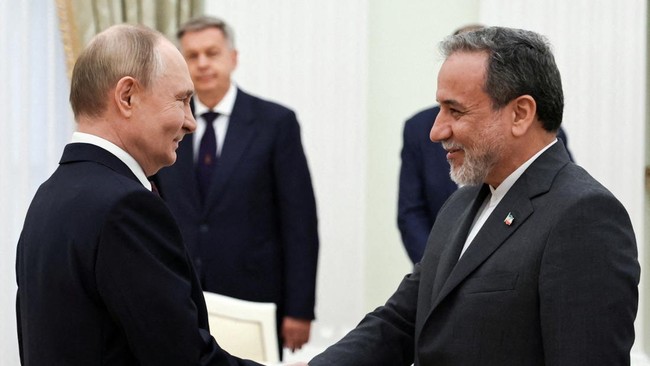
Iran’s Foreign Minister, Abbas Araghchi, launched strong accusations against the United States for the failure of Middle East peace negotiations during his diplomatic visit to Russia on Monday (28/04/2026). Amid the deadlock, Russian President Vladimir Putin promised Moscow’s full support to help end the raging warfare.
Araghchi’s visit to Saint Petersburg was part of a lightning diplomatic tour following stops in Oman and Pakistan. Pakistan has acted as the main mediator in the conflict and facilitated the first round of talks between the US and Iran, which ended without results.
Hopes for continuing negotiations briefly emerged over the weekend but vanished after US President Donald Trump cancelled plans to send his envoys, Steve Witkoff and Jared Kushner. Citing AFP, Araghchi described Washington’s stance as the main obstacle to previous progress.
“The US approach caused the previous round of negotiations, despite progress, to fail to achieve its goals due to excessive demands,” Araghchi stated.
On the other hand, President Trump stated via Fox News that the cancellation was not a signal of returning hostilities. He emphasised that Iran could contact him anytime if they were serious about dialogue. However, Iran demands more concrete security guarantees before reciprocating commitments.
Iran’s UN envoy, Amir Saeid Iravani, conveyed his country’s position at a UN Security Council session. He stressed that regional stability could only be achieved with a permanent halt to aggression against his nation.
“Lasting stability and security in the Persian Gulf and the broader region can only be achieved through a durable and permanent cessation of aggression against Iran, complemented by credible guarantees that it will not recur,” Iravani asserted firmly.
Tehran’s Economy at Rock Bottom
Although Araghchi boasted of Iran’s stability and strength during his Russia visit, conditions inside Tehran painted a contrasting picture. Field reports indicate that civilians are beginning to feel the impact of economic destruction due to war and blockades.
A small business owner in Tehran named Farshad shared his grievances with an AFP journalist. He described the country’s situation as one of total uncertainty.
“Everything in this country is hanging in the balance right now. I haven’t worked in a long time. The country is in total economic collapse,” Farshad revealed bitterly.
A similar situation is faced by Shervin, a 42-year-old photographer. He admitted to experiencing severe financial difficulties for the first time, to the point of being unable to meet basic obligations.
“This is the first time I’ve reached a point where I’m late on rent. I still don’t have any projects,” Shervin explained his hardships.
Global Trade Route Dispute
Tensions are escalating over Iran’s plan to unilaterally manage the Strait of Hormuz. Tehran reportedly sent a written message to Washington via Pakistan regarding their “red lines,” including nuclear issues and operations in the strategic strait.
Ebrahim Azizi, chairman of Iran’s parliamentary national security commission, stated that his side is proposing a new law. This regulation would grant full authority to Iran’s armed forces to oversee the strait and impose toll fees payable in Iranian Rials.
However, the proposal was flatly rejected by US Secretary of State Marco Rubio. In a Fox News interview, Rubio affirmed that the US would not allow Iran to illegally control international waterways.
“They cannot normalise—and we cannot tolerate them trying to normalise—a system where Iranians decide who can use international waterways and how much you have to pay them to use them,” Rubio stated firmly.
Escalation on the Lebanon Front
While high-level diplomacy hits a dead end, violence continues in southern Lebanon. Lebanon’s Health Ministry reported that Israeli strikes killed four people and injured 51 others, including three children, despite a recent extension of the ceasefire with Hezbollah.
Hezbollah leader Naim Qassem expressed a hardline stance by rejecting any direct negotiations between Lebanon and Israel. He called such efforts a grave mistake and vowed not to retreat from the battlefield.
In response, Israeli Defence Minister Israel Katz issued a stern warning to Qassem. Katz assessed Hezbollah’s actions as only inviting larger retaliatory strikes from the Israeli military.
“Qassem is playing with fire,” Katz warned.
In agreement, Israel’s Army Chief of Staff Eyal Zamir predicted that the conflict situation would not subside anytime soon. He hinted that Israel’s military readiness would continue to be tested into next year.
“2026 is likely to be another year of combat for Israel on all fronts,” Zamir concluded.