
Iranian Rial Weakens Further as Dollar Surges to 2.69 Million Rial
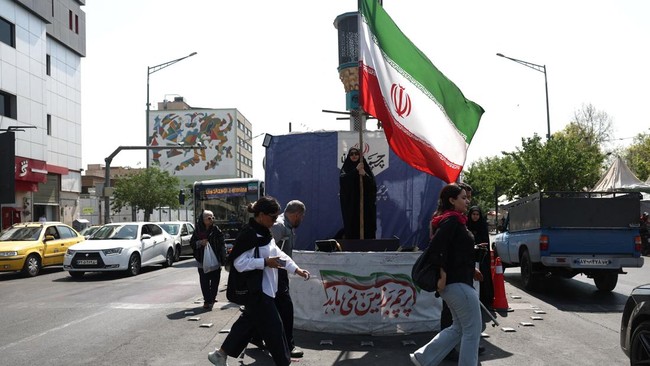
The Iranian rial has once again hit a record low in the free market. Economic pressure is also evident from the widening gap between dollar prices in Refinitiv quotations and the free market, illustrating the complexity of the country’s foreign exchange system.
Quoting Reuters on Sunday (4/10/2026), the dollar price in the free market, according to the currency monitor Bonbast, reached approximately 2,688,000 rial on Saturday (3/10/2026), up from 2,632,000 rial the previous day. This means the price of one dollar increased by 56,000 rial in a single day. Another monitor, Alanchand, even recorded a price of 2,695,000 rial per dollar.
Refinitiv data also shows pressure. On 3 October 2026, the closing US dollar bid quotation was recorded at 1,747,044 rial per US$. This figure increased from 1,374,100 rial on 31 August 2026. Consequently, the dollar price in this series rose by approximately 27.14%, equivalent to a 21.35% depreciation of the rial against the dollar.
Historical data spanning one year, from 3 October 2025 to 3 October 2026, also shows massive fluctuations. However, annual performance readings require caution due to a surge from 42,000 rial on 1 January to 762,100 rial per dollar on 2 January 2026. Such a spike cannot be immediately interpreted as a single-day currency collapse; the continuity of recording benchmarks must be confirmed before using the start and end figures of the period to calculate annual depreciation. Nevertheless, recent movements show that the amount of rial required to obtain one dollar continues to rise in these quotations.
Iran’s foreign exchange issues become increasingly complex when comparing Refinitiv figures with free market prices. The dollar price based on Bonbast is approximately 940,956 rilar, or 53.86%, higher than the Refinitiv quotation. This comparison is indicative, as bid quotations and free market selling prices may not share the same transaction basis.
This discrepancy does not automatically mean one source is incorrect. The Japan External Trade Organization (JETRO) explains that Iran maintains several exchange rates for trade, remittances, and foreign exchange. The applicable rate depends on the type of transaction and its specific terms. Therefore, the lower exchange rate may not represent the price accessible to the general public. Available Refinitiv data also does not clarify market categories, making it impossible to label it strictly as an official or subsidised rate. This price gap demonstrates why Iran’s currency condition cannot be understood through a single figure; transaction routes and access to foreign exchange determine how much rial must be spent to acquire dollars.
Pressure is spreading to households and businesses. Reuters reports that the rial has lost more than half its value within a year. Inflation exceeding 70% is driving up the costs of basic necessities and rent, while US sanctions and maritime blockades are weighing on oil exports. Many citizens have turned to buying dollars, other strong currencies, or gold to protect their savings.
Economically, the rising dollar price can increase the cost of imports in local currency. If these costs are passed on to retail prices, the pressure on public purchasing power could intensify. For businesses, the exchange rate disparity also creates uncertainty. The cost of obtaining raw materials or imported goods depends on the foreign exchange purchase channels available to them, rather than just the rate appearing on a screen.
Thus, the dollar price gap is not sole evidence that Iran’s entire economic system has collapsed. However, coupled with inflationary pressures and currency depreciation, the situation depicts the severity of the challenges faced by the public and the business community.
To support the rial, the central bank has announced an intervention of up to US$2 billion. State television reported that state-owned banks have begun selling dollars. Mehdi Darabi, deputy governor of the central bank for foreign exchange, blamed part of the weakness on US officials’ predictions regarding an Iranian economic collapse. He stated that the current rial decline is temporary.
Increasing the dollar supply may help alleviate short-term pressure. However, sustainable stabilisation will depend on the ability to improve foreign exchange supplies and restore confidence in the rial. Iran’s challenge is ultimately not just halting the rise in the dollar price, but also addressing the need to reduce uncertainty in foreign exchange access, so that the public and businesses have a clearer benchmark for transactions.
Source: jawawa.id (https://jawawa.id/newsitem/iranian-rial-weakens-further-as-dollar-surges-to-2-69-million-rial-1791114706)
Originally published by CNBC Indonesia (https://www.cnbcindonesia.com/research/20261004104926-128-773129/rial-iran-kian-tak-berdaya-dolar-tembus-269-juta-rial), translated from Indonesian