
Iranian President Asserts Distrust of US, Views Hormuz Blockade as Justified Response
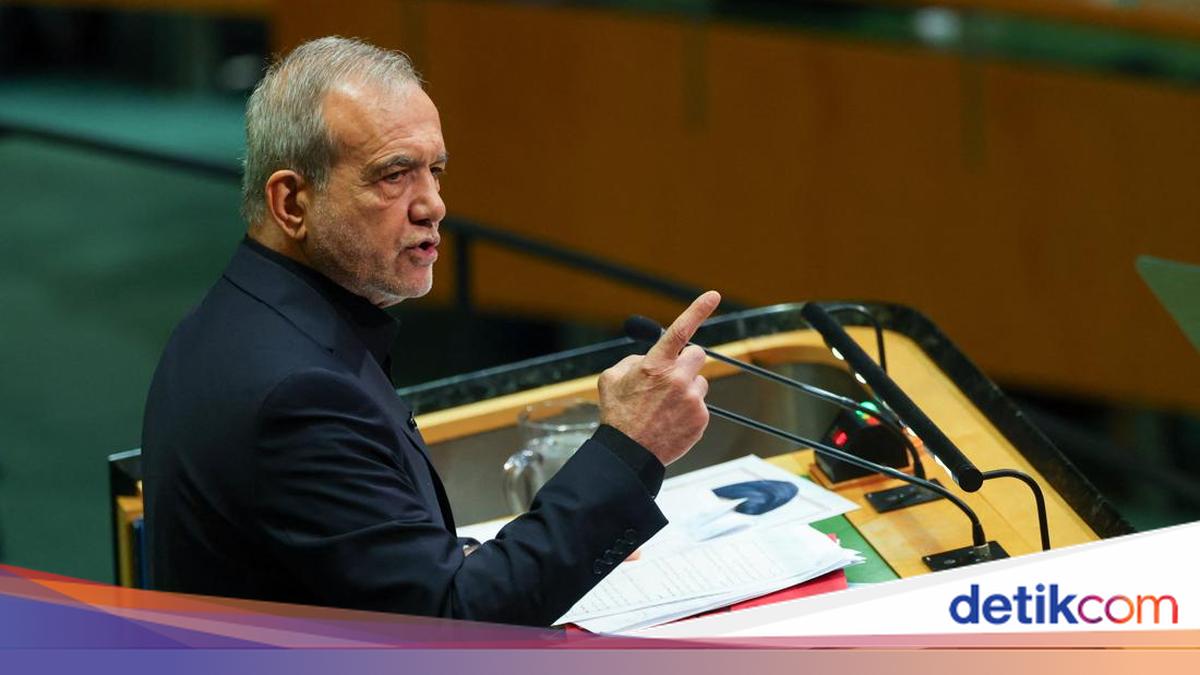
Iranian President Masoud Peheshkian has stated that his country no longer trusts negotiations with the United States, following previous rounds of talks that were followed by attacks and sanctions. Tehran is now awaiting a response to its latest proposal to end the war.
“We have no trust in the American side and do not know on what basis an understanding can be reached with them,” Pezeshkian said, as reported by Al-Jazeera on Sunday (27/9/2026).
Pezeshkian and Iranian Foreign Minister Abbas Araghchi visited the US this week to attend a meeting of world leaders at the United Nations (UN). Iran has proposed a deal that would end the fighting in the war initiated by the US and Israel and reopen the Strait of Hormuz within seven days.
Araghchi told reporters on Friday that initial steps would take four to five days, the Strait of Hormuz would be reopened on the sixth day, and “on the seventh day, talks with the US will begin for a final agreement on mutually agreed topics,” referring to Iran’s nuclear programme.
Under the plan, Washington would lift its naval blockade of Iranian ports, suspend sanctions on Iranian oil sales, unfreeze approximately $12 billion in Iranian assets, and adhere to a ceasefire covering the region, including Lebanon and Yemen. In return, Iran would reopen the Strait of Hormut—a route used for one-fifth of the world’s oil and gas trade before the war and which has now become Tehran’s primary leverage.
Returning to Pezeshkian, he told Al Jazeera that mediators, namely Qatar and Pakistan, are conveying Iran’s messages to Washington. He stated that the negotiations are based on a previous Memorandum of Understanding (MoU) reached by both parties in June, and the US must clarify its position regarding the agreement.
The war began in late February when the US and Israel launched attacks against Iran, which resulted in the death of Iran’s then-Supreme Leader, Ayatollah Ali Khamenei. Pezeshkian also denied that Iran was responsible for the blockade of the Strait of Hormuz, stating that it was the US that had “closed that route to us.”
He described the closure as a “justified response when access routes to Iran are severed.” He stated that the crisis could be resolved through negotiation rather than violence, and that the waterway would be reopened for commercial shipping if negotiations successfully end the war.
Pezeshkian labelled the US as the aggressor in this conflict, stating that Iran “has never attacked any country in the last 200 years.”
He claimed that the US and Israel have dragged regional nations into war with the belief that the Iranian system “would collapse in a matter of days.” However, he noted that Iran has proven to be resilient.
“We have withstood the attacks of America and Israel, and we will continue to stand firm,” he said, adding that the assassination of Iranian commanders and economic pressure have not caused the Iranian people to retreat.
He stated that Israel and the US have attacked Iran from the airspace of other Islamic nations, and that Iran has targeted bases used by US forces in the region because operations against Iran were launched from there. He asserted that Tehran demands nothing beyond international law and only reacts when other parties violate the rules.
Pezeshkian linked the imposition of sanctions on Iran to the tactics used by Israel in its genocidal war against the Palestinian people in Gaza.
“Those who are preventing the Iranian people from accessing medicines and raw materials are the same people who are cutting off the supply of food and water to Gaza,” he said, adding that anyone believing the Iranian people could be subdued through sanctions had “miscalculated.”
Pezeshkian also stated that regional security could be achieved through cooperation between the nations within the region itself. He accused the US and Israel of attempting to sow discord among Islamic nations to control the region’s resources.
“We do not need a regional policeman,” he asserted.
He also stated that Saudi Arabia is capable of playing a role in uniting the Islamic world. He further noted that the actions of the Houthis are unrelated to Iran and that Tehran stands in solidarity with “anyone who becomes a victim of injustice.”
He urged the Houthi group and Saudi Arabia to resolve their differences through dialogue—stating that “brothers should not fight their own brothers.” He also offered Iran’s assistance in resolving the dispute.
“We will not be a party that triggers war,” he concluded.
Source: jawawa.id (https://jawawa.id/newsitem/iranian-president-asserts-distrust-of-us-views-hormuz-blockade-as-justified-response-1790495767)
Originally published by detikcom (https://news.detik.com/internasional/d-8681303/presiden-iran-tegaskan-tak-percaya-as-anggap-blokade-hormuz-respons-wajar), translated from Indonesian