
Iran Weakens US Influence, Trump Cornered as Allies Begin to Desert
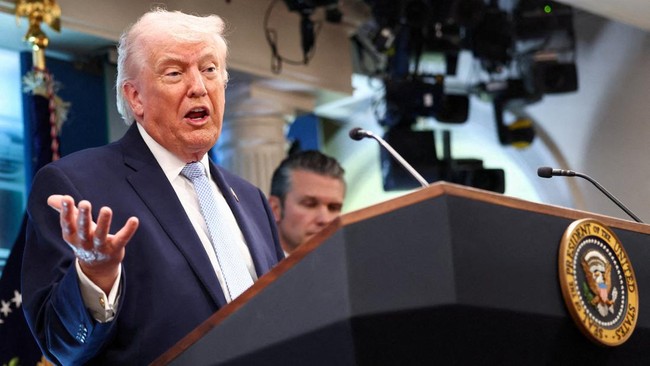
The iron law that has governed US President Donald Trump’s presidency—strength, coercion, and power—is now facing a formidable challenge both domestically and internationally.
Citing an analysis from CNN International on Tuesday (14 April 2026), Trump and his team have not hidden their belief in the president’s dominance and their willingness to use America’s unchecked might to pursue economic, geopolitical, and domestic victories. His policies are an extension of the personal brand built on confrontation and escalation of disputes.
However, the increasingly chaotic international situation and rising domestic turmoil indicate that the president’s methodology of escalation and coercion has limits. This is believed to be steering him into a politically disadvantageous corner.
The Heavy Test of the Iran War
The war in Iran has proven to be the ultimate test of Trump’s approach. His political instincts may explain his decision to launch attacks on Iran’s military, nuclear, and regional ambitions—steps avoided by previous presidents. Yet Tehran’s refusal to yield to Trump’s demands is beginning to reveal the boundaries of American power and his own.
This situation leaves the president with difficult choices. He could escalate the conflict to try to force Iran to comply with his demands, but that could increase US casualties and trigger a severe economic explosion. He could claim victory and withdraw, but Iran’s control over the Strait of Hormuz and its stockpile of enriched uranium would contradict such a claim.
To escape this trap, Trump has chosen a path that combines American military might with his refusal to back down from a defiant adversary. A new blockade in the strait is an attempt to strangle Iran’s economy, despite the potential for severe adverse impacts on global energy markets.
Failure of Diplomacy and China’s Retaliation
The search for an endgame in Iran is the president’s most critical crisis, but his erratic war leadership has been evident in other controversies. He failed to coerce NATO allies into joining a war they challenged and were not informed about beforehand.
Even his threats to abandon the alliance have not convinced countries to abandon what they see as their own national interests. This lack of support has damaged US options that were often relied upon in past wars.
Trump’s rough approach can succeed, as when he cut deals by using tariff wars against US trading partners. However, China, an economic superpower, retaliated by threatening to halt critical rare earth exports. Beijing used the potential trade war to unsettle global markets and force Trump to back down.
Iran appears to have learned from that episode that the US is vulnerable to shocks in the global economy. The country has done its best to hold the US hostage by closing its own strait.
Fading Political Power
The sense that some of Trump’s power is waning extends beyond the Iran deadlock. He has seen the limits of his political appeal after mobilising his political movement to support Hungarian Prime Minister Viktor Orbán. That effort failed on Sunday as voters rejected the dictator and damaged Trump’s project to turn Europe into “MAGA”.
Like his counterpart in Hungary, some of Trump’s domestic policies have caused backlash. Public opinion forced him to retreat from mass deportation programmes after the murder of two Americans by federal agents in Minnesota earlier this year. The failure of most of Trump’s efforts to use the law to punish political enemies—which helped trigger the dismissal of Attorney General Pam Bondi—shows that at least some constitutional guardrails still constrain him.
Even Pope Leo XIV, an American who has angered the president with his vocal opposition to the war in Iran, commented on Monday.
“I am not afraid of the Trump administration,” said Pope Leo XIV.
Why Trump Believes His Power is Absolute
Trump has not hidden his belief that he enjoys unrivalled power. He stated this openly to the public last August.
“I have the right to do whatever I want to do. I am the President of the United States,” said Trump.
He also told The New York Times this year that the only constraint on his foreign actions is his own morality.
“The only limitation on my foreign actions is my own morality,” Trump revealed.
This conviction is reflected in his refusal to seek input from Congress or prepare the country for battle before launching a war that has now lasted six weeks. White House officials, when asked about next steps in Iran, often respond with variations of “only the President knows what he will do”. This highlights a trend of rejecting the principles of power-sharing in the republic’s system.
The belief in strength and escalation underlying Trump’s second term was bluntly explained by White House Deputy Chief of Staff Stephen Miller in January, amid the euphoria of the strong capture of Venezuelan leader Nicolás Maduro.
“We live in a world, in the real world… governed by strength, governed by violence, governed by power,” Miller told CNN.
How Iran is Damaging Trump’s Aura
Trump’s dominance game seemed to work better in the early days of his presidency. He transformed the Republican Party into a vessel for his unyielding will, which remains unwilling to curb his wild impulses despite perin