
Iran War Puts Pressure on US Economy as Support for Trump Falls to 31 Per Cent
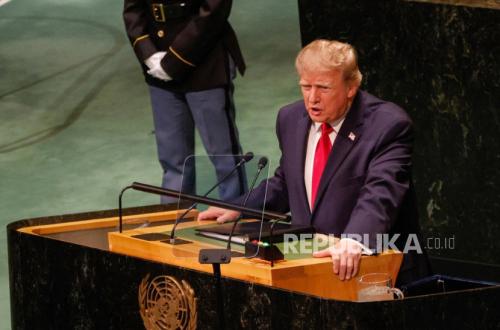
JAKARTA — The war between the United States and Israel against Iran is creating mounting political pressure for President Donald Trump. Rising fuel prices, accelerating inflation and weakening household purchasing power have become serious concerns ahead of the midterm elections on 3 November 2026. Amid this economic pressure, public approval of Trump’s performance has fallen to 31 per cent, the lowest level of his presidency.
A Reuters/Ipsos poll published on Monday (19 October 2026) found that 68 per cent of respondents disapproved of Trump’s handling of the economy. The dissatisfaction comes as Americans face persistently high petrol prices, while the war with Iran, now nearly eight months old, shows no sign of ending.
The poll, which surveyed 1,679 adults, also indicated pressure on the Republican Party ahead of the midterms. Among registered voters, 47 per cent said they would vote for a Democratic candidate for Congress, compared with 35 per cent who favoured a Republican.
The situation presents a challenge for Trump, who has long promised lower energy prices and an improved domestic economy. The conflict in the Middle East is now having direct economic consequences for Americans.
Data from the American Automobile Association (AAA) showed that the average US price of regular petrol reached US$4.30 a gallon on 19 October 2026, up from US$3.04 during the same period last year.
The increase was steeper for diesel, which reached US$6.32 a gallon, compared with US$3.63 a year earlier. High fuel prices are adding to transport and goods-distribution costs across the country.
The burden on households has grown as rising energy prices have coincided with accelerating inflation. The US Bureau of Labour Statistics (BLS) recorded annual inflation of 3.7 per cent in September 2026, up from 3.4 per cent in August.
Energy prices rose 20.4 per cent year on year, while petrol prices surged 34.2 per cent. Heating oil prices climbed by 74.2 per cent.
Strait of Hormuz becomes a pressure point for the global economy
One of the main sources of pressure on energy prices is disruption to shipping through the Strait of Hormuz, a strategic oil and gas trade route linking the Persian Gulf with the Gulf of Oman.
Before the war broke out on 28 February 2026, the Strait of Hormuz was one of the world’s main energy-distribution routes. US Energy Information Administration (EIA) data show that around 20 million barrels of oil a day passed through the area in 2024, equivalent to about one-fifth of global consumption of oil and petroleum products.
The war, which began with US and Israeli military strikes against Iran, caused major disruption to shipping in the Gulf. Attacks on vessels and heightened security risks have seriously hampered oil distribution.
Although oil shipments from several Gulf countries have begun to recover, energy-trade volumes have yet to return fully to pre-war levels.
Data from energy analytics firm Vortexa, cited by Reuters on 6 October, showed that exports of oil and energy products from Gulf countries, excluding Iran, averaged 19.2 million barrels a day throughout September. That was around 81 per cent of the pre-war level of 23.6 million barrels a day.
The recovery, however, has been uneven. Exports of crude oil and condensate have reached about 91 per cent of their pre-war level. By contrast, exports of refined fuels have recovered to only around 60 per cent.
The difference shows that the recovery in crude shipments has not fully resolved disruption to supplies of refined fuels, including diesel and aviation fuel.
Meanwhile, the United States continues to maintain a blockade on Iranian oil exports. Reuters reported on 13 October, citing Vortexa data, that no Iranian crude oil exports were recorded during the October period monitored by the company.
Security in the Strait of Hormuz also remains volatile. On Monday (19 October 2026), a tanker was reported to have suffered an explosion south of the strait. Iran’s Islamic Revolutionary Guard Corps said the vessel had struck a sea mine.
The incident has renewed concerns about shipping security in the Gulf. Meanwhile, Brent crude was still trading at around US$108 a barrel on Monday, far above its pre-war price.
The situation shows that the partial recovery in energy supplies has not removed the pressure on global oil markets.
Source: jawawa.id (https://jawawa.id/newsitem/iran-war-puts-pressure-on-us-economy-as-support-for-trump-falls-to-31-per-cent-1792475461)
Originally published by Republika (https://news.republika.co.id/berita/tn6vdr451/perang-iran-tekan-ekonomi-as-dukungan-untuk-trump-anjlok-ke-31-persen), translated from Indonesian