
Iran Threatens to Attack Gulf States as Military Comparisons Surprise
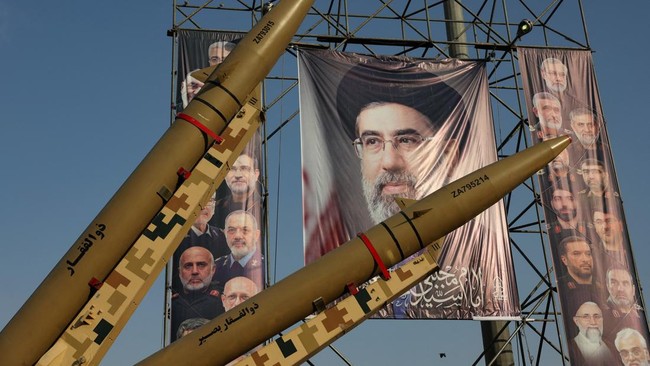
Tensions in the Middle East have risen again. Iran has threatened to attack key facilities in several Gulf countries if the United States and Israel launch fresh strikes on its territory.
Iran’s threats now extend beyond oil and energy facilities to data centres, undersea cable networks and artificial intelligence (AI) facilities.
According to The Guardian on Thursday (22 October 2026), Mohsen Rezaei, secretary of Iran’s Supreme National Security Council, warned that Iranian retaliation could reach as many as seven countries in the Gulf region if war broke out again.
A similar warning was issued by Mehdi Mohammadi, an adviser to Mohammad Ghalibaf who was previously involved in negotiations between Iran and the United States.
Mohammadi said the next war would pose a major threat to Iran’s existence. Tehran would therefore no longer limit the targets or geographical scope of its retaliation.
“Our strategy is that there are no limits,” Mohammadi said, as quoted by The Guardian.
The threat comes amid renewed tensions between Iran, the US and Israel, raising fears that a new war could spread to Gulf countries.
The region is one of the world’s largest centres of oil and gas production. If the conflict expands, the effects would be felt beyond the countries directly involved and could disrupt global energy supplies.
How does Iran’s military strength compare with that of the Gulf states? Does Iran have more troops and weapons than its neighbours?
Comparing Iran’s military strength with Gulf states
According to the 2026 Global Firepower Military Strength Ranking, Iran remains one of the strongest military powers in the Middle East.
Global Firepower ranks Iran 16th in the world out of 145 countries assessed in 2026.
That places it above every member of the Gulf Cooperation Council (GCC), including Saudi Arabia and the United Arab Emirates (UAE).
Saudi Arabia, known for its substantial defence budget, is ranked 25th globally.
Iraq is 44th, followed by the UAE in 54th place.
Qatar, Bahrain, Kuwait and Oman are all outside the world’s top 70 military powers.
Global Firepower uses more than 60 indicators to compare countries’ military strength. These include troop numbers, military aircraft, tanks, warships, defence spending and a country’s ability to support military logistics.
The indicators are combined into a score known as the Power Index (PwrIndx). A lower score indicates a higher military ranking.
Iran’s score is 0.3199, ahead of Saudi Arabia’s 0.4473 and Iraq’s 0.8115.
However, a higher military ranking does not mean that a country would necessarily win a war. The outcome also depends on factors such as strategy, weapons technology, troop readiness and military support from other countries.
Troops, fighter aircraft and tanks
In terms of troop numbers and weaponry, Iran has a sizeable advantage over several Gulf states.
Global Firepower’s 2026 figures put Iran’s active military personnel at about 610,000, far more than Saudi Arabia’s 247,000.
Iraq has 193,000 active personnel, while Oman is listed at around 100,000.
The picture is different in the air. Saudi Arabia has more military aircraft than Iran, with 917 compared with Iran’s 551.
Saudi Arabia also has more fighter aircraft: 283, against Iran’s 188.
The comparison shows that Iran has more active troops than any individual Gulf state. It also has 2,675 tanks, substantially more than Saudi Arabia’s 1,085 and Iraq’s 1,188.
Saudi Arabia, however, has the advantage in air power. The UAE, ranked 54th globally, is also listed as having 581 military aircraft, slightly more than Iran.
Qatar has 115 fighter aircraft, despite having far fewer active troops than Iran.
The six GCC members together have 601 fighter aircraft, more than three times Iran’s total.
That figure is only the combined inventory of the individual countries, however. It does not mean all Gulf states’ fighter aircraft could automatically be deployed together if war broke out.
Iran’s submarines and Saudi Arabia’s defence budget
Iran also has a sizeable arsenal for naval operations.
Global Firepower lists Iran as having 109 naval assets, including 25 submarines, seven frigates and three corvettes.
The other seven countries included in the comparison have no submarines recorded in the 2026 Global Firepower data.
The submarines are one of Iran’s advantages, particularly given its position on the Strait of Hormuz, a vital route for global oil and gas shipments.
Naval strength, however, is not determined solely by the number of warships. Weapons, technological capabilities and fleet readiness are also important.
Saudi Arabia, meanwhile, has a substantial advantage in military spending. Global Firepower estimates its defence budget at US$63.99 billion, almost seven times Iran’s US$9.23 billion.
The UAE also spends more than Iran, with a military budget of US$23.48 billion. Qatar’s budget is listed at US$11.95 billion.
The combined military budgets of the six GCC members amount to around US$116.77 billion—more than 12 times Iran’s defence spending.
The comparison points to the Gulf states’ considerable financial capacity to buy weapons, develop military technology and fund their defence needs.
Nevertheless, a larger military budget does not necessarily translate into more troops or weapons.
What would another war mean?
The comparison suggests Iran has several military advantages, particularly in active personnel, tanks and submarines. Saudi Arabia and some other Gulf states, by contrast, have larger defence budgets and more military aircraft.
Combined, the seven countries in the comparison have around 728,000 active troops, 2,519 military aircraft and 3,470 tanks. Their totals exceed Iran’s in several categories.
Those figures do not, however, mean that the Gulf states have a unified military force ready to fight Iran. Each country has its own interests, strategy and defence policy.
Moreover, the current threat is not limited to fighting between troops or the use of aircraft and warships. Iran has also threatened oil facilities, data centres, undersea cable networks and other critical infrastructure across the Gulf.
If carried out, such attacks could disrupt economic activity, energy supplies and daily life in affected countries.
The Gulf plays a major role in supplying the world’s oil and gas. Disruption to energy facilities or shipping routes could push up energy prices and add pressure to the global economy.
Therefore, although Global Firepower ranks Iran above each individual Gulf state, that does not mean Iran would necessarily prevail in a war. The balance of military power in the region would become far more complex if the United States and Israel became directly involved.
Source: jawawa.id (https://jawawa.id/newsitem/iran-threatens-to-attack-gulf-states-as-military-comparisons-surprise-1792853462)
Originally published by CNBC Indonesia (https://www.cnbcindonesia.com/research/20261024083134-128-779080/iran-ancam-serang-negara-teluk-adu-kekuatan-militernya-bikin-kaget), translated from Indonesian