
Iran and its Proxies in Yemen: As Houthis Strengthen Influence and Avoid Expansion
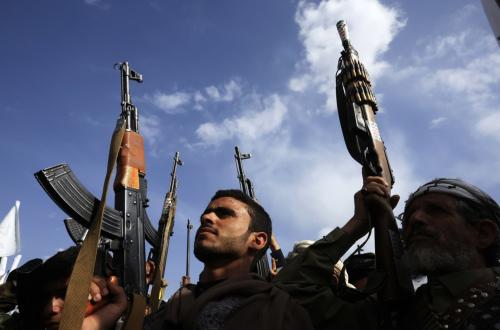
This week, we are presented with simultaneous movements on three main fronts in the Middle East. The Houthi militia is attempting to strengthen its position on the West Coast of Yemen and avoid direct US intervention; Iraqi armed factions are seeking to ensure the continuity of their influence and weaponry; and Iran is moving to reduce economic isolation and withstand internal pressure following the imposition of new US sanctions.
Many questions have arisen regarding the recent Houthi attacks on Saudi Arabian cities, specifically concerning Iran’s role in these strikes, why the US has not intervened militarily to support Saudi Arabia, and the UAE’s position regarding whether they support the Houthis to pressure Saudi Arabia.
Iranian support for the Houthi militia has been long-standing and continuous; last week’s tensions are not a new development in the Yemeni conflict. However, the level of direct Iranian support for its proxy in the region appears lower than in previous phases, due to the military, economic, and political pressures currently facing Tehran and its regional network.
Nevertheless, current Houthi attacks clearly show traces of Iranian assistance in operational planning, information management, reconnaissance, the deployment of missile and drone capabilities, and the integration of ground operations with naval pressure and strategic guidance. Conversely, the military experience the Houthis have gained through years of warfare, and their ability to manage and execute field operations with a reasonable level of operational independence, should not be overlooked.
Therefore, Iran’s role appears to be a key element in developing and directing Houthi capabilities, without assuming that every detail of military decision-making and field implementation originates directly from Tehran. Meanwhile, the US position in the current Yemeni crisis is not new. This position has been defined since the launch of ‘Operation Decisive Storm’ in 2015, which is limited to providing intelligence and logistical support to the coalition supporting the legitimate Yemeni government led by Saudi Arabia.
Over time, direct US involvement in the Yemeni war has decreased, and Washington has become more hesitant to intervene militarily on behalf of Saudi Arabia against the Houthis, particularly in operations related to ground warfare. Conversely, the US acts directly in a military capacity when Houthi activities threaten navigation in the Red Sea and the Bab al-Mandab Strait, or when they target US troops, ships, and interests.
The Houthis appear very aware of the sensitivity of these borders. Consequently, at this level, they are interested in avoiding the opening of a new, broad, and direct front with the US, Egypt, or the international military forces present in the region, as long as they can achieve their field objectives without provoking these parties into wider intervention. However, the possibility of escalation remains if current operations evolve into a direct and sustained threat to navigation or if regional military intervention against the Houthis expands.
On the other hand, to understand the UAE’s position regarding the current Houthi success in Yemen, one must distinguish between short-term retaliatory gains and long-term strategic interests. It is true that Houthi pressure on Saudi Arabia could indirectly create political advantages for the UAE, either by increasing pressure on Riyadh or by altering the balance of power within the anti-Houthi camp. However, these gains remain limited compared to the strategic damage that could result from the expansion of Houthi control over the west coast or their advance closer to Bab al-Mandab.
The UAE’s vision in Yemen is based on several key interests: protecting its sphere of influence in the South and along the coast, supporting allied local forces, securing maritime routes in Bab al-Mandab and the Gulf of Aden, and protecting ports, trade, and investments related to Yemen’s maritime locations. The UAE also focuses on countering armed ideological organisations that it considers a threat to its security or regional projects, particularly groups linked to Iran and certain currents of political Islam. From this perspective, the current Houthili success poses a direct threat to several UAE interests:
First, it weakens local forces allied with Abu Dhabi, both in the South and on the west coast, reducing their ability to manoeuvre politically and militarily. Second, Houthi expansion along the coast increases their ability to threaten international navigation in the Red Sea and the Bab al-Mandab Strait, directly impacting the UAE’s economic and security interests as a major hub for trade, maritime transport, and logistics.
Third, the increase in Houthi military strength increases the likelihood of missile and drone attacks targeting the heart of the UAE, a threat that the UAE has faced directly. This factor is one of the reasons Abu Dhabi has adopted a policy in recent years to reduce direct confrontation with the Houthis and minimise its military involvement in Yemen, while continuing to support allied local forces.