
IPB University's Swarm Drone Innovation: Smart Monitoring Solution for Indoor Farming
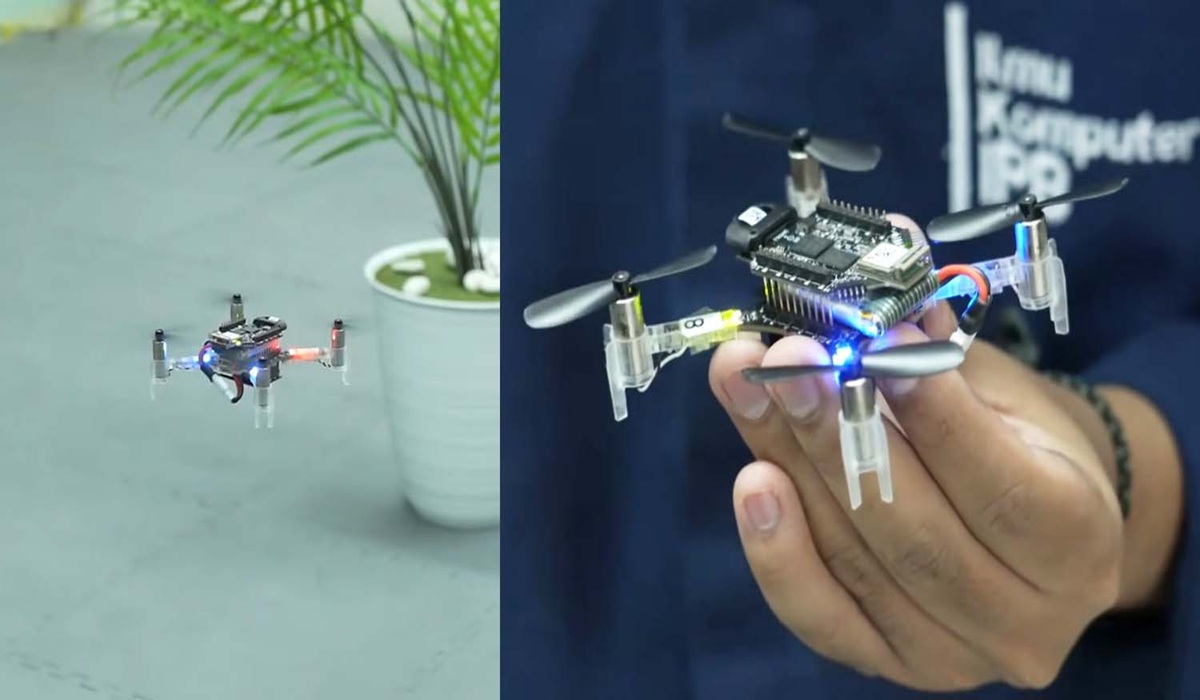
The era of precision agriculture is entering a new phase with the integration of drone technology and artificial intelligence (AI). Addressing these challenges, two lecturers from the Computer Science Programme at IPB University, Dr. Karlisa Priandana and Dr. Medria Kusuma Dewi Hardhienata, have developed swarm drone technology specifically designed for indoor farming ecosystems. This innovation aims to optimise efficiency and accuracy in monitoring plants in controlled environments.
Here are the main points of this technological development:
Unlike single drones, swarm drones consist of a group of small units that work collectively. Karlisa explained that the system was initially developed to enhance surveillance functions in enclosed areas.
“These swarm drones were initially developed by us to assist in monitoring or surveillance for indoor farming. Swarm drones are designed as a collection of small drones capable of working coordinatively like a swarm of bees,” Karlisa elaborated.
In indoor farming, environmental factors such as temperature, light, and humidity must be monitored continuously. Previously, farmers relied on static sensors that carry the risk of damage. This is where swarm drones play a crucial role.
“Swarm drones are used to cover or serve as a backup when static sensors experience disruptions, ensuring monitoring continues uninterrupted,” Karlisa explained.
Each drone unit is equipped with: [Note: Specific equipment details appear incomplete in the source, but collectively they gather data on plant health and environmental conditions.]
The data collected by the swarm of drones is transmitted directly to a central computer. Dr. Medria Kusuma Dewi Hardhienata emphasised that the use of AI models enables sharper decision-making.
“The results of this analysis help farmers or operators make quick, accurate, and data-based decisions, thereby increasing crop productivity and quality,” Medria stated.
In addition to analysing plant health, the AI algorithms also enable the drones to: [Note: Specific capabilities appear incomplete in the source, but include predictive adjustments for optimal growth.]
This technology is expected not only to improve efficiency but also to support more environmentally friendly farming practices. With the utilisation of precise data, farmers’ welfare is hoped to improve alongside optimal harvest yields in the future.