
IPB University Introduces CIBEST Poverty and Welfare Measurement Model to Islamic Boarding Schools
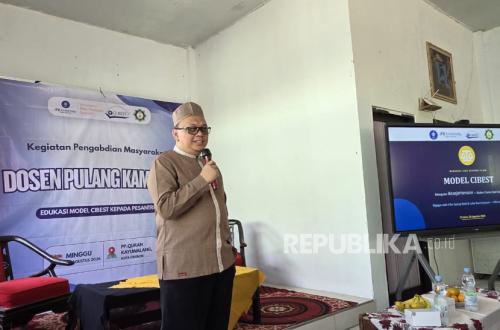
A delegation of lecturers from IPB University conducted the ‘Dosen Pulang Kampung’ (Lecturers Return to Hometown) programme at the Quran Kayuwalang Islamic Boarding School, Cirebon, on Sunday (30/8/2026). The activity introduced the CIBEST model—an instrument for measuring poverty and welfare based on Sharia economics developed by Irfan Syauqi Beik and Laily Dwi Arsyianti—to 50 junior and senior high school students at the boarding school.
The Dean of the Faculty of Economics and Management (FEM) at IPB University, Irfan Syaiqi Beik, presented material regarding the CIBEST model as a measurement tool that considers two primary dimensions: the material dimension and the spiritual dimension. During the session, Irfan was accompanied by the Director of CIBEST IPB, Laily Dwi Arsyianti, CIBEST Secretary Rahmat Yanuar, and several assistants.
Irfan noted that the students demonstrated a strong understanding of the material, evidenced by the various questions raised throughout the session. “In our visit to the boarding school, the understanding of the CIBEST model was evident from the questions asked by the students. This shows their extraordinary reasoning and comprehension abilities. This is one of the reasons for our effort to introduce one of IPB’s knowledge products, the CIBEST model, which has been widely used, particularly in the field of zakat (almsgiving),” said Irfan.
He explained that socialising the CIBEST model within the boarding school environment is highly relevant to the ongoing educational processes in these institutions. Education regarding the material and spiritual dimensions in the CIBEST model can be synchronised with religious education that teaches Islamic teachings comprehensively, ensuring students gain not only religious understanding but also insights into applying Sharia economic principles in society.
Similarly, the Director of CIBEST IPB, Laily Dwi Arsyianti, emphasised the importance of the role of boarding schools in the community economy, suggesting that the CIBEST model needs to be introduced more widely to these environments. “Boarding schools are very important economic actors; therefore, the CIBEST model needs to be introduced to boarding schools more extensively. The hope is that religious leaders (kyai) and students can integrate it into various community empowerment programmes based in boarding schools,” said Laily.
Meanwhile, the Secretary of CIBEST IPB, Rahmat Yanuar, explained that the educational activities for the CIBEST model in boarding schools have been running for three consecutive years, following previous implementations in Lombok and Yogyakarta. “This is the third year of CIBEST model education in boarding schools. Previously, it was held in Lombok and Yogyakarta. The hope is that universities and boarding schools can continue to synergise and strengthen one another,” said Rahmat.
Muhammad Gaza, a 12th-grade student at Pondok Quran Kayuwalang, admitted that the activity provided additional insights, particularly regarding Sharia economics and the allocation of zakat. “With the arrival of IPB University, my knowledge has increased, both in terms of economics, zakat allocation, and other matters. I believe this programme is excellent because it teaches how zakat allocation can be done effectively to provide an impact on society,” said Gaza.
The leader of Pondok Pesantren Quran Kayuwalang, Kyai Agus Talik, expressed his appreciation for the ‘Dospulkam’ activity organised by IPability University. He noted that the presence of the lecturers provided educational benefits to the students, specifically through the introduction of the CIBEST model and studies on Sharia economics based on community mapping.
“Alhamdulillah, on behalf of the leadership of Pondok Pesantren Quran Kayuwalang, Cirebon, I welcome the arrival of these special guests, the IPB lecturers and their delegation. This visit brings educational benefits regarding the CIBEST model, its development, and Sharia economic studies based on community mapping and grouping,” said Agus Talik.
He hoped that CIBEST education could help students understand that welfare is not only related to spiritual aspects but also the ability to be part of an economically empowered community. “Hopefully, this socialisation provides benefits for the students’ understanding so they can fall into the best category of the community based on the CIBEST model—not only as good Muslims but also as empowered economic actors. May this activity serve as a good deed for the lecturers and encourage Muslims to compete in goodness for the sake of society, nation, and country,” he added.
At the end of the event, Irfan Syauqi Beik expressed his gratitude for the support of IPB University in implementing the ‘Dosen Pulang Kampung’ programme. He hoped that similar programmes could continue to be developed to reach more boarding schools across Indonesia, given that these institutions have contributed significantly to national education. “Hopefully, similar programmes and ‘Dospulkam’ can continue to be developed by targeting boarding schools more broadly. Ultimately, boarding schools are educational institutions that have made a significant impact on the development of national education in Indonesia. Through this programme, I hope the collaboration between IPB University and boarding schools will become even closer and stronger in the future,” concluded Irfan.
Source: jawawa.id (https://jawawa.id/newsitem/ipb-university-introduces-cibest-poverty-and-welfare-measurement-model-to-islamic-boarding-schools-1788267452)
Originally published by Republika (https://sharia.republika.co.id/berita/tkoozx502/ipb-university-kenalkan-model-pengukur-kemiskinan-dan-kesejahteraan-cibest-di-pesantren), translated from Indonesian