
IPB University: Community Participation Key to Successful Rice Field Expansion in Papua
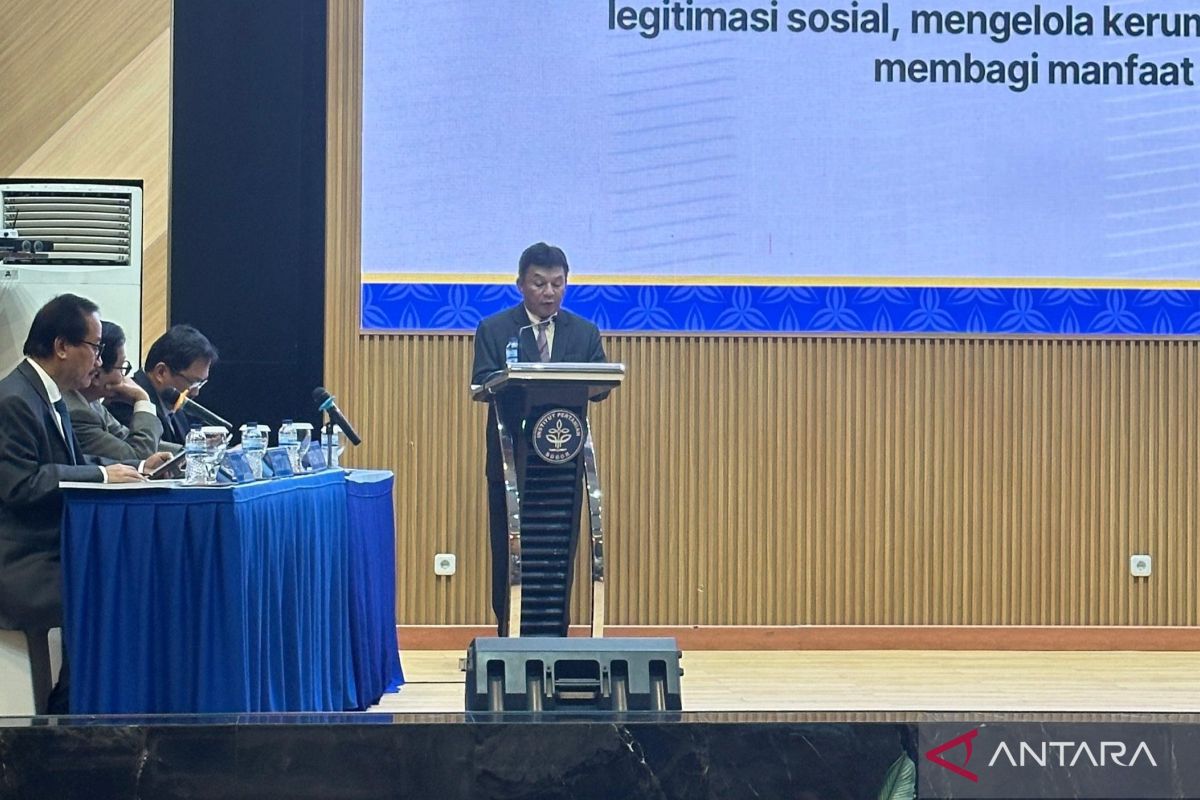
The rice field expansion programme in Papua has been successfully developed through a participatory approach that involves local communities in land management, according to research from IPB University. Fredian Tonny Nasdian, a researcher at IPB’s Centre for Agricultural and Rural Development Studies (PSP3-IPB), presented these findings during his dissertation defence on Monday at the Andi Hakim Nasution Auditorium, IPB Dramaga Campus, Bogor Regency, West Java. His dissertation is titled ‘Sustainable Food Farming Communities in Merauke: Neoliberal Penetration in the Transformation of Local Governance’.
Fredian explained that the programme, covering 20,000 hectares in Merauke and around 9,000 hectares in Sorong, was implemented together with village residents, both indigenous Papuans and transmigrants, through a process of participation and negotiation. ‘The rice field expansion programme was carried out using a participatory approach with village residents, both indigenous people and transmigrants,’ he stated.
According to Fredian, the land used remains the property of the community because residents voluntarily lend their land for rice field development. The programme’s implementation was also tailored to the needs of the residents, including preserving forest areas around agricultural land and avoiding areas with steep slopes. He noted that this approach differs from several large-scale agricultural development programmes that have been criticised for neglecting the social and ecological aspects of local communities.
The research, conducted from June to November 2025, covered 46 villages across nine districts in Merauke Regency, South Papua. The study employed participant observation, in-depth interviews, focus group discussions, and a survey of 594 respondents. The results showed that communities dominated by former transmigrants had the highest potential for programme sustainability. Mixed communities of indigenous Papuans and ex-transmigrants ranked next, while communities dominated by indigenous Papuans with traditional subsistence livelihoods had a lower chance of sustainability.
Fredian emphasised that food security and self-sufficiency are not solely about increasing production but also involve governance that determines community access to resources, decision-making, and the distribution of development benefits. He argued that the success of the Merauke rice field expansion programme in 2025 should not be measured only by the area of land developed or the volume of production. ‘Success must be assessed by the governance’s ability to maintain social legitimacy, manage spatial complexity, and distribute benefits fairly within the community,’ he said.
In his research, Fredian introduced the concept of ‘sodality governance’, a hybrid governance model that combines production targets with social justice and local community sovereignty. Empirically, this concept is realised through the formation of Food Brigades involving millennial farmers from both indigenous Papuan and ex-transmigrant communities, blending local values with modern agricultural experience. He recommended that the government fulfil social and ecological protection prerequisites in any expansion of the rice field programme and ensure space for community participation in policy-making and technical guidelines. This approach, he argued, is necessary to ensure that food self-sufficiency targets align with the protection of community rights and environmental sustainability.