
IPB Professor Exposes Indonesia's Poultry Industry Issues, Urges KPPU Intervention
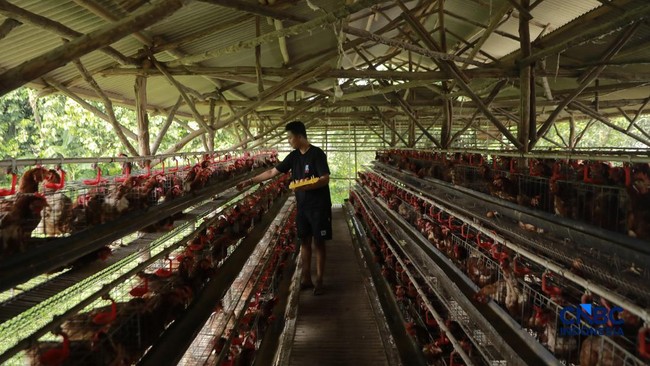
Jakarta, CNBC Indonesia - IPB University Professor Yuli Retnani has revealed the root issues plaguing the national poultry industry, including the sharp decline in chicken egg prices. According to her, the problem does not lie in production technology, but in the increasingly concentrated business structure that is vulnerable to monopolistic practices.
Yuli assesses that Indonesia’s poultry industry has actually developed in a very modern and efficient manner. However, behind this success, there is a serious problem that continues to pressure small-scale farmers.
“The main problem in Indonesia’s poultry industry is no longer merely production technology, but its structure and the industry which is becoming increasingly concentrated, making monopolistic practices easy to occur. As a result, the poultry system creates serious economic injustice,” said Yuli in her statement received by CNBC Indonesia, quoted on Wednesday (13/5/2026).
She explained that the poultry industry is a strategic sector for the national economy because it provides affordable animal protein for the public. Broiler chicken production can even be harvested in just around 30-40 days.
“The poultry industry is very strategic in influencing Indonesia’s economy. Protein supply can be produced in a short time, fulfilled from animal protein provision from broiler chicken meat and chicken eggs,” she stated.
Yuli noted that the poultry sector also serves as an example of successful agricultural modernisation and food technology in Indonesia. Production efficiency is supported by breeding technology, feed, livestock health, and modern housing management.
“So, the industry is a success story of agricultural modernisation and food technology,” she said.
Not only that, this sector also provides the most affordable source of animal protein for the public while absorbing a large amount of labour.
“With the current production system, the people’s protein needs are met and affordable because the price is cheap,” Yuli explained.
However, on the other hand, she highlighted that many small-scale farmers are experiencing prolonged losses. In fact, not a few are burdened with debt and lose business assets due to unprofitable operations.
“There are many complaints among poultry farmer producers due to frequent losses, business closures, involvement in debt, even seizure of housing assets or homes, occurring due to business losses,” she said.
According to Yuli, this condition indicates an unhealthy poultry industry structure. She assesses that horizontal and vertical concentration has occurred, benefiting large companies in the upstream sector, while small farmers downstream are increasingly pressured.
“The poultry industry is experiencing horizontal and vertical concentration, thus benefiting conglomerates upstream and harming farmers downstream. Added value is enjoyed by large companies, while small businesses are oppressed,” she stated.
She explained that large companies currently control the poultry business chain from upstream to downstream, starting from DOC (day-old chick) breeding, animal feed, medicines and vaccines, slaughterhouses, distribution, cold storage, to retail trade.
“As a result, large companies control input prices, control DOC supply, control distribution, and can even easily influence market prices for chicken and eggs,” Yuli clarified.
This condition, she continued, makes small-scale farmers merely “price takers” or recipients of prices without the power to influence market prices and must accept prevailing prices, buying expensive inputs but selling livestock products at low prices.
“On one side, consumers enjoy cheap protein prices. But on the other side, small farmers often go bankrupt, profit margins are very thin, business assets are often seized by banks,” she said.
Therefore, she urges the government and the Business Competition Supervisory Commission (KPPU) to intervene and carry out poultry industry structural reform to make business competition healthier.
“The government or state in this case must be present because the industry is unhealthy. The government and KPPU must absolutely carry out gradual structural reform of the industry to make it competitively healthy,” she said.
Yuli also touched on the Indonesian Chamber of Commerce and Industry (Kadin)’s plan to invite new investors from China in the upstream poultry sector. According to her, this step has become a sensitive issue among farmers, academics, and even large business players.
“The presence of Kadin’s plan to invite new investors upstream has become a sensitive issue and widespread discussion among farmers, academics and campuses, as well as large entrepreneurs themselves,” she stated.
She assessed that this plan must be explained openly, whether it will improve business competition and provide better access for farmers, or instead strengthen the existing business concentration.
“Will it improve healthy competition so that farmers have better access to production inputs, production processes, and markets? Or conversely, will the presence of new investors only perpetuate concentration from upstream to downstream and its horizontal concentration,” Yuli concluded.