
IPB Expert Warns Forest and Land Fires in 2026 Could Extend into 2027
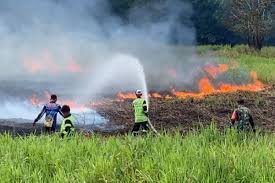
The threat of forest and land fires in 2026 is regarded as far more serious than in previous years. IPB University forestry expert Bambang Hero Saharjo warned that the fire pattern this year could resemble the 1997–1998 tragedy, which burned 10–11 million hectares, and could continue into 2027. ‘It is plausible that the fires in 2026 will be similar to the 1997/1998 fire events. The fires began in 1997 and then continued into 1998. This is what is feared will occur, where the fires will begin in mid-2026 and then continue into 2027,’ Bambang said on Thursday (21 May).
The concern is based on signals of a Super El Niño in 2026, marked by an increase in surface sea temperature in the tropical Pacific by at least 2 degrees Celsius above the average. The strongest El Niño on record occurred in 1997–1998, with Niño 3.4 region temperatures about 2.7°C above average, and in 2015–2016 with about a 2°C rise.
Bambang reminded that 2026’s forest and land fires had in fact begun two months earlier, but were often ignored until the flames and smoke grew extensive. ‘We sometimes neglect and do not take seriously the potential fires as predicted earlier, and only realise when fires and smoke are widespread, while infrastructure has already worn out from frequent use and maintenance and provision of new equipment are constrained by budget efficiency,’ he said.
Referring to the study by Aoyun Xue et al., published in Nature Communications 2025, Bambang stressed that early warnings and proactive steps are crucial to suppress the rising risk. Priority areas that must be prepared immediately include Sumatra, Kalimantan, Nusa Tenggara, and several other provinces entering the dry season soon.
He urged the public to monitor information from BMKG and related ministries via mobile phones, and to wear masks and limit outdoor activities when smoke production increases (H-2).
A complete guide to the illnesses increasing in children during the dry season, from ISPA to dengue fever, and effective prevention tips for parents.
This year’s dry season is forecast to begin in May’s second dekad, with rainfall below normal or drier than usual.
The IKN Authority has drafted a strategy for controlling forest and land fires, covering prevention, preparedness and early detection, firefighting, and post-fire management.
The Meteorology, Climatology and Geophysics Agency (BMKG) projects that rainfall with significant intensity is still likely in several parts of Indonesia during 12–18 May 2026. The El Niño phenomenon is expected to reduce rainfall from June to August.
IDAI warns that the Godzilla El Niño could increase stunting risk by up to 25% due to food shortages and poor sanitation.
One measure already underway and showing positive impact is the operation of Waduk Teritip as an additional source of raw water.
BPBD Banyumas has prepared three water-tank trucks and one multipurpose truck to support distribution of clean water to communities if needs rise. The head of Banyumas BPBD, Dwi Irawan Sukma, said they have mapped drought-prone areas based on data from previous years.