
IPB Educates Bubulak Residents on Tilapia Farming Through Returning-Home Lecturers Programme
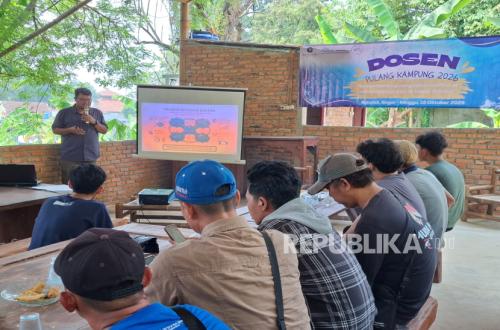
IPB University’s 2026 Dosen Pulang Kampung (Dospulkam, or Returning-Home Lecturers) team held an educational session and knowledge-sharing event on optimising tilapia farming. The event took place at Kopi Wana in Bubulak, Bogor, on Sunday (18 October 2026), attracting participants from a range of backgrounds, including tilapia farmers, local residents and students.
Wildan Nurussalam, a lecturer at IPB University’s Faculty of Fisheries and Marine Science, delivered a presentation entitled “Water Management Technology Innovations for Freshwater Fish Farming in Bogor”. In an interactive session, he shared strategies for managing tilapia farming efficiently and profitably.
“Tilapia has potential because it is highly tolerant and adapts very well to varying environments. Many farmers have optimised its genetics and selected monosex fingerlings, preferably all-male, so that energy is channelled into meat growth rather than reproduction,” Wildan said.
Wildan, who lives in Bubulak, also assessed the area’s ponds, some of which are already used to farm various freshwater fish. He said the ponds were well suited to tilapia farming because they do not dry up at any time of year and have good water conditions thanks to the presence of a spring.
He explained that successful tilapia farming depends on using formulated feed efficiently so that it is converted into fish flesh. He stressed the importance of maintaining an ideal Feed Conversion Ratio (FCR) of between 1.3 and 1.4. Keeping the FCR within this range can significantly reduce production costs for pond owners, as feed is the largest expense in fish farming.
Wildan also discussed other key aspects of tilapia farming, including topographical and land suitability surveys, a stable water supply, waste treatment and pond ecosystem management to support optimal fish growth. “For the commercial market, tilapia are generally harvested at a weight of 250–500 grams per fish,” he said.