
IPB and Nanjing Agricultural University Develop AI for Rice Growth
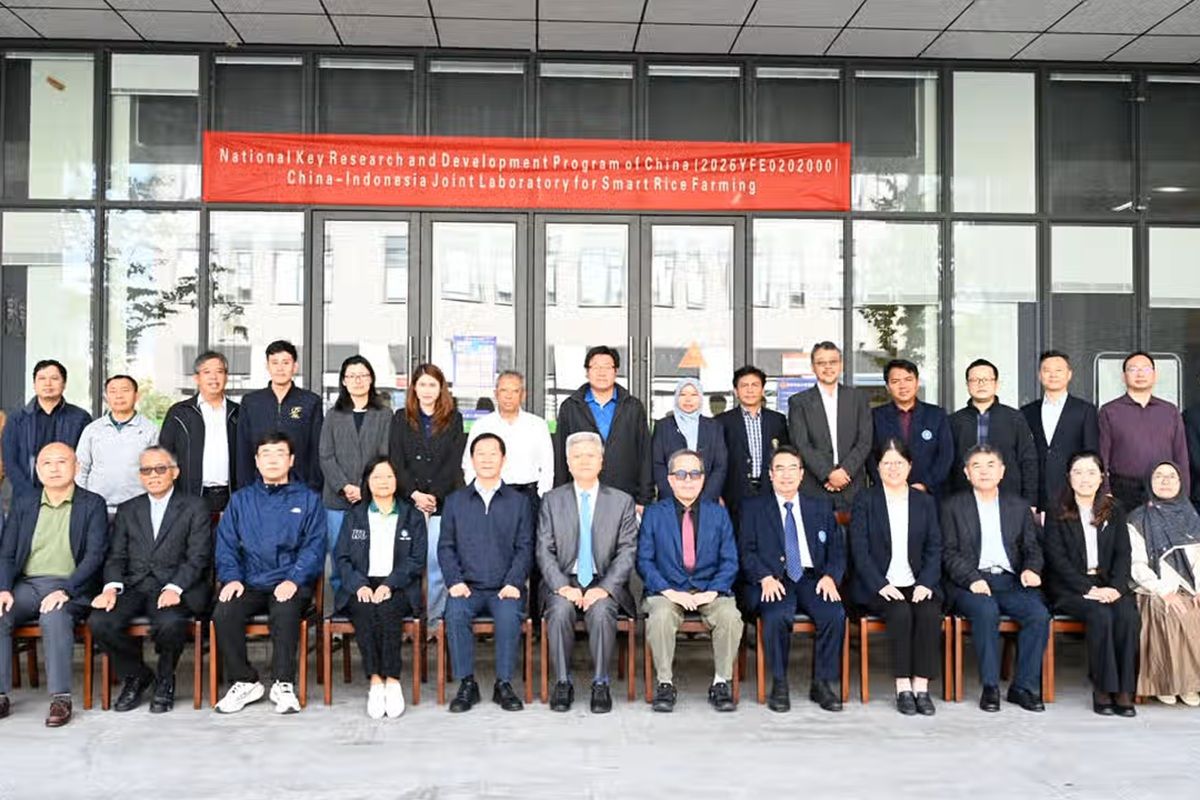
Bogor (ANTARA) — IPB University and Nanjing Agricultural University (NAU) in China are developing a rice-growth model and an artificial intelligence (AI)-based simulation platform.
“One of the main aims of this collaboration is to develop a rice-growth model and simulation tools by integrating mechanistic crop models with AI and big data technologies. This integration is expected to produce a model that can be generalised across different agro-ecosystem conditions,” said IPB University Vice-Rector for Research, Innovation and Agromaritime Development, Professor Ernan Rustiadi, in a statement from Bogor, West Java, on Wednesday.
The platform is designed to be open-source and open-access, and will be used to predict rice-plant growth. The work is being carried out under the China–Indonesia Joint Laboratory for Smart Rice Farming, which officially began with a kick-off event at NAU on 30 October 2026.
The collaboration is part of the Belt and Road AI Joint Laboratory Programme, an initiative of China’s Ministry of Science and Technology (MOST) to promote AI research and development with Belt and Road partner countries under the Industrial Intelligentisation in Key Scenarios framework.
Rice farming is the main focus, as rice is an important food commodity for China and ASEAN countries. The programme is intended to address challenges including climate change, limited natural resources, more efficient use of water and production inputs, and the need to raise productivity and strengthen food security.
“With the support of these data and models, smart-farming technology is expected to improve the accuracy of decision-making in farm management and rice production systems,” Professor Ernan said.
Three years, three components
IPB University Vice-Rector for Global Connectivity, Cooperation and Alumni, Professor Iskandar Zulkarnaen Siregar, said the project would run for three years, from 2026 to 2028. Its target is a package comprising a rice-growth model and simulation platform, validated and demonstrated in China and Indonesia.
The project has three components. Demonstration covers agricultural demonstrations, field testing of the technology and the creation of a database to underpin the development and validation of the model.
Innovation involves developing AI-based models, algorithms and tools to predict and simulate rice growth. The third component, communication, focuses on building human-resource capacity by involving students, early-career researchers and experts, alongside scientific meetings, seminars and the dissemination of research findings.
The collaboration is a strategic opportunity to increase Indonesia’s contribution to international science and technology partnerships.
“Indonesia’s involvement as a demonstration site provides an opportunity to develop and test innovations suited to farmers’ needs and the characteristics of the national rice production system,” Professor Iskandar added.
Source: jawawa.id (https://jawawa.id/newsitem/ipb-and-nanjing-agricultural-university-develop-ai-for-rice-growth-1794372893)
Originally published by Antara (Indonesian) (https://www.antaranews.com/berita/5845819/ipb-nanjing-agricultural-university-mengembangkan-ai-pertumbuhan-padi), translated from Indonesian