
IPB Alumni Bridge Superior Rice Variety Innovation in Banyumas
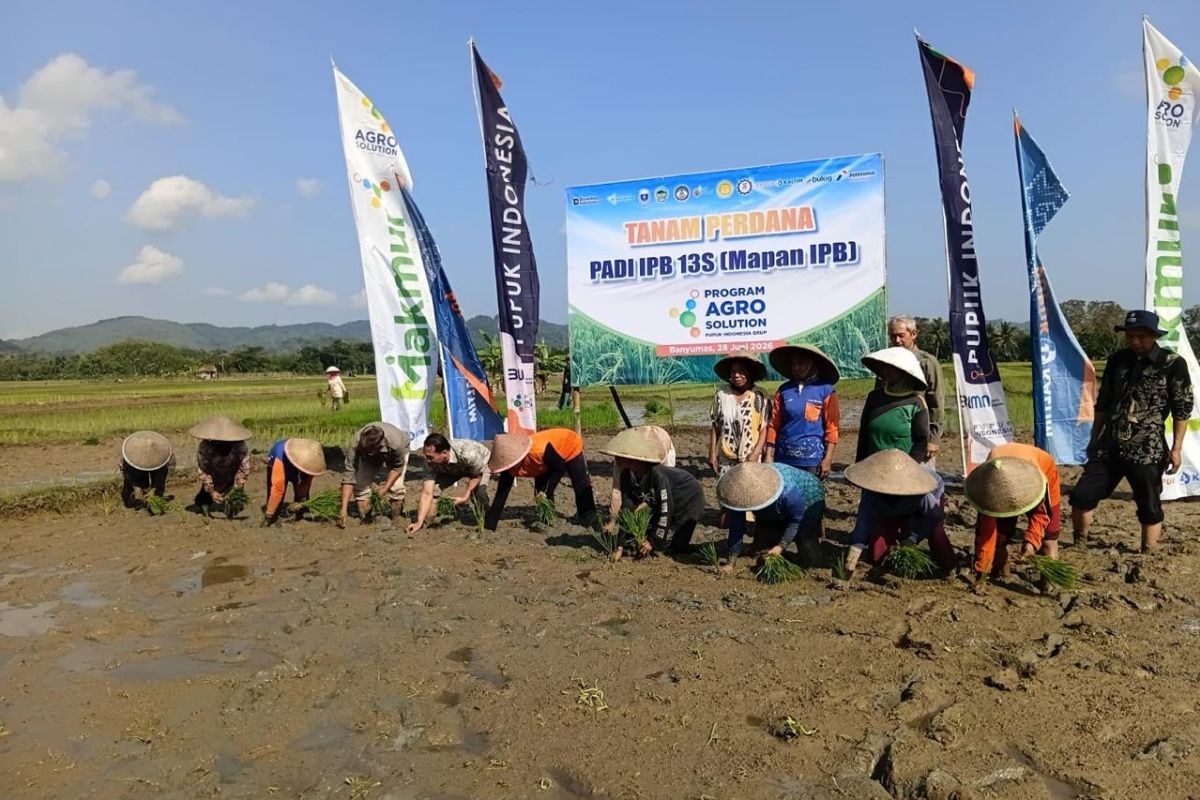
Banyumas (ANTARA) - The IPB University Alumni Association (HA IPB) of Banyumas Raya is bridging the application of superior rice variety innovations, the result of IPB University research, to farmers through the initial planting of the IPB13Senopati (IPB13S/Mapan IPB) variety to increase productivity and farmer welfare.
The planting of IPB13S rice was carried out on one hectare of land in Pegalongan Village, Patikra ext{raja} District, Banyumas Regency, Central Java, on Sunday, as an initial stage in the development of this superior variety.
The Vice Chairman of HA IPB Banyumas Raya, Kukuh Rasiyanto, stated that IPB13S has a short growth cycle of approximately 85 days after planting, which has the potential to support an increase in the cropping index to up to three times per year (IP300).
“It has a short lifespan, around 85 days to harvest. Therefore, it is possible to plant three times a year, provided that replanting is done immediately after harvest,” he said.
In addition to its short growth cycle, he noted that the variety has a potential yield approaching 12 tonnes of grain per hectare, which is expected to help meet Banyumas’ rice production targets.
According to him, the development of IPB13S will be expanded through partnerships that provide easier access to seeds, capital support, and market certainty for farmers.
Meanwhile, the Head of the Food Crops Division of the Banyumas Regency Agriculture Office, Yusuf Khanafi, stated that the introduction of new varieties is one of the strategies to achieve the Banyumas rice production target of 390,003 tonnes from a standard paddy field area of approximately 30,421 hectares.
“The IPB13S variety has high productivity with a lifespan of about 85 days after planting, making it possible for the cropping index to increase from approximately 2.1 times to 2.5 or even three plantings per year,” he said.
He added that although the realised yield is estimated at around 9 tonnes per hectare, the variety still has the potential to increase rice production.
Furthermore, he noted that its resistance to planthoppers is expected to reduce the risk of crop failure.
“The Agriculture Office will assist farmers through agricultural extension officers, ranging from soil fertility management and balanced fertilisation to the use of environmentally friendly pesticides,” he said.
A farmer from Pegalongan Village, Amin, expressed optimism regarding the development of IPB13S, which was being planted on his land for the first time.
“Our hope is that the results will be good, the harvest will be bountiful, and it will be protected from various pests so that yields are abundant, and in the future, the price of grain will also be better,” he said.
He mentioned that the cultivation was conducted with assistance from HA IPB Banyumas Raya and utilised subsidised fertilisers and NPK Pelangi fertiliser through the Agro Solution programme.
In a separate occasion, the Chairman of HA IPB Banyumas Raya, Prawoko Setyo Aji, stated that IPB13Senopati is an innovation resulting from IPB University research, with a potential yield of up to 11.55 tonnes of milled dry grain per hectare. The variety has a harvest age of approximately 85 days, is adaptive to various land conditions, is resistant to blast disease and planthoppers, and produces premium rice with a soft texture.
According to him, the development of IPB13S is a manifestation of the role of HA IPB as a bridge between the university and farmers, ensuring that research results can be applied directly to agricultural land.
“We want the innovations of agricultural experts to be accessible to farmers and provide real benefits for increasing their productivity and welfare,” said Mr Aji, who is also the Head of the Bulog Branch Office in Banyumas.
He expressed hope that more research results from IPB University could be implemented in Banyumas to strengthen agricultural productivity and support national food security.