
IoT-Based Smart Pens Drive Modernisation of Smallholder Livestock Farming
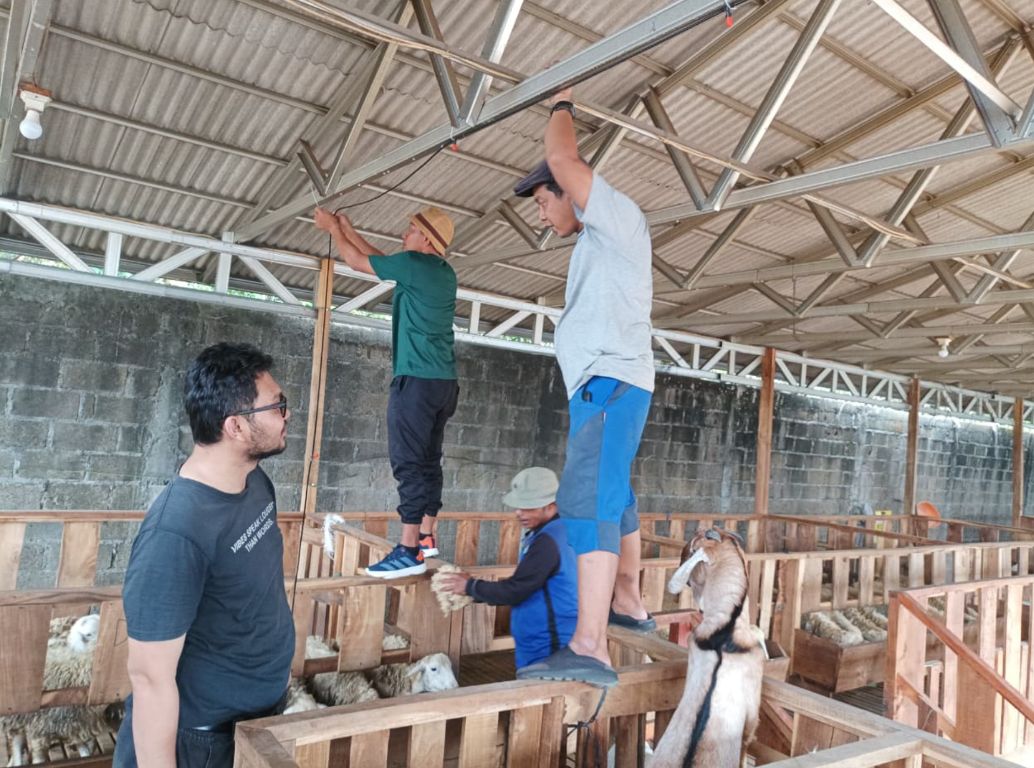
Digital transformation is beginning to reach the smallholder livestock sector as part of efforts to improve productivity, efficiency, and national food security.
One application has been developed through an integrated Internet of Things (IoT)-based smart pen in Ciangsana Village, Gunung Putri District, Bogor Regency.
The innovation was developed by the Universitas Pancasila Community Partnership Programme (PKM) implementation team through funding from the Kemdiktisaintek PKM Bima 2026 programme. The technology was applied at BUMDes Mitra Warga Sejahtera to support goat farmer groups that have so far relied on conventional pen condition monitoring.
Until now, temperature, humidity, lighting, and air quality inside the pens have mostly been monitored through direct observation and farmer experience. This means changes in the pen environment could not be identified in a measurable, real-time manner.
Yet the pen environment plays an important role in livestock comfort and health. Limited information can also make husbandry decisions more reactive because farmers lack adequate historical data as a basis for evaluation.
Universitas Pancasila Community Service Team Leader Bambang Cahyadi explained that through the smart pen system, pen environmental conditions can now be monitored using a number of sensors. “The system includes monitoring of temperature, humidity, lighting, and air quality or ammonia gas,” said Bambang on Thursday (20/8/2026).
He continued that data from the sensors is then processed through a control device and used as information to help farmers understand pen conditions more measurably. The system is also equipped with environmental control devices, such as ventilation fans and exhaust fans, adjusted to the operational needs of the pen.
“The application of this technology does not only produce devices, but also encourages changes in livestock management patterns. If previously management relied more on observation and experience, now partners are being introduced to data-supported decision-making,” said Bambang.
He explained that the technology application is carried out in stages with community involvement from the outset. The programme began with socialisation and needs identification together with BUMDes managers and farmer groups.
Next, partners received training on the IoT-based smart pen concept, the functions of system components, sensor use, and how to read monitoring information. The training was designed practically so that the technology could be directly linked to daily livestock husbandry activities.
After the training, the system was installed directly in the partners’ pens. Installation included sensors, control devices, data communication systems, and monitoring devices adapted to actual field conditions.
“Up to the progress stage of implementation, the integrated IoT-based smart pen has been applied at the partner location. This technology is one form of Appropriate Technology (TTG) that can be used by the community to improve pen environment monitoring capabilities,” he explained.
From the production side, farmers are beginning to have the means to obtain pen condition information more measurably. Meanwhile, from the management aspect, monitoring data is directed towards becoming historical information that can be used to evaluate husbandry conditions and support decision-making.
The programme also positions the community not merely as technology recipients, but as key actors in the transformation process. BUMDes managers and farmer groups were involved from problem identification, training, through to technology application.
Bambang stated that this approach is important so that innovation does not stop at device installation, but can be used sustainably by the community. With direct involvement, partners are expected to have both the capability and a sense of ownership over the technology applied.
Going forward, activities will continue through mentoring and evaluation to ensure the system can be operated independently and integrated into routine livestock activities. “Evaluation will also be directed at utilising monitoring data to maintain pen environmental conditions and improve business management efficiency,” he concluded.