
Involved in KSSK, Purbaya Affirms Danantara Is Not a Decision Maker
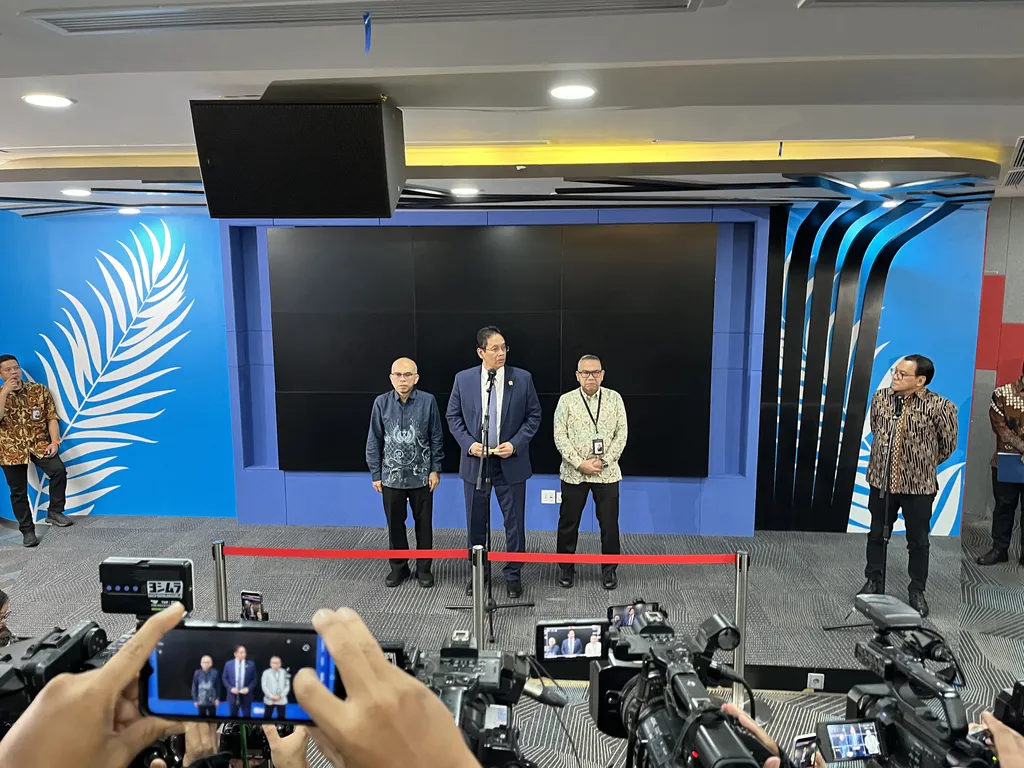
JAKARTA, KOMPAS — The involvement of the Daya Anagata Nusantara Investment Management Agency, or Danantara, in the coordination meetings of the Financial System Stability Committee (KSSK) is beginning to alter the coordination pattern of the national financial stability forum.
The government has assured that Danantara only plays a role in providing input and has no authority in decision-making. However, Danantara’s involvement in the financial stability forum has raised questions about the potential overlap of mandates between regulators and the state investment institution.
Danantara attended a KSSK coordination meeting for the first time in Jakarta on Tuesday (28/7/2026), following President Prabowo Subianto’s directive for the investment management body to be included in KSSK coordination. The government stated that Danantara’s presence is necessary to provide a business perspective so that economic policies formulated by regulators are more aligned with real-world conditions.
Finance Minister and KSSK Chair Purbaya Yudhi Sadewa said that Danantara attended as an invited party and does not have voting rights. He explained that decisions remain the authority of the four KSSK members: the Ministry of Finance, Bank Indonesia (BI), the Financial Services Authority (OJK), and the Indonesia Deposit Insurance Corporation (LPS).
“Danantara’s position in this meeting is as an invitee. We are all regulators. Sometimes, when meetings are only among regulators, we need to hear input directly from business actors who run large-scale businesses,” Purbaya said after the meeting.
He added that Danantara’s input is necessary so that regulators can obtain additional information regarding business conditions, especially in formulating policies that impact the economy. “So far, they have provided input, and it has been very useful for us to see the real conditions in the business world. We as regulators sometimes see issues from a regulatory perspective. Therefore, Danantara enriches us with additional information from the business side,” he said.
Purbaya confirmed that Danantara’s involvement does not change the decision-making mechanism within the KSSK. The government also noted that the involvement of other parties outside KSSK membership is permitted under Law Number 4 of 2023 concerning the Development and Strengthening of the Financial Sector (P2SK).
“The law allows it to be attended by other invited institutions or parties. So, KSSK may invite other parties outside of KSSK. However, in decision-making, Danantara will not have voting rights,” Purbaya stated.
Going forward, the government plans to involve Danantara in KSSK coordination on a regular basis. According to Purbaya, this step is a directive from the President to ensure that policies across various economic sectors can run more harmoniously.
However, this routine involvement has drawn attention from economists, given that KSSK and Danantara have different mandates. KSSK was formed as a coordination forum among authorities to maintain financial system stability, whereas Danantara’s mandate is to manage strategic investments and optimise state assets.
Bhima Yudhistira, Executive Director of the Center of Economic and Law Studies (Celios), said that Danantara’s involvement is still acceptable as long as it is limited to providing information without participating in the decision-making process. However, he warned that problems would arise if Danantara began to influence KSSK decisions, as the forum’s mandate is to maintain financial system stability through coordination among authorities with public powers.
According to Bhima, Danantara has a different character because it is an investment institution that also has interests in business development and asset optimisation. This condition could potentially create a conflict of interest if it becomes too deeply involved in policy discussions.
“If Danantara can intervene in every KSSK meeting, there is a concern that when Bank Indonesia raises interest rates to maintain rupiah stability or issues other monetary policies, Danantara might consider it unsupportive of its priority programmes,” Bhima said.
He assessed that this situation could put Bank Indonesia in a dilemma in carrying out its mandate to maintain monetary stability. Moreover, Danantara’s involvement comes at a time when BI is still without a definitive governor following the resignation of Perry Warjiyo.
Bhima emphasised that the independence of the central bank is one of the factors that determine the credibility of monetary policy in the eyes of the market. If the market perceives interference from a non-regulatory institution in the financial stability forum, risk perception could increase.
“This situation could actually cause investor confidence to decline because they see the monetary sector being intervened by an institution that is not actually a financial sector supervisor,” he said.
In addition to the risk to BI’s independence, Bhima also highlighted Danantara’s position as an institution that has its own financing instruments, such as Patriot Bonds and Merah Putih Bonds. He said this condition needs to be considered in setting boundaries for Danantara’s involvement in KSSK.
Meanwhile, Andalas University economist Syafruddin Karimi assessed that Danantara’s presence in KSSK can still be justified as long as it is placed in a limited capacity as a provider of technical information, not as part of the decision-making structure.
Nevertheless, he reminded that the P2SK Law has provided a clear design for KSSK. The forum is built upon the mandates of each authority: the Ministry of Finance with fiscal authority, BI with monetary stability and payment systems, OJK with financial services sector supervision, and LPS with deposit insurance and bank resolution functions.
Danantara can provide input regarding risks in the real sector.