
Investors Turn to Gold as Global Demand Reaches Record $193 Billion in Q1
Investors Turn to Gold as Global Demand Reaches Record $193 Billion in Q1
Jakarta. Global gold demand remained resilient in the first quarter of 2026 despite heightened market volatility and geopolitical uncertainty, with total demand – including over-the-counter (OTC) transactions – rising 2% year-on-year to 1,231 tons, according to data released Wednesday by the World Gold Council.
The total value of gold demand surged 74% to a record $193 billion, underscoring strong price momentum and sustained investor interest in the precious metal as a safe-haven asset.
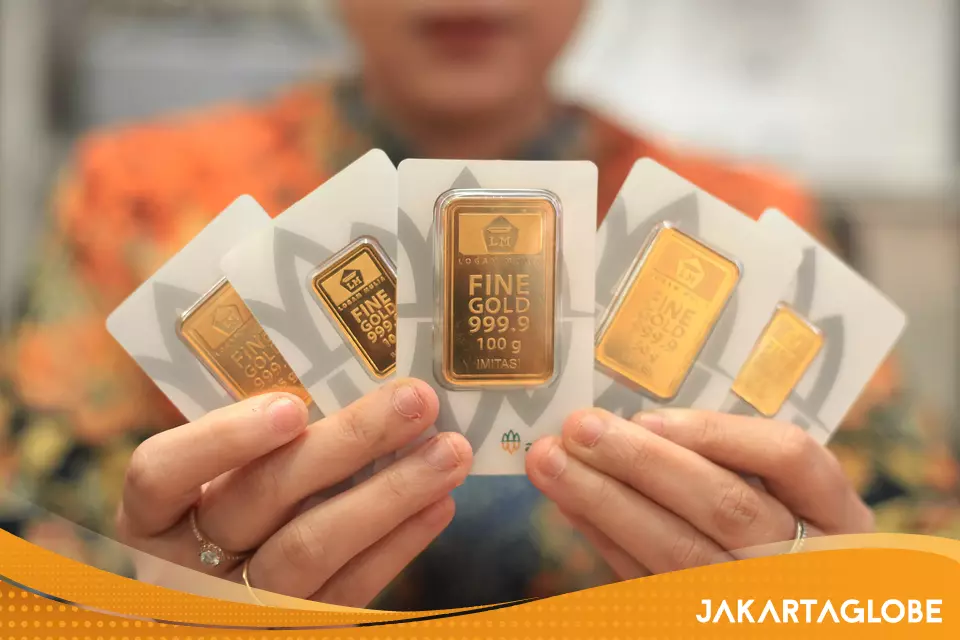
Demand for gold bars and coins jumped 42% year-on-year to 474 tons, driven largely by strong buying across Asia, particularly in China and India, according to Shaokai Fan, the council’s head of Asia-Pacific and global head of central banks.
“Global geopolitical uncertainty continues to drive investors toward gold as a safe-haven asset,” Shaokai said during a teleconference with Indonesian journalists. “In Indonesia, this confidence is reflected not only in physical demand, but also in the evolution of the market itself. The growth of digital platforms and bullion banking initiatives is a crucial step in removing access barriers and strengthening market confidence.”
Strong purchases of bars and coins also reinforced a broader structural shift in global gold demand. The trend extended beyond Asia, with demand in the United States and Europe rising 14% and 50%, respectively.
Central banks remained major buyers during the quarter, purchasing 244 tons of gold, up 3% from a year earlier. The figure exceeded both the previous quarter’s total and the five-year average. Bank Indonesia added two tons to its reserves, signaling continued institutional confidence in gold as a store of value amid persistent global uncertainty.
Overall investment demand remained relatively firm. Although total gold investment demand fell 5% year-on-year to 536 tons, robust purchases of bars and coins helped offset softer demand for exchange-traded funds (ETFs). Continued inflows into Asian-listed gold ETFs were partially offset by outflows from US-listed funds in March, highlighting the resilience of physical investment demand.
Gold Emerging as a Core Investment Asset
Shaokai said demand for gold bars and coins remained a key driver of growth globally and in Indonesia. Domestic demand for bars and coins rose 47% year-on-year, reflecting growing investor interest in assets perceived as protection against economic uncertainty and inflation.
Gold has historically served as a trusted hedge during periods of financial instability in Indonesia. During the 1997–1998 Asian financial crisis, the metal helped preserve purchasing power as the rupiah depreciated sharply, a pattern that has resurfaced during subsequent episodes of currency weakness and market stress.
In 2025, gold outperformed most domestic and global equities as well as rupiah-denominated bonds. In the first quarter of 2026 alone, gold prices rose 14% in rupiah terms while Indonesia’s stock market corrected by as much as 13%.
As the world’s largest Muslim-majority country, Indonesia has also shown strong demand for investment products that comply with Syariah principles. Gold, as a tangible and non-interest-bearing asset, is widely regarded as compatible with Islamic finance.
“Physically backed gold ETFs, when designed in accordance with Syariah principles, will align strongly with investment preferences in Indonesia,” Shaokai said. “This creates significant opportunities to reach the country’s large Muslim investor base. The continued development of a Syariah-based gold ecosystem will further strengthen gold’s appeal as a long-term wealth protection instrument.”
Louise Street, senior markets analyst at the World Gold Council, said gold market volatility intensified in early 2026, with prices briefly surpassing $5,400 per troy ounce in January.
She said geopolitical risks and strong price momentum continued to support investment demand, particularly in Asia, while sustained central bank purchases helped cushion selling pressure in the market.
Looking ahead, the council expects geopolitical uncertainty to remain a key pillar supporting gold demand. Jewelry demand is projected to stay resilient despite elevated prices, while mine supply is expected to grow moderately, although energy supply constraints could present challenges for producers.
Tags: Keywords: