
Investor Hearts Calm Slightly, Here's Why the IHSG Rose 1%
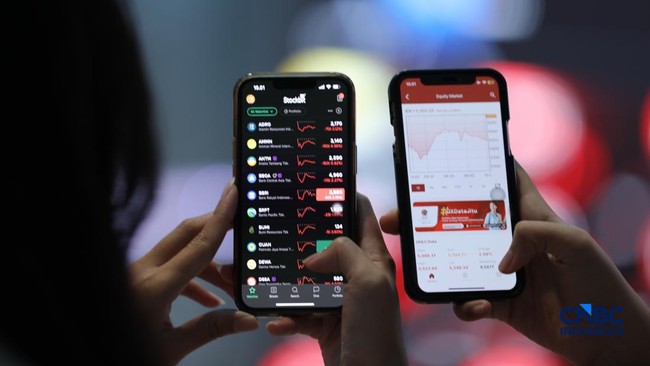
Jakarta — Stock investors in the country breathed a sigh of relief this morning. After the Jakarta Composite Index (IHSG) closed down 3.56% yesterday, the IHSG strengthened this morning with all sectors in the green zone. The IHSG initially opened in the red zone before finally accelerating and rising by more than 1%. A majority of shares, or 463 issuers, rose, 153 fell, and 343 were stagnant. Transaction value was fairly busy, amounting to Rp 3.02 trillion, involving 5.13 billion shares in 400,300 transactions. Market capitalisation remained below Rp 11,000 trillion, precisely at Rp 10,426 trillion. Based on Refinitiv data, the IHSG’s strengthening was broad-based, with all sectors in the green zone. The energy sector rose 1.57%, technology 1.19%, and consumer non-cyclicals 1.15%. In terms of index contributors, large-capitalisation stocks were the main engine of the strengthening. PT Bank Central Asia Tbk (BBCA) was the largest contributor with a contribution of 7.02 points to the IHSG. It was followed by PT Mora Telematika Indonesia Tbk (MORA) with 5.83 points, PT Astra International Tbk (ASII) with 4.79 points, PT Barito Pacific Tbk (BRPT) with 4.78 points, and PT Bank Rakyat Indonesia (Persero) Tbk (BBRI) with 4.70 points. Support also came from SMMA, BYAN, TLKM, DSSA, and BMRI. Meanwhile, the drag on the index’s rise was relatively limited. Shares of PT Amman Mineral Internasional Tbk (AMMN) were the largest weight with a negative contribution of 1.21 points, followed by PT Aneka Tambang (Persero) Tbk (ANTM) at -1.13 points, PT Merdeka Copper Gold Tbk (MDKA) at -0.79 points, PT Bank Mega Tbk (MEGA) at -0.44 points, and PT Alamtri Minerals Indonesia Tbk (ADMR) at -0.37 points. Entering trading on Thursday (25/6/2026), the IHSG’s movement is expected to still be influenced by sentiment from the MSCI review results, which maintained Indonesia in the Emerging Market classification. The decision eased market concerns over the potential for massive foreign fund outflows if Indonesia’s status were downgraded to Frontier Market. However, MSCI still provided notes regarding share ownership transparency, allegations of coordinated trading, and the effectiveness of capital market reform implementation, which will be re-evaluated in November 2026. Domestically, the Financial Services Authority (OJK) and the government assessed that the MSCI decision reflects the continued strong confidence of global investors in Indonesia’s financial market. The OJK affirmed it will continue reforms to strengthen market integrity and transparency, while the government considers MSCI’s continued evaluation a normal process. On the external side, investor attention is shifting to the release of the United States Personal Consumption Expenditures (PCE) inflation data, which is the main reference for the Federal Reserve in determining the direction of interest rate policy. If PCE inflation shows another increase, expectations of higher-for-longer interest rates could strengthen, driving a stronger US dollar and higher Treasury yields, which could trigger pressure on risky assets including the IHSG and the rupiah. In addition, the market is also waiting for weekly US jobless claims data to gauge the latest condition of the labour market. The combination of still-high inflation and a solid labour market could reinforce the view that the Fed does not yet have room to cut interest rates soon. Amid these sentiments, the US dollar index, which has breached the 101.609 level, remains a factor limiting the room for rupiah and domestic stock market strengthening, along with increasing pressure on capital flows to developing countries. Referring to Refinitiv data, the rupiah had to settle in the red zone after closing down 0.50% at Rp17,925/US$ yesterday, Wednesday (25/6/2026). With that position, the Garuda currency has not been able to escape pressure and has weakened for four consecutive trading days.