
Investment Targeted to Grow 7 Per Cent to Chase 6 Per Cent Economic Growth
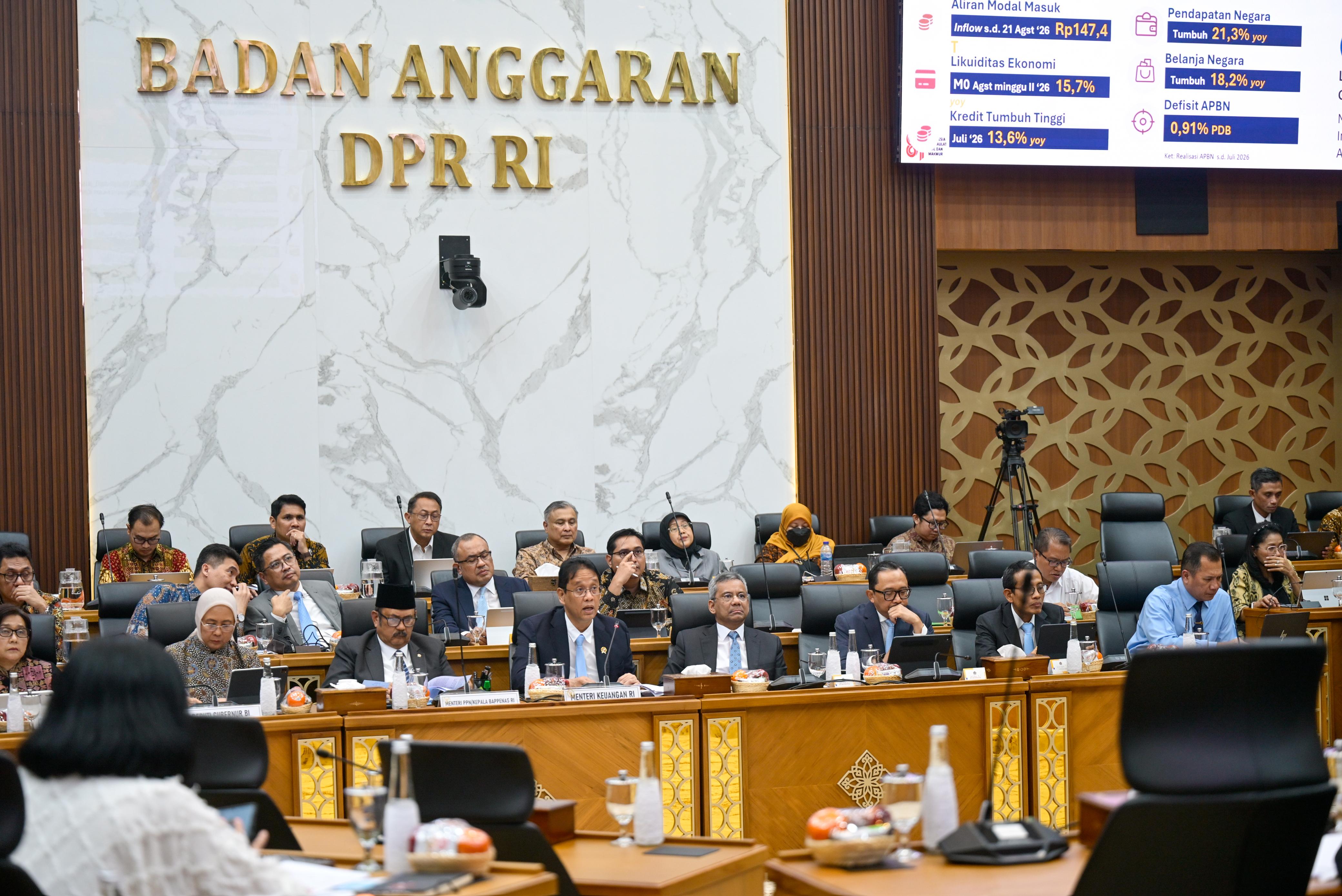
The government is relying on investment acceleration to chase a 6 per cent economic growth target in 2027. Investment growth is targeted to reach 7 per cent, with the majority of financing requirements expected to originate from the private sector.
Finance Minister Purbaya Yudhi Sadewa stated that investment will be one of the main pillars to drive economic growth next year. The government will act as a catalyst, while the private sector is expected to be the primary engine of investment.
“To drive higher economic growth, namely 6 per cent in 2027, investment growth acceleration of up to 7 per cent is required,” said Purbaya during a working meeting with Commission XI of the House of Representatives (DPR) and the government regarding the basic assumptions for the 2027 State Budget (APBN) in the Parliament Complex, Jakarta, on Tuesday (1/9/2026).
According to Purbaya, achieving this target requires collaboration between the government, the private sector, and the Danantara Investment Management Agency. The government will strengthen the synergy between fiscal, monetary, and financial sector policies, alongside Danantara, to ensure every instrument operates optimally.
Danantara is directed to accelerate productive investment, particularly in strategic sectors and downstreaming processes that possess high added value. Danantara’s investment for 2027 is even targeted to reach Rp 1,200 trillion.
This target was agreed upon during a meeting between Danantara, the Ministry of Finance, the Ministry of National Development Planning/Bappenas, Bank Indonesia, and the leadership of the DPR on Monday.
Following the meeting, the Vice Chairman of Commission XI of the DPR, Fauzi Amro, stated that the Rp 1,200 trillion Danantara investment target serves as one of the benchmarks in drafting the 2027 economic growth target. This figure represents an increase of approximately 370.58 per cent compared to the 2026 Danantara investment target of Rp 255 trillion.
“Danantara has formulated its investment at Rp 1,200 trillion. Since we want the Rp 1,200 trillion investment to support economic growth, that figure becomes our benchmark in drafting growth projections,” said Fauzi.
Meanwhile, the Chief Operating Officer of Danantara, Dony Olam, stated that investment plays an increasingly significant role in the effort to achieve 6 per cent economic growth. Therefore, Danantara is prepared to provide a greater push for capital investment next year.
According to him, the target was set after policymakers conducted a consolidation of the macro assumptions within the 2027 Draft State Budget (RAPBN).
“This is in the context of growth. One of the most significant components of growth is investment,” he said.
The scale of the Danantara investment target is part of a much larger national investment requirement. The Ministry of Finance estimates that the total investment requirement for 2027 will reach Rp 8,705 trillion.
Of this requirement, the capacity of the State Budget (APBN) to support investment is estimated to be only around 5 per cent. The government estimates that the APBN can support investments worth Rp 459 trillion, or approximately 5.2 per cent of the total requirement.
Meanwhile, State-Owned Enterprises (SOEs), including Danantara, are expected to contribute Rp 330 trillion, or approximately 3.8 per cent. Consequently, about 91 per cent, or Rp 7,973 trillion, must come from private sector financing.
Deputy Finance Minister Juda Agung, who also attended the meeting, stated that private financing could come from banks, other financing institutions, and the capital market.
“The remainder must largely come from private financing sources, namely Rp 7,973 trillion, or 91 per cent from private financing. This includes banks, other financing, and the capital market,” he said.
The large proportion of private involvement indicates that achieving economic growth targets cannot rely solely on the expansion of government spending or SOE investment. The government’s ability to create an attractive investment climate is crucial to ensure that businesses are willing to increase expansion.
Juda noted that the capital market also plays a strategic role as a source of private financing, acting as a link between corporate financing needs and public funds.
Furthermore, the government will optimise the development of the Indonesia International Financial Centre (PFII). This financial centre is designed as a new financial instrument to support the utilisation of Indonesia’s natural wealth while attracting financing into the country.
Finance Minister Purbaya stated that investment acceleration must proceed alongside macroeconomic stability. Stability is required to provide certainty for businesses, maintain investor confidence, and encourage sustainable investment.
The government will maintain this stability through several policies. Inflation control is one of the focuses to maintain public purchasing power, consumption, and the investment climate.
A mix of fiscal and monetary policies will also be directed towards keeping interest rates competitive to support access to financing, strengthen business confidence, and encourage investment activities. Purbaya is optimistic that the government, alongside Bank Indonesia, will continue to maintain the stability of the rupiah exchange rate.
“These policies are aimed at strengthening economic resilience, mitigating global impacts, and providing certainty for the business world in making investment and expansion decisions,” said Purbaya.
The government’s optimism is supported by several economic indicators. In the first half of 2026, the Indonesian economy grew by 5.45 per cent cumulatively. Inflation also remained controlled, while banking liquidity was deemed adequate to support credit distribution.
Indonesia’s trade balance for January-June 2026 still recorded a surplus. Foreign exchange reserves as of July 2026 reached 145.3 billion USD.
Positive sentiment was also visible in the financial markets.