
Investment Grows 7%, Indef Urges Focus on Accelerating Project Realisation
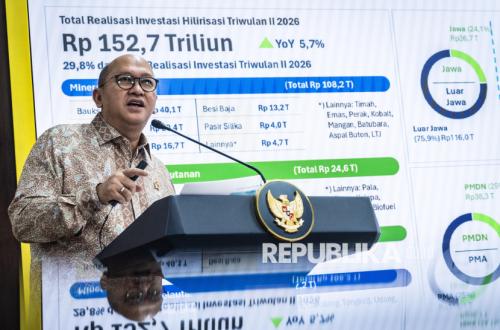
The Head of the Centre for Macroeconomics and Finance at the Institute for Development of Economics and Finance (Indef), M Rizal Taufikurahman, views the investment realisation in the first half of 2026 as showing that Indonesia’s investment appeal remains reasonably intact amid global economic uncertainty.
According to a report by the Ministry of Investment and Downstream Industry/Investment Coordinating Board (BKPM), investment realisation over the period reached Rp 1,010.6 trillion, or about 49.5 percent of this year’s target.
“However, the challenge in the second half is no longer attracting investment commitments, but ensuring that investment is promptly realised into productive projects,” Rizal said in Jakarta on Saturday (18/7/2026).
Therefore, he said, the government needs to accelerate project execution through simplified licensing, regulatory certainty, faster infrastructure development, and the resolution of various obstacles on the ground.
“This means investment should not only be high in nominal terms, but also capable of driving economic growth and boosting national production capacity,” he said.
Rizal assessed that Indonesia’s investment climate still has relatively good resilience, supported by a large domestic market, the downstreaming agenda, and maintained macroeconomic stability.
However, investors in the second half are expected to be more selective given high global uncertainty, geopolitical tensions, and still-elevated funding costs.
These conditions mean investment is likely to flow towards sectors offering assured returns and high added value, such as mineral downstreaming, manufacturing, the digital economy, data centres, energy, and logistics.
“Therefore, policy consistency becomes a key factor for Indonesia to remain competitive compared with other investment destination countries in the region,” Rizal said.
Meanwhile, investment realisation in the first half of 2026 absorbed 1.44 million workers, up 15 percent compared with the same period last year, according to the Ministry of Investment and Downstream Industry/BKPM.
Rizal considered the increase in employment absorption a positive development, but said it was not yet sufficient to conclude that investment has been of high quality.
“The measure of investment success is determined not only by the number of jobs created, but also by productivity, wage levels, technology transfer, improvements in workforce skills, and the amount of added value generated,” he said.
To that end, Rizal said, investment policy needs to shift orientation from merely chasing realisation figures towards more productive, inclusive, and sustainable investment, so as to strengthen the competitiveness of national industry while improving public welfare.