
Investment Grows 7.59% in Q3 2026 as Domestic Investment Weakens
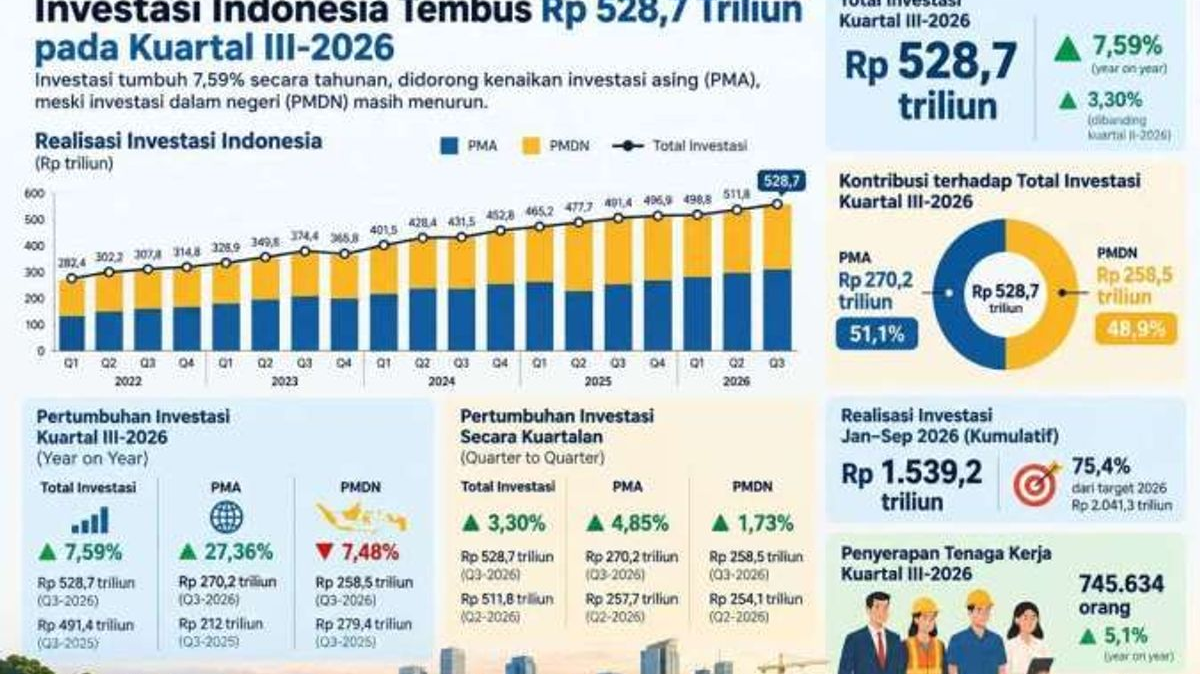
Indonesia’s investment realisation reached Rp528.7 trillion in the third quarter of 2026, growing 7.59% compared with the same period a year earlier. The Ministry of Investment and Downstreaming recorded the figure, despite domestic investment (PMDN) falling by 7.48%.
The data show that national investment growth still faces challenges towards the end of 2026. In a report published on 20 October 2026, Kontan highlighted financial-market volatility and weaker business activity as factors that could prompt companies to postpone expansion plans.
Against this backdrop, mineral downstreaming is one of the government’s strategies to strengthen investment and increase the added value of natural resources. Investment and Downstreaming Minister and Investment Coordinating Board (BKPM) head Rosan Roeslani said the sector had made a significant contribution to national investment.
Speaking at the Indonesia Sustainability Forum (ISF) in Jakarta on 6 October 2026, Rosan said downstreaming accounted for around 30% of total investment in Indonesia, worth US$61 billion, an increase of 7.2%.
“Indonesia has some of the world’s most important reserves of nickel, bauxite, copper and strategic critical minerals. Our goal is to build industries. That is why downstreaming remains a main pillar of our economic strategy,” said Rosan Roeslani, Investment and Downstreaming Minister and head of BKPM.
Rosan explained that downstreaming development is now focused on building an integrated industrial ecosystem. This approach links mining, mineral processing, manufacturing, clean energy and technology so that natural resources generate greater added value domestically.
One of the groups implementing the strategy is MIND ID, which is developing value chains for various commodities, including nickel, bauxite, alumina, aluminium and copper. Its plans also include preparing a recycling industry to support a circular industrial ecosystem in Indonesia.
In the nickel sector, development is intended to support the electric-vehicle battery supply chain through Indonesia Battery Corporation (IBC). This work connects the country’s mineral resources with the battery and electric-vehicle industries.
For bauxite, industrial development includes processing it into alumina and then aluminium for use in manufacturing. Copper downstreaming, meanwhile, is intended to meet demand across sectors including electricity, electronics and manufacturing.
Rosan also identified electrification as a key area for mineral-based industrial development in Indonesia. He linked it to building a production chain spanning mining, battery-cell manufacturing and electric vehicles.
“There are three prominent areas. First, electrification, from mining through to battery cells and electric cars. Indonesia is now producing battery cells at two large factories with Hyundai and CATL, as well as at IBC, our state-owned company, which began operating in stages in August,” Rosan said.
The downstreaming programme is part of the government’s effort to expand domestic industrial activity, while third-quarter 2026 data show that overall investment continued to grow alongside a decline in domestic investment.
Source: jawawa.id (https://jawawa.id/newsitem/investment-grows-7-59-in-q3-2026-as-domestic-investment-weakens-1792601435)
Originally published by demokratis.co.id (https://demokratis.co.id/investasi-kuartal-iii-2026-tumbuh), translated from Indonesian