
Inverted Ground: Traces of a Major Earthquake Found on Mount Ciremai
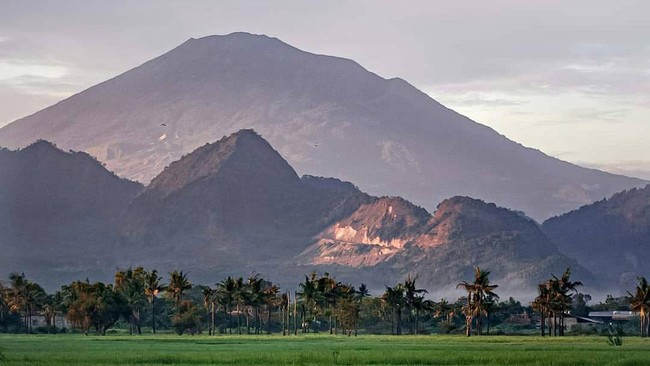
Inverted Ground: Traces of a Major Earthquake Found on Mount Ciremai
West Java, CNBC Indonesia - Traces of tectonic and volcanic activity dating from the Quaternary period (beginning around 2.58 million years ago) have been found in West Java, specifically in the East Ring of Kuningan. This was revealed through geochronology analyses and LiDAR mapping of distal deposits of Mount Ciremai.
Junior Researcher at the Center for Geohazard Research (PRKG BRIN) and the lead of the research team, Sonny Aribowo, explained that the study was conducted to determine the age of Ciremai’s deposits disturbed by tectonic activity.
Using radiocarbon dating along the East Ring of Kuningan, deposits aged about 22,000 years were found above a deposit aged about 20,000 years. This indicates evidence of uplift fault activity occurring after 20,000 years, whereby older layers would be thrust above younger ones.
“In addition to the uplift fault, there is also evidence of a normal fault in deposits around 16,000 years old, which indicates a phase of sediment balancing after the major tectonic pressure, or possibly traces of a major earthquake event in that period,” Sonny said in a statement, quoted on Friday (8 May 2026).
“The study also succeeded in distinguishing distal and proximal deposits of Mount Ciremai. Distal deposits are volcanic basaltic sub-alkaline sediments with high iron content and low silica, while proximal deposits near the summit area are dominated by basaltic andesitic rocks with a medium-K magma series,” he explained.
However, he added, the relationship between the two needs further study, as both distal and proximal deposits exhibit different characteristics.
The use of LiDAR in this study enables viewing Earth’s surface features without vegetation obstruction. The results also show tilting and faulting in the land morphology.
“Radiocarbon and LiDAR data provide an important update to the chronology of Mount Ciremai’s eruptions. This finding shows that the phase of tectonic deformation in the Kuningan region occurred in step with the volcano’s history of volcanism,” Sonny said.