
Interview with 'King of Krakatau' Prof Tukirin: This Volcano Teaches the Succession of Life
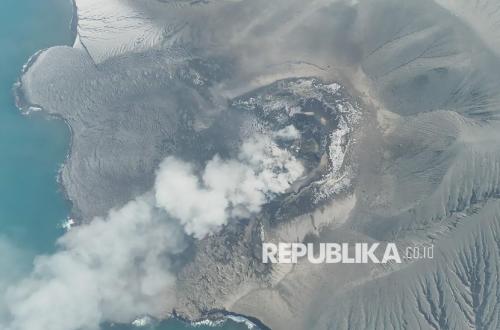
The eruptions of Krakatau’s child, Anak Krakatau, and Rakata continue. Ash from the eruptions has spread from Sumatra to Java, with extraordinary effects: aircraft have been barred from the skies, schools in several regions closed over fears of volcanic ash affecting pupils, though ferry crossings remain carefully monitored.
The life of Krakatau and Rakata seems to breathe in step with words like disaster and destruction. Yet behind that, this ancient child-volcano harbours a unique form of life. Professor Tukirin Partomihardjo is a researcher at the Indonesian Institute of Sciences (now the National Research and Innovation Agency, BRIN) who has diligently studied the environment of that dangerous area. He has spent more than 30 years travelling back and forth to research and write about the environment of Krakatau, Rakata and the surrounding islands.
No wonder Prof Tukirin was dubbed the ‘King of Krakatau’ in a documentary film, given his expertise in such an extremely unstable place. Republika interviewed Prof Tukirin on Monday (7/9/2026) at midday. Though no longer young, his answers sounded spirited and very coherent. “I keep communicating with the Natural Resources Conservation Agency (BKSDA) of Banten to monitor the situation at Krakatau,” he said. Although he last visited Rakata in 2018, after the devastating tsunami, Prof Tukirin promptly replied that he was ready to return once the situation allows. The following are excerpts from the interview:
When did you last visit Krakatau-Rakata?
It has been quite a while; the last time was in 2018, after that tsunami.
You have researched the Krakatau islands for more than 30 years. What was different between your first visit and your most recent one?
I first set foot on Anak Krakatau in 1981. What has changed greatly by the time of my last visit is that Anak Krakatau has become extremely active. In the early 1980s, Anak Krakatau stood about 150-200 metres above sea level; before the 2018 tsunami it had already reached 300 metres. When the eruption and landslide that caused the 2018 tsunami occurred, it changed completely to 150 metres — half the mountain was lost. There used to be vegetation covering 17 per cent of Rakata, but that was completely lost to the eruption. There was no life of any kind after the last eruption and landslide.
Krakatau and Rakata have erupted repeatedly, causing extraordinary ecological destruction. How does the environment recover? Which animals and plants appear there first?
It is difficult to detect. But based on previous literature, what is fascinating is that spiders could be the pioneer animals there. It turns out these spiders have an extremely wide dispersal range. However, spiders cannot survive alone; they cannot endure without a food source, so there must be insects for them to eat. As for plants, mosses could be the first to live there. Mosses can survive in extreme soil conditions. Where does the moss come from? It could arrive through the air, carried by the wind, or brought by ocean currents. After the 2018 eruption, all animals and plants were completely wiped out — starting again from zero. At that time, six months after the landslide, I stopped by Krakatau-Rakata. Sailing around, I already found small leaves growing, and also a coconut seed just beginning to sprout.
After three decades researching the Krakatau environment, have you found any unique plants there?
The most interesting thing is indeed the presence of plant species dispersed by humans. There was once a fairly large banana plantation on Sertung Island, and there were also durian trees, orange trees, guava trees and jackfruit trees. This is because of human intervention. We once found, along the Krakatau tourist trek, grass typical of a particular region of Java. How could it be there? It seems the grass seeds were carried in the trouser cuffs of visiting hikers. We also found tomato and red chilli vegetables, and bird’s eye chilli too. Tomatoes and chillies most likely came from fishermen cooking their meals, while bird’s eye chilli could have been spread by birds carrying the seeds. Humans also act as dispersal agents for animals, for instance rats. There were once very many rats on Krakatau. Where did they come from? We discovered that the rats came down from fishermen’s boats via mooring ropes when the fishermen stopped at the island.
What does Krakatau-Rakata teach us with its erupting activity — bringing life, then wiping everything out, and erupting repeatedly again?
It teaches us about succession. It shows that for life to grow and develop stably takes a very long time. Imagine: from 1883 until now, Krakatau has still not stabilised; primary vegetation has not yet formed. Destroyed, then growing and developing again. So exploiting natural resources, for example in mining, must be done most wisely, so that damage is not too great and the environment remains sustainable.
What has been your most memorable experience there?
What I remember most is that I felt I came back to life at Krakatau! The story is that in 1998/1999 I was invited to take part in an Australian documentary shoot. The main ship anchored quite far away. I and two others were taken by small boat to Krakatau. We had only been climbing for a short while when the mountain erupted, rocks scattering and falling from the sky. I panicked terribly. Thank God, the three of us survived, not hit by a single rock. The team on the main ship had already declared that all three of us must have died. But they still sent a boat to check on us at the beach. When they saw us on the shore they were shocked, thinking we were ghosts. Behind me, a single casuarina tree had been struck by erupting rocks and burnt completely. Thank God… thank God…
In your view, with the current eruption situation, could another landslide like the one in 2018 occur?
Theoretically, it seems not. Because the steep part of Rakata that existed in 2018 has already slid away. Now it is actually in an accumulating phase, building up until it becomes quite high again, and then, if triggered by an eruption, that wall could well collapse again.
Source: jawawa.id (https://jawawa.id/newsitem/interview-with-king-of-krakatau-prof-tukirin-this-volcano-teaches-the-succession-of-life-1788774996)
Originally published by Republika (https://news.republika.co.id/berita/tkzey8475/wawancara-king-of-krakatoa-prof-tukirin-gunung-ini-mengajarkan-suksesi-kehidupan), translated from Indonesian