
Internet Access Helps Schools in East Flores Implement Digital Learning
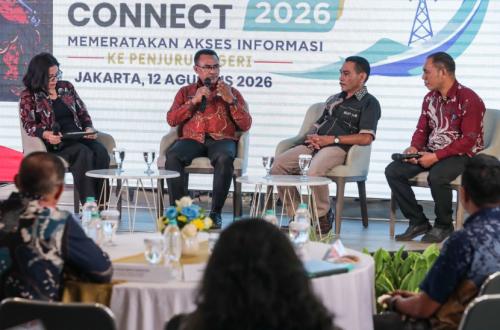
Internet access is beginning to transform educational activities in remote areas, including East Flores Regency, East Nusa Tenggara. Connectivity is not only opening up access to information for students and teachers but also helping schools conduct digital-based learning, administration, and various assessments. Konrardus Kudarto, Head of SMAN 1 Titehena, said his school’s situation changed after receiving internet infrastructure support from the Telecommunications and Information Accessibility Agency (BAKTI) of the Ministry of Communication and Digital. Previously, the school was in a blank spot area with very limited internet access. “In 2016 when I became the principal, the school was located in a blank spot village, there was no signal. There was a signal only in certain places where 4G could appear, like up a tree. But almost everywhere else it was E (Edge),” Konrardus said during the BAKTI Media Connect 2026 event on Wednesday. At that time, he relied on a modem and data package to meet the school’s communication needs. Conditions began to change in 2017 when the school received Wi-Fi equipment assistance from BAKTI Kominfo through iForte. “In 2017 the school got Wi-Fi equipment assistance from Bakti Kominfo, iForte. That really helped us on the ground,” Konrardus said. According to Konrardus, the need for connectivity is now even greater along with the use of digital technology in educational activities. The internet is used not only for the learning process but also for administration and student assessments. “There are many things, learning must be digital-based, administrative reporting is also digital, and it is most needed for assessments,” he said. He hopes the existing infrastructure can be strengthened so that its utilisation can be more optimal, especially to support the implementation of assessments. Several educational assessments require an internet connection, including the Computer-Based National Assessment (ANBK), Academic Competency Tests (TKA), and Teacher Competency Tests. BAKTI President Director Fadhilah Mathar said the need to improve connectivity quality is also a common input received from local governments and beneficiary communities. He noted that this demand is a consequence of the increasing number of activities using the internet once connectivity is available. “We are used to being scolded in the literal sense, but we accept that as something we must endure because of the community’s longing for a signal,” Fadhilah said. To date, BAKTI has built internet access in more than 31,000 locations. Around 68 percent of these are in the education sector, while 5.89 percent are in the health sector to support e-government. Approximately 19.9 percent of other locations cover government offices and various public facilities, such as traditional markets, places of worship, defence and security posts, business and service locations, and public transportation. “Development at BAKTI is like the legs of a table tennis table. There are four legs. First is community sustainability because this will help adoption and inclusion. Second is service quality. Third is encouraging MSME scalability. Fourth, and no less important, is industry sustainability. The government must not come in and kill commercial space,” Fadhilah said. Therefore, BAKTI encourages collaboration between local governments, cellular operators, and other partners so that the infrastructure that has been built can evolve according to community needs. Fadhilah said the development of connectivity in underdeveloped, frontier, and outermost regions must ultimately result in community self-reliance. The government does not want to remain in a location once the digital ecosystem there can run independently. “Because the success of the government’s Universal Service Obligation is not how long we are there, but how quickly we leave that location. In the sense that the community can already be self-sufficient,” Fadhilah said.