
International Webinar Reflects on 20 Years of Sukma Bangsa School, Building the Future of Educational Civilisation
The essence of the restoration movement is to build civilisation and strengthen human quality.
It has been exactly 20 years since the birth of Sukma Bangsa School in Aceh. This child of the nation’s civilisation was born from the womb of the ‘Indonesia Weeps’ programme run by Media Indonesia and Metro TV.
By divine will, this brilliant child grew up thanks to the contributions of Acehnese intellectuals, a number of national figures and public donations. Its embryo began as a seed of recovery from the natural disaster of the earthquake followed by the tsunami of 26 December 2004.
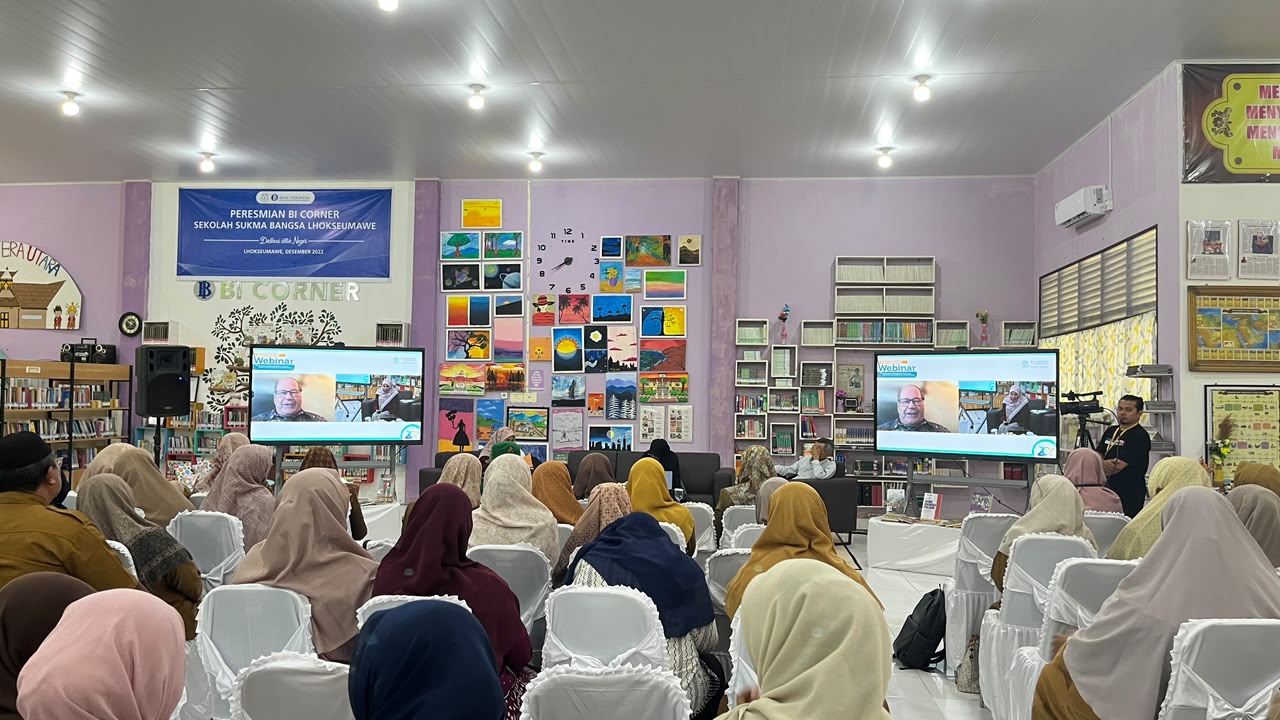
To mark two decades of reflection on this school of character, peace and environmental care, the Sukma Foundation held an International Webinar on Tuesday (21 July). The seminar, titled ‘Perspectives on Sukma Bangsa School: Two Decades of Transformative Education, Collaboration, and Global Citizenship’, was centred at the Sukma Bangsa School complex in Lhokseumawe.
The hybrid event brought together academics, education practitioners and international partners from various countries. It also served as a projection of the future of education after two decades of Sukma Bangsa School’s journey to humanise humanity.
The academic presenters, education practitioners and international partners were experts or academics from Finland, the United States, Japan and South Africa, alongside local and national education figures.
Lestari Moerdijat, Chair of the Sukma Foundation, said in her remarks that Sukma Bangsa School was built not only as a response to conditions after the Aceh earthquake and tsunami, but also as a long-term investment to build human civilisation.
‘Sukma Bangsa School was built to produce global citizens who are not only capable of competing, but also capable of working together with people from all corners of the world,’ said Ibu Rerei, as Lestari Moerdijat is affectionately known.
According to Lestari, who is also Deputy Speaker of the People’s Consultative Assembly (MPR RI), education must become a space of learning for all parties, not only for students. Teachers, school administrators, foundations and education partners must continue to learn and collaborate to answer ever-evolving global challenges.
THE JOURNEY
On that occasion, Ahmad Baedowi, Executive Director of the Sukma Foundation, also recounted the twenty-year journey of Sukma Bangsa School, which cannot be separated from the support of partners and friends of education from various countries and nations across the world.
‘Twenty years of Sukma Bangsa proves that education built with sincerity is capable of transcending the boundaries of geography, culture and even countries,’ said Baedowi.
Academic speaker Professor Eero Ropo from Finland emphasised the importance of education in facing the climate crisis, which has become a global problem that has unsettled lives in many parts of the world.
‘If schools fail to teach climate awareness today, then future generations will inherit problems far greater than those we face now,’ said Professor Eero Ropo.
The professor from Tampere University explained that future curricula must not contain knowledge alone; they must also shape students’ awareness, identity and responsibility towards the environment and the sustainability of human life and its surroundings.
Meanwhile, Tahir Schad, an academic from the United States, expressed appreciation for Sukma Bangsa School’s journey of more than two decades. ‘The greatest legacy of a school is not its buildings, but the human beings it shapes,’ explained Tahir Schad.
In his view, Sukma Bangsa School has demonstrated how to become a space that brings diversity together, builds cross-cultural collaboration and strengthens humanitarian bonds between nations.
A positive and inspiring response was also conveyed by Yuji from Japan. The professor from the Land of the Rising Sun was very positive about the reflection on Sukma Bangsa School’s long journey, from the early recovery of Aceh after 26 December 2004 to the present day.
‘For twenty years, Sukma Bangsa has grown from a post-disaster recovery school into a school that prepares agents of change and peace,’ said Yuji.
According to him, the next phase is for Sukma Bangsa to continue expanding its contribution in answering global education challenges and strengthening its role within society.
A CULTURE OF LEARNING
National speaker Komaruddin Hidayat hoped that a culture of learning would begin with educators themselves. Education must help students understand their identity as part of Acehnese society, the Indonesian nation, and simultaneously as global citizens with humanitarian responsibilities.
‘A teacher who stops learning is in fact closing off the future of his or her students,’ said Komaruddin Hidayat.
A similar view was expressed by Professor Ahmad Humam Hamid of Syiah Kuala University (USK) in Banda Aceh. According to him, the presence of Sukma Bangsa School is part of the great endeavour to rebuild Acehnese civilisation after the armed conflict and the tsunami that devastated the local coastal areas.
‘Aceh was once tested by conflict and tsunami. Sukma Bangsa exists to ensure that education becomes the path towards a stronger civilisation,’ said the professor, a son of Ayah Hamid of Samalanga, Aceh.
The sociologist from USK stressed that a school’s strength is measured not only by academic achievement, but also by its ability to shape the character and integrity of the younger generation.
Another speaker, Dr Iryana from Malikussaleh University (UNIMAL), emphasised the importance of synergy between educational institutions in building a better future for Aceh. Today’s educational challenges cannot be solved by a single institution alone.
Strong collaboration is needed between schools, universities, government, communities and various other stakeholders to ensure that every child has access to quality education.
LOCAL VALUES IN EDUCATION
Next, Baiquni from UIN Sultanah Nahrasiyah Lhokseumawe reminded the audience of the importance of making local values the foundation for developing future education.
‘Strong education is education capable of dialogue with its own cultural roots, whilst remaining open to global developments,’ said Baiquni.
In line with the ethno-theological perspective he presented, the wealth of Acehnese values, traditions and local wisdom can serve as important capital for building education that is relevant, character-driven and oriented towards humanity.
Finally, in the closing session, Samsir Alam of the Sukma Foundation’s Supervisory Board invited all education stakeholders to ensure that genuine change takes place in the classroom. ‘Educational transformation is not born from curriculum documents, but from what happens every day in the classroom,’ said Samsir Alam.
Meaningful learning must be able to connect knowledge with culture, history, the environment and the lived realities of students, so that education truly becomes a means of building a better civilisation.
Meanwhile, the chair of the International Webinar organising committee, Nadia Sabrina, expressed hope that the event would be an important moment to reflect on the journey of Sukma Bangsa School and to strengthen the global collaboration networks that have been built over the years.
The presence of speakers from various countries demonstrates that education is a joint endeavour that transcends territorial boundaries and backgrounds.
‘The spirit we wish to celebrate at this 20th anniversary is steadfastness in learning, collaborating and continuing to deliver benefits to society,’ Nadia hoped.
As is known, the primary, junior secondary and senior secondary schools were each built under one roof (one unit): one campus in Pidie Regency, one complex in Bireuen Regency and another in Lhokseumawe City.
Over two decades, Sukma Bangsa has grown from a school born of Aceh’s post-conflict and post-tsunami period into an educational institution that continues to build global collaboration in order to deliver meaningful learning for future generations.
Source: jawawa.id (https://jawawa.id/newsitem/international-webinar-reflects-on-20-years-of-sukma-bangsa-school-building-the-future-of-educational-1784796702)
Originally published by Media Indonesia (https://mediaindonesia.com/nusantara/913953/webinar-internasional-refleksi-20-tahun-sekolah-sukma-bangsa-membangun-masa-depan-peradaban-pendidikan), translated from Indonesian