
International Lectures No Longer Require Going Abroad
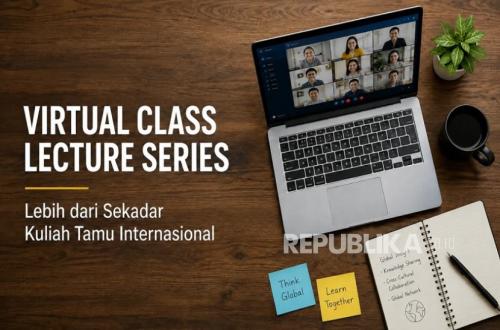
Amidst the rapid flow of globalisation and digital transformation, the concept of internationalising higher education is undergoing a major shift. While international academic experience was once synonymous with student exchange programmes, studying abroad, or physical mobility between countries, technology has now introduced a new paradigm that is more inclusive and accessible.
Internationalisation is no longer measured solely by how many students travel abroad, but also by the extent to which universities can bring global experiences into the student’s learning space. In this context, the use of digital technology has opened much wider opportunities to build academic networks across nations without being limited by geographical distance.
In my view, this change represents an important momentum for the Indonesian higher education sector. For years, the opportunity to gain international experience was often only available to a small fraction of students with access to global mobility programmes. However, global competence is no longer just an added advantage, but a necessity for every university graduate.
The modern workforce demands human resources capable of adapting to multicultural environments, understanding global perspectives, and collaborating with individuals from various cultural and national backgrounds. These skills cannot be acquired through conventional classroom learning alone.
Therefore, various digital-based international learning innovations, such as Virtual Class Lecture Series, are becoming increasingly relevant. Such programmes do not merely bring in international lecturers or experts as speakers, but also create spaces for academic interaction that allow students to exchange ideas, discuss global issues, and understand different viewpoints from around the world.
Furthermore, these experiences help students develop cross-cultural communication skills, enhance critical thinking abilities, and build the global mindset required in the digital economy era. Ultimately, technology is changing the very meaning of internationalisation.
Global learning experiences no longer need to depend on an individual’s ability to travel abroad. With the support of digital platforms, access to international learning can now be experienced more evenly and inclusively by more students. This is vital because future challenges demand graduates who are not only academically excellent but also capable of collaborating in an increasingly globally connected environment.
Multinational companies, digital industries, and international organisations are currently seeking talent capable of working in cross-border teams, understanding cultural diversity, and communicating effectively on a global level.
For universities, internationalisation does not stop at teaching activities. International academic activities can serve as a gateway to broader collaborations, ranging from joint research and international publications to global curriculum development and various strategic partnerships that can sustainably improve educational quality.
As part of Nusa Mandiri University (UNM), known as a Digital Business Campus, we view internationalisation as a long-term investment in building the quality of graduates who are competitive on a global scale. Therefore, various international collaboration programmes continue to be developed to ensure students gain learning experiences relevant to the needs of the future workforce.
The true essence of internationalisation lies not in how far someone travels, but in how broad their horizons become. An increasingly connected world requires a generation capable of understanding differences, adapting to change, and contributing to the global ecosystem.
Consequently, universities must continue to provide learning spaces that grant students access to international knowledge, perspectives, and networks. In the digital era, the world no longer feels far away. The world is now present within the learning space, and students who can leverage this will have greater opportunities to become global talents ready to compete and contribute internationally.