
International expert team reviews accelerated development of Way Kambas National Park
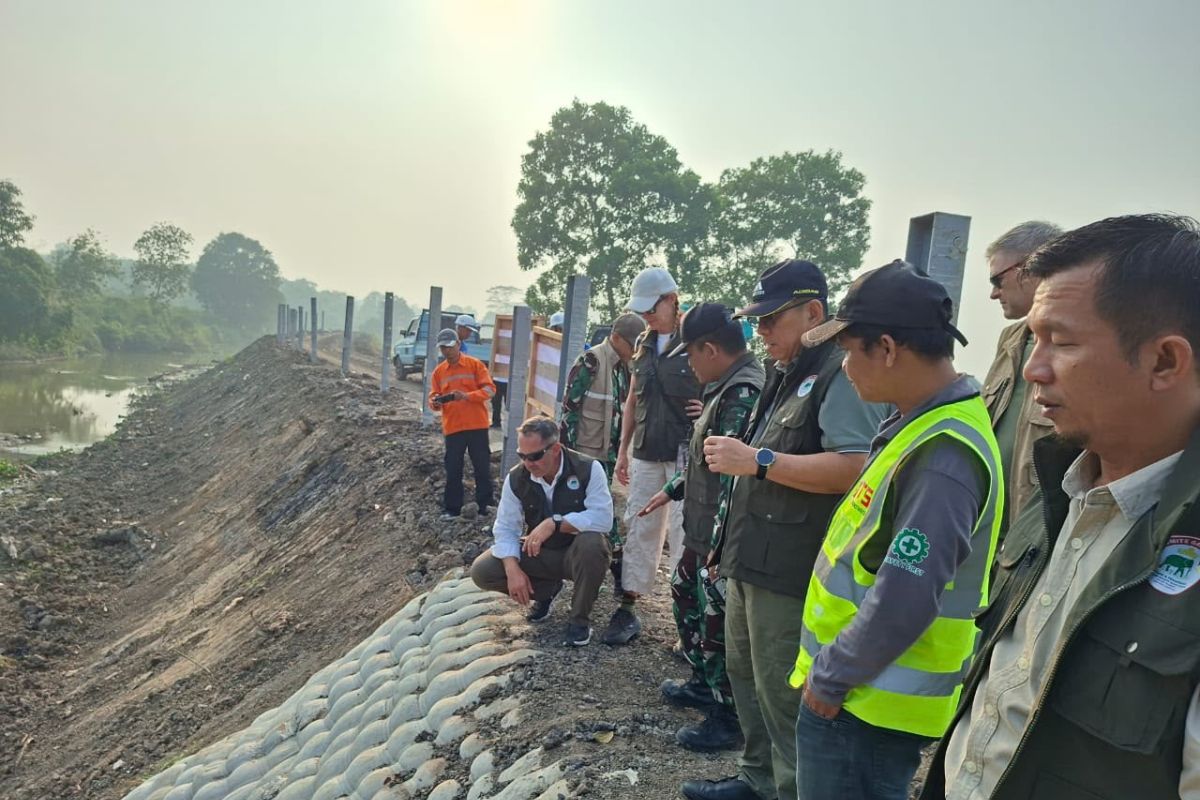
An international conservation expert team, together with the Joint Committee for Mitigation and Handling of Negative Interactions with Sumatran Elephants, has directly reviewed the accelerated development of facilities and infrastructure in the conservation area of Way Kambas National Park (TNWK) in East Lampung. The activity involved a delegation from Elephant Nature Park (ENP) Thailand, Saengduean Chailert, as well as a team of experts from Wilderness (PT Living Landscapes Indonesia) led by Keren Brooks. The review was conducted to ensure that the infrastructure development at TNWK proceeds according to plan, while also meeting conservation principles and environmental preservation standards that support efforts to make the area one of the world-class conservation centres for the Sumatran elephant (Elephas maximus sumatranus).
The Chairman of the Joint Committee for Mitigation and Handling of Negative Interactions with Sumatran Elephants at TNWK, Brigadier General TNI Sriyanto, said that providing assistance to the international expert team was part of efforts to align development with conservation needs. ‘The review of the progress of the accelerated development of Way Kambas National Park by the ENP Thailand team and the Wilderness team is a form of attention and coordination to ensure that the development of facilities and infrastructure in the TNWK area proceeds according to the plans and targets that have been set,’ he said. According to him, cross-party coordination is needed so that the development of facilities and infrastructure can be carried out in a targeted manner without ignoring the characteristics of the conservation area.
Sriyanto, who is also Head of the Expert Staff Unit of Regional Military Command XXI/Radin Inten, stressed that the accelerated development is still carried out with the precautionary principle through supervision of technical, environmental, security aspects, as well as its benefits for the surrounding community. ‘Close communication and coordination are key so that the government’s major targets can be achieved without being hampered by technical obstacles,’ he said. The transformation of TNWK, he said, is not only directed at physical development, but also at strengthening the conservation ecosystem and the mitigation system for interactions between humans and Sumatran elephants.
The transformation is directed, among other things, at improving the comfort and welfare of Sumatran elephants through the provision of clean water facilities and proper living quarters, strengthening wildlife-human interaction mitigation through a layered system, and the construction of environmentally friendly educational tourism facilities. In addition, the involvement of surrounding communities and the provision of learning facilities at monitoring posts are part of the strategy to build shared awareness about the importance of protecting the habitat and the survival of the Sumatran elephant population. All stages of the development and expansion of TNWK will be evaluated periodically to ensure that development proceeds in balance with the interests of conservation, safety, education, tourism and community empowerment.
With this approach, TNWK is expected not only to become a protection area for Sumatran elephants, but also to develop as a conservation model that integrates natural sustainability, science, culture, tourism and community life in a sustainable manner. Meanwhile, Lampung community figure and cultural observer Ansori Djausal assessed that the development of TNWK has strategic value in strengthening Indonesia’s position as one of the world’s reference countries for wildlife conservation. He said the existence of TNWK is the result of a long journey of conservation in Lampung, including the change of a former forest concession (HPH) area into a conservation area in the early 1980s and efforts to save the elephant population through the Tata Liman activity in 1986.
‘Way Kambas has now become an important conservation area with the Rhino Conservation Centre. The first elephant conservation in Indonesia cannot be separated from the success of changing the former HPH area into a conservation area as a National Park in the early 1980s,’ he said. He explained that the development of TNWK must continue to place conservation as a priority, while opening space for strengthening tourism potential and introducing Lampung culture to the international community. ‘It is necessary to support conservation efforts, especially as a world example located in Indonesia in the development and preservation of wildlife such as the Sumatran elephant,’ he said.
Source: jawawa.id (https://jawawa.id/newsitem/international-expert-team-reviews-accelerated-development-of-way-kambas-national-park-1786863154)
Originally published by Antara (Indonesian) (https://www.antaranews.com/berita/5696935/tim-ahli-internasional-tinjau-percepatan-pembangunan-tn-way-kambas), translated from Indonesian