
International Container Traffic Grows 11%, Positive Signal for Indonesia's Economy
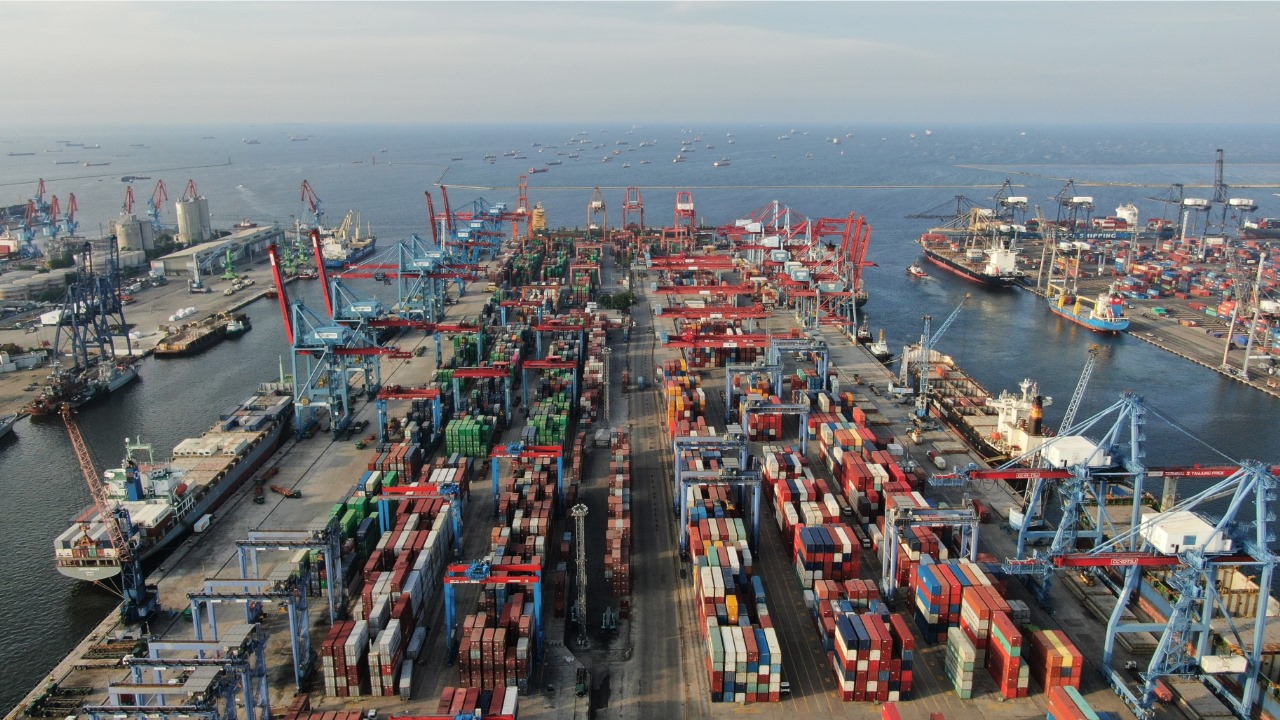
National economic activity shows positive signs in early 2026, reflected in increased cargo movement through ports, particularly container traffic as an indicator of production, trade, consumption, investment, and domestic distribution.
By April 2026, container traffic handled by PT Pelabuhan Indonesia (Persero) or Pelindo reached 6.42 million Twenty-foot Equivalent Units (TEUs), a 7% increase from the same period last year’s 5.99 million TEUs.
This growth indicates national logistics activity remains positive amid global dynamics. Ports play a strategic role as the main node of the national supply chain, serving as routes for raw materials, consumer goods, export commodities, and industrial capital goods.
Pelindo CEO Achmad Muchtasyar stated that the increase in container traffic stems not only from export-import activities but also domestic distribution.
“This growth is supported by an 11% rise in the international segment, with exports growing 10% and imports up 12%. Domestic container traffic grew around 4%, with unloading activities rising 5% and loading increasing 4%,” Muchtasyar said on Thursday (29 May 2026).
He added that this shows Indonesia’s foreign trade remains robust, while inter-island cargo distribution continues to support household consumption and regional economic activities.
He noted that the increase in export and import flows reflects Indonesia’s trade resilience amid global uncertainties, partly due to its trade structure heavily focused on intra-Asia, particularly China and ASEAN.
According to him, strengthening port services is increasingly crucial. Terminal productivity, service digitalisation, equipment readiness, facility reliability, and national supply chain integration must be enhanced to ensure smooth, efficient, and competitive cargo movement.
“Reliable logistics connectivity is key to supporting national economic growth, international trade, domestic distribution, investment, industrial downstreaming, and equitable economic activity across Indonesia’s regions,” Muchtasyar said.
Meanwhile, Directorate General of Sea Transportation Muhammad Masyhud stated the government continues to push port operators to enhance container capacity and services.
“One of our steps is issuing technical recommendations to designate container terminals from previously multipurpose facilities. These are then officially designated as container terminals by the Harbour Master and Port Authority (KSOP), in accordance with Minister of Transportation Regulation No PM 50/2021 on Sea Port Operations,” Masyhud explained.
Between 2025 and April 2026, 12 terminal locations were designated, including Banten Port and Tanjung Emas Port in Semarang as container terminals.
The government has also set operational service performance standards, including container loading/unloading and equipment performance. These standards are periodically evaluated to ensure service quality.
On another front, container traffic growth has spurred efforts to strengthen national port infrastructure development and modernisation. From 2025 to 2026, the government, along with state-owned port companies and state budget support, has boosted existing port capacity through container terminal development, channel deepening, increased berthing and storage capacity, modernisation of loading/unloading equipment, and accelerated port service digitalisation.
Masyhud added that during 2025-2026, government-owned port facilities construction and rehabilitation were carried out at 74 locations nationwide. This aims to strengthen the hub-and-spoke port network, develop collector and feeder ports in eastern Indonesia, integrate ports with industrial zones and downstreaming, and enhance national logistics connectivity.
“This infrastructure strengthening supports intra-Asia trade growth and the national economic transformation agenda. With improved capacity and service quality, Indonesian ports are expected to keep pace with projected continued growth in international and domestic container traffic in the coming years,” Masyhud concluded.
Container truck queues at ports are not only harming the real sector but also causing congestion on Jakarta’s toll roads.
PT Pelindo Sinergi Lokaseva (SPSL) continues to strengthen implementation of Security, Safety, Occupational Health, and Environment (K3L) across all operational areas of the group company.
At Tanjung Emas Port in Semarang, before and after Lebaran 2026, anchorage queues reached nine vessels simultaneously with waiting times of 4-6 days.
PT Kaltim Kariangau Terminal (KKT) conducted an ISPS Code Table Top Exercise 2026 to anticipate sabotage and strengthen maritime security in Balikpapan.
Container traffic at KIK Balikpapan increased by 3% in March 2026, driven by Ramadan and Eid al-Fitr logistics activity.