
Internal Auditors Urged to Play Strategic Role Amid Business Dynamics
The development of artificial intelligence (AI), the dynamics of business risk, and increasingly rapid regulatory changes are driving the internal audit profession to expand its role. Auditors are no longer sufficient merely to ensure compliance, but are also required to provide strategic perspectives and build trust within organisations.
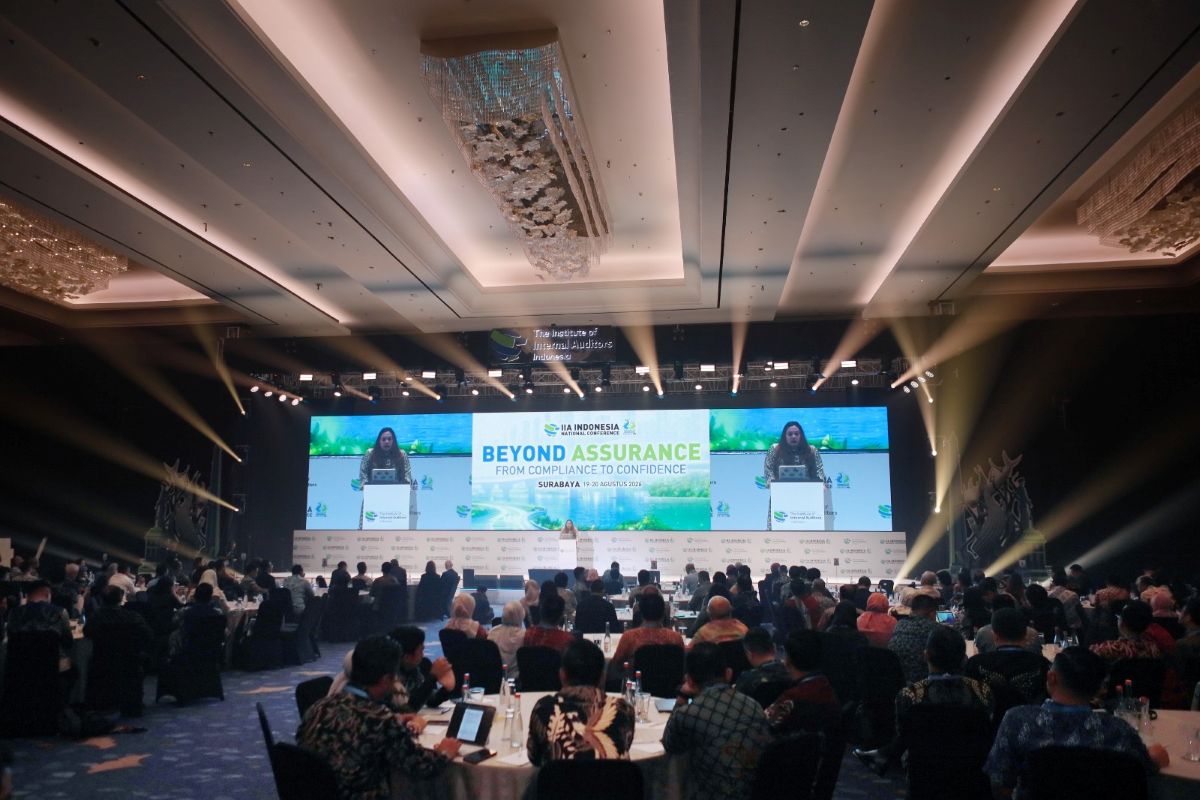
This was one of the main topics of discussion at the IIA Indonesia National Conference 2026 organised by The Institute of Internal Auditors (IIA) Indonesia at The Westin Surabaya. Carrying the theme Beyond Assurance: From Compliance to Confidence, the two-day conference was attended by more than 600 leaders and internal audit practitioners from various regions across Indonesia.
IIA Indonesia President Angela Simatupang said that the internal audit function is fundamentally not merely about providing an assessment that all organisational processes are running well. Auditors have a responsibility to help ensure that organisations truly have a solid foundation for earning the trust of stakeholders.
“Internal Audit does not create confidence by saying that everything is fine. Our task is to help ensure that our organisations and institutions are indeed worthy of trust,” said Angela, as quoted from a press release on Wednesday (19/8).
During the conference, IIA Indonesia also presented the results of a survey on the implementation of the Global Internal Audit Standards (GIAS). The survey results showed that the capability to carry out audit assignments is relatively well established, but the application of methodology and quality oversight mechanisms still requires strengthening.
Angela revealed that only around 40% of organisations have fully aligned their audit methodologies with GIAS. Meanwhile, boards that routinely review the Quality Assurance and Improvement Programme (QAIP) have only reached 49%.
“The survey shows that we are quite strong in carrying out audit assignments. However, only 40% of organisations have fully aligned their audit methodologies with GIAS, and only 49% of boards routinely review QAIP. Methodology, governance, and quality oversight still need to be strengthened together,” she emphasised.
According to Angela, this strengthening is important so that the internal audit profession in Indonesia can develop with benchmarks that are aligned with international practice. She believes that auditors’ capabilities cannot be measured solely by the existence of standards, but also by the consistency and quality of their implementation.
“If we want Indonesian professionals to be recognised as capable of competing globally, we must also be willing to be measured against benchmarks used globally. Professional maturity is not measured by the number of standards we create, but by the quality and consistency of our implementation,” she said.
The conference also served as a forum to discuss a number of strategic issues facing organisations today. The discussions covered governance and internal audit, environmental, social, and governance (ESG) aspects, technological developments, and the need to prepare auditor talent capable of facing future challenges.
A number of officials and organisational leaders attended the conference, including the Minister of Finance, the Minister of Cooperatives, the Chairman of the Board of Commissioners of the Financial Services Authority (OJK), the Deputy Governor of East Java, as well as boards of directors, commissioners, and Chief Audit Executives (CAE) from various companies, state-owned enterprises (BUMN), and government agencies.
Angela expressed hope that the Indonesian internal audit profession will not merely be a user or learner of various best practices developing at the global level. According to her, Indonesia also has the opportunity to contribute to and help shape the development of these professional practices.
“I do not want Indonesia to be a country that only ever learns from the world’s best practices. I want Indonesia to also help shape them. Not because we want the world to acknowledge that we are great, but because our quality leaves the world with no choice but to acknowledge it,” she concluded.