
Intergenerational Forum Visits KWI, Exchanges Views on the State of the Nation
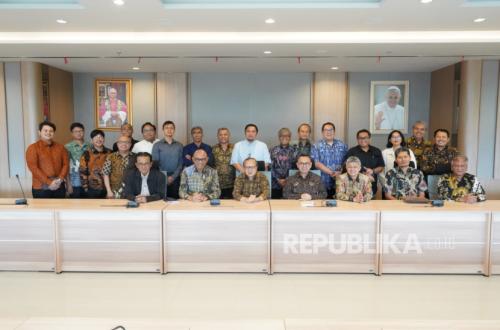
REPUBLIKA.CO.ID, JAKARTA – Sudirman Said, along with a delegation from the Intergenerational Forum representing various sectors and professions, met with the leadership of the Indonesian Bishops’ Conference (KWI).
This visit took place amid a national atmosphere and practices that are increasingly diverging from the original intent of the nation’s founding.
The meeting in Jakarta on Wednesday (15/4/2026) was intended as an effort to organise hopes, converting public anxieties into a movement for change grounded in divinity or morality.
Received directly by Cardinal Ignatius Suharyo Hardjoatmodjo, Chairman of KWI Mgr Antonius Subianto Bunjamin, and their team, Sudirman Said emphasised that their presence was to foster brotherhood while sharpening consciences among moral anchor figures.
In addition to morality, Sudirman stated, what is currently missing from the national atmosphere is spirituality and the ideology of the state.
These three must be supported by nobility (virtue) and the enforcement of law. Nobility will guide the behaviour of leaders. Law enforcement will discipline administrators and the citizens they govern.
“We come to meet moral figures with the intention of continuously sharpening consciences. We also want to hear views and advice not only based on broad knowledge but also on the breath of spirituality, namely wisdom and the depth of divine voice,” said Sudirman.
According to Sudirman, the solution to be sought for the current national issues is a “beyond politics” solution, namely politics as a path to humanity and nationhood, not politics as usual, let alone a brutal path to seizing power.
The common thread of this meeting was woven by Yanuar Nugroho. Yanuar emphasised the role of moral authorities as guides to conscience when the boundary between right and profitable becomes increasingly blurred in the public sphere. “Social crises are inseparable from moral crises. Structural injustices occur due to failures in ethical choices,” one of his conclusions.
These concerns were vividly reflected in various sectoral presentations. Legal expert Feri Amsari highlighted the tendency of rulers to trample the constitution for group interests.
“The constitution says A, what the president does is Z. As a result, rules are adjusted to interests, amend laws. If we continue like this constitutionally, this country faces many threats ahead,” Feri asserted.
From the business sector, Anton Supit criticised the prevalence of incompetence among policymakers. “Incompetence is more dangerous than crime,” said Anton.
These signals were reinforced by research from the Indonesian Business Council (IBC), which revealed four aspects of deficit in Indonesia’s current economy: jobs deficit, investment deficit, fiscal deficit, and trust deficit.
The causes are the 3 Cs: namely the absence of certainty (rule of law) and capability to drive the business world, as well as reduced capital.
In the field of social health, Diah Satyani Saminarsih explained that marginalised communities are increasingly squeezed by policies deemed overly simplistic.
Meanwhile, Shofwan Al-Banna highlighted impulsive and selfish foreign policies. “The root lies in our very high involvement without good institutionalisation; not only personalisation, but also egoisation,” Shofwan explained.